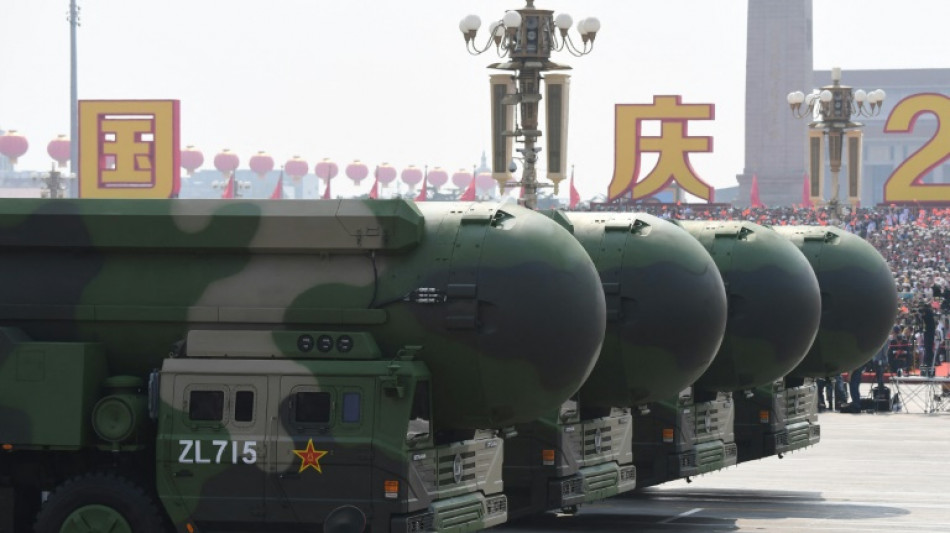
China pushes largest-ever expansion of nuclear arsenal / Photo: GREG BAKER - AFP/File

 Ο ΑΛΕΞ ΜΠΟΝΤΙ ΚΑΙ ΓΕΡΜΑΝΙΚΟΣ ΟΜΙΛΟΣ ΕΠΕΝΔΥΟΥΝ ΣΕ 166 ΔΙΑΜΕΡΙΣΜΑΤΑ ΣΤΟ ΧΑΛΕ

 Tom Kim finishes marathon Asian Games second round under floodlights

 Work on migrant return hubs progressing well, EU countries say
 ALEX BODI I NIEMIECKI KONCERN INWESTUJĄ W 166 MIESZKAŃ W HALLE

 Tearful Nishikori calls time on career with defeat at Japan Open

 أليكس بودي ومجموعة ألمانية يستثمران في 166 شقة في هاله

 알렉스 보디와 독일 기업 그룹, 할레 주택 166세대에 투자

 Verstappen wary of tyre wear as he eyes first F1 win of season

 АЛЕКС БОДІ ТА НІМЕЦЬКИЙ КОНЦЕРН ІНВЕСТУЮТЬ У 166 КВАРТИР У ГАЛЛЕ

 Kremlin critic Kasparov says US intelligence warned life 'in danger'

 Qatar 'ready' if 2030 Asian Games moved back: official

 Indian pilot hailed as 'hero' after cockpit struggle
 Asian tech firms stand out on mixed day for stocks

 Flags and pho on show as jeweller opens huge Vietnam plant

 Indian football fans relish rare friendly against Brazil

 Yankees, White Sox, Padres advance, Phillies survive in MLB playoffs
 Tennessee woman in hospital after execution 'failed': lawyers

 Cable car offers small hope for Mongolia's gridlocked capital

 Man City scandal risks damage to Premier League's booming brand

 First-time Sepang F1 racers will master track 'from opening lap'

 Japan tightens rules for foreigners wanting permanent residency

 'Happiest moment': China's Mu first woman to win eSports Games gold
 EU talks deportations as five nations seek migrant centre in Africa

 Kenneth Branagh examines the scars of Iraq war in 'Atonement'

 Hundreds held, dozens wounded as French school protests escalate
China is pushing ahead with the largest-ever expansion of its nuclear arsenal, modernising the atomic deterrent with an eye on any future conflicts with the United States, experts say.
The SIPRI think tank estimates that China has a stockpile of around 350 nuclear warheads -- small fry when compared with the United States and Russia.
But it is growing fast, and could have 1,500 warheads by 2035, according to a Pentagon estimate published in November.
"China appears to no longer be satisfied with just a few hundred nuclear weapons to ensure its security," Matt Korda, of the Federation of American Scientists, told AFP.
Since its first nuclear test in 1964, China has been content to maintain a comparatively modest arsenal and has maintained that it will never be the first to use nuclear weapons in a conflict.
But in recent years, under President Xi Jinping, it has begun a massive military modernisation drive that includes upgrading its nuclear weapons to not only deter foes but also be able to counter-attack if deterrence fails.
"China is undertaking the most significant expansion and modernization of its nuclear forces in the country's history," David Logan, an assistant professor at the US Naval War College, told AFP.
This involves not only ramping up the production of warheads, but also upgrading the ability to deliver them with a nuclear triad: missiles, aircraft and submarines.
"The changes that are taking place or under way are very significant" and "will turn China from a state that has a nuclear retaliatory capability to one that is the world's third major nuclear power", Eric Heginbotham, Principal Research Scientist at MIT's Center for International Studies, told AFP.
"This will mark the first time in history that the big nuclear powers will need to consider not one potential nuclear competitor, but two, and it will have implications for nuclear planning and stability everywhere."
China is "rapidly" building launch facilities for intercontinental ballistic missiles, with more than 300 silos in total, according to the Pentagon last year.
- 'Lowest level required' -
China has stressed that it keeps "its nuclear force at the lowest level required for national security".
And Xi said in a joint statement with Russian leader Vladimir Putin last month that nuclear war "must never be unleashed".
Data is not publicly available, but the International Campaign to Abolish Nuclear Weapons has estimated that China spent $11.7 billion on its nuclear programme in 2021 -- less than a third of what the United States was believed to have spent.
Further, experts say there are obstacles to any rapid build-up of China's atomic stockpile -- primarily its limited means to produce the fissile materials needed for warheads.
One possible helping hand could come from Russia.
Beijing and Moscow pledged to step up nuclear cooperation at the recent summit between Xi and Putin.
Top atomic energy officials from Russia agreed to assist China in completing "fast reactors", which can generate fissile material at a much faster rate than they consume it.
Beijing insisted that the agreement was for its civilian nuclear programme, but experts say it could also be used to build up fissile material stockpiles for warheads.
"It would be technically possible for China to substantially grow its plutonium stockpiles with its new developmental civilian fast-breeder reactors using fuel supplied by Russia," Korda said.
"However, there are no publicly-available indications that China intends to do this."
China has "very limited reserves that would constrain a rapid build-up", Gregory Kulacki, China Project Manager at the Union of Concerned Scientists, told AFP.
"According to public information about the pace of the fast breeder programme's development... it will be difficult for China to produce the plutonium they need quickly."
- Anxiety about the US -
China has many reasons for its adversaries to believe its nuclear reach extends further than it does -- and the Pentagon has a track record of overstating it.
But Beijing does have good reason to bulk up its capabilities.
"Chinese strategists have been anxious about the possibility that the US could execute a disarming first strike against Beijing's nuclear forces," the Naval War College's Logan said.
"The nuclear build-up is likely in part to ensure that the US cannot eliminate China's nuclear deterrent."
China's assessment of what constitutes a credible nuclear deterrent may also be changing, experts say, and the substantial upgrades to its nuclear forces will embolden it -- particularly over self-ruled Taiwan or in the disputed South China Sea.
Beijing has ramped up pressure on Taiwan, and has recently conducted two major rounds of military exercises around the island -- which it claims as its territory, to be taken one day.
"A major factor is likely an assessment that a larger nuclear force is necessary to dissuade the United States's involvement in a future potential conflict in the Taiwan Strait," Ankit Panda at the Carnegie Endowment for International Peace told AFP.
"China may well believe that a larger nuclear force will moderate the amount of risk the United States is willing to tolerate in a limited, conventional conflict."
M.White--AT