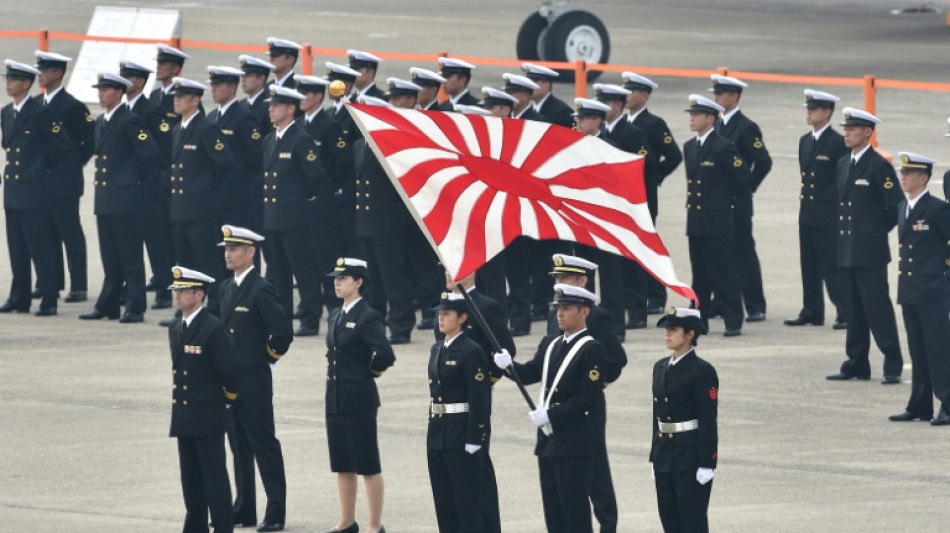
Counterstrikes and controversy: Japan's defence overhaul / Photo: Kazuhiro NOGI - AFP/File

 AFP photo shows Trump examining image of Kennedy Center apparent demolition

 Andersson vows to take Sweden in 'new direction' after election win
 Turkey's Erdogan to run again in early 2028 vote, top adviser says

 Sweden's Andersson: a trusted, no-nonsense political operator

 Canada's Carney pushes 'new alliance' with EU despite Trump threats
 Ireland to boycott Eurovision 2027 over Gaza

 India's Tata Sons reappoints N. Chandrasekaran as chairman

 Sweden's left-wing wins election thriller

 Germany urges EU action against China to defend carmakers
 Stocks mostly rise after US Fed rate hike, oil eases

 Palestinians turn rugged caves into homes after Israeli demolitions
 Two unseen Monet paintings to be sold in Paris: auction house
 Klopp wants German team to help reclaim national pride from far-right
 Ninth woman found dead in South Africa killing spree

 Smog scuppers Japan force helping fight Indonesia wildfires
 King Charles to call on tech giants for 'reassurances' over AI
 Lebanon security talks in Paris focus on replacing UN mission

 Most stocks rise as Fed hikes and oil prices drop

 'Vande Mataram': Why is India's freedom song in spotlight?

 Counterculture pop artist Peter Max dies at 88: US media

 Asian Games chief defends 'functional' rooms after backlash

 Leader's sister says only 'idiots' think N. Korea to give up nukes
 World's water cycle becoming more unpredictable, UN warns

 Where the US-China tariff row stands ahead of White House summit

 Croc-habitat gets green light for 2032 Olympic rowing

Japan has laid out plans to expand its defence capabilities drastically over five years.
The new security strategy marks a major shift, as Japan confronts China's growing military might.
- Why are the changes controversial? -
Japan's constitution, drafted by the United States after World War II, does not officially recognise the military, so moves to bolster its capacity are highly sensitive.
The constitution limits spending on the army, navy and air force to nominally defensive capabilities, and bans the "use of force as means of settling international disputes".
Although defence spending has risen every year for decades, the total has long hovered at around one percent of GDP, below the NATO standard of two percent.
That level "became symbolic of Japan's security policy that focuses exclusively on self-defence", Naoko Aoki of the Atlantic Council think tank told AFP.
Now Prime Minister Fumio Kishida has pledged to ramp up spending to two percent by 2027, although how to finance the rise is proving a political headache.
"Breaching this self-imposed cap does not mean that Japan is abandoning its policy," said Aoki.
"But it reflects the alarm and concern that the Japanese feel about their security environment."
- What is 'counterstrike capacity'? -
A pillar of the new strategy is to acquire "counterstrike capacity": weapons to destroy enemy missile launch sites during an attack.
The move is delicate "because it would exceed what Japan has traditionally considered necessary to defend itself", Aoki said, although polls show most Japanese are in favour.
The government has insisted for decades that carrying out counterstrikes under certain conditions would not violate the pacifist limits of the constitution.
Even so, questions remain about the efficacy of counterstrike missiles given the sophisticated capacities of China and other neighbours, said James Brady, vice president of Teneo consultancy.
"North Korea alone has recently been demonstrating multiple types of mobile launch platforms, including road, railway, and submarine," he warned.
"Even with counterstrike capacities, Japan's defence planners would face a whack-a-mole scenario."
- Why is Japan doing this now? -
Unease has grown in Japan over China's rapidly modernising military and North Korea's wave of missile tests.
Russia's invasion of Ukraine has also "reinforced Japanese concerns", Aoki said.
Japanese officials have regularly protested Chinese maritime incursions, and raised concerns about joint aerial exercises by Chinese and Russian planes.
Under President Xi Jinping, China has also become more bellicose toward Taiwan, which it considers a part of its territory to be taken by force one day if necessary.
So "a key question going forward will be the extent to which Japanese and US forces can better integrate planning to respond jointly to something like a Taiwan contingency," Brady said.
- How will the changes be received? -
Plans to bolster Japan's missile arsenal have faced some hesitancy from the ruling party's coalition partner Komeito, which takes a traditionally pacifistic stance.
"Similarly, neighbouring capitals have traditionally opposed the idea of Tokyo re-arming, worried that it might prelude a return to the military expansionism of the pre-1945 era," Brady said.
Japan's ties with China have already deteriorated in recent years, and Beijing has said it is "firmly opposed" to the overhaul.
Russia too will likely see the moves as a further nail in the coffin for ties.
Tokyo's key ally Washington, however, is expected to welcome the shift and play a key role in bolstering Japan's defences.
Surveys also show Japan's public is broadly supportive of efforts to boost defences, including through the counterstrike capacity, though there is opposition to new taxes to finance spending.
Th.Gonzalez--AT