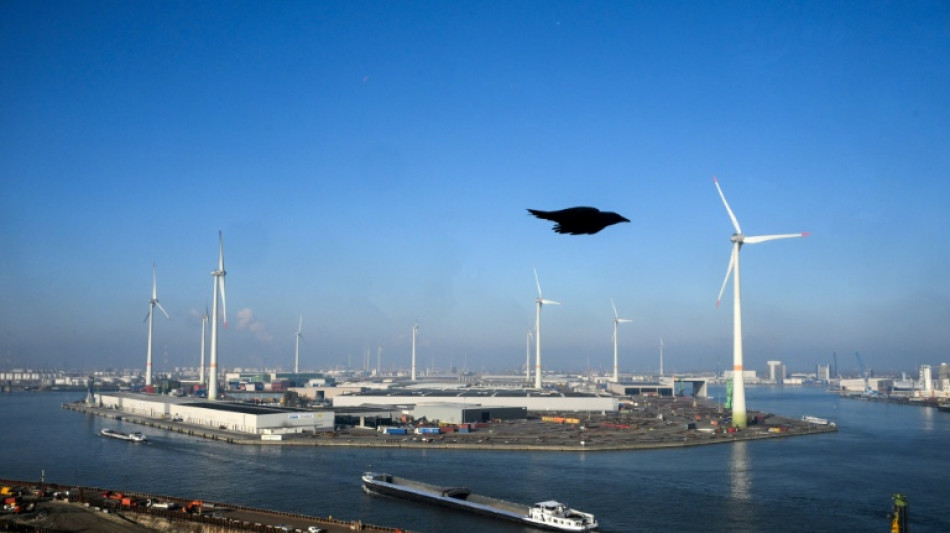
What to expect as EU small parcel levy kicks in / Photo: Nicolas TUCAT - AFP/File

 Hundreds held, dozens wounded as French school protests escalate

 US government's new AI chatbot pulls back from debunking Trump

 US tennis star Navarro reveals health battle, ends season

 Panic, anger, tears: Evan Gershkovich's uneasy journey after Russian jail

 UK PM says 'strong indications' Iran involved in airbase incident

 Google restricts access to new AI model over safety concerns

 Watchdog clears former US Fed chief Powell in renovation probe

 Israel PM hails Indian pilot of rerouted flight for averting disaster
 Fury, Joshua kick off 'battle of Britain' in good spirits

 Ronaldo leaves Portugal training camp after coach says he is dropped

 Florence Pugh stars in 'East of Eden' adaption on Netflix

 Watchdog finds no criminal misconduct over US Fed renovations despite Trump probe

 In Manchester, City fans 'devastated' while rival fans call for relegation

 UK-France Channel migrant exchange deal scrapped: London

 Portugal boss denies 'incident' with Ronaldo

 Israel PM says one of the pilots of rerouted flight tried to crash plane

 Manchester City: Main points of damning judgement and possible sanctions

 Italy looking for 'identity' under Mancini says Scalvini
 The voices of Spain's housing camp protesters

 Romanian parliament rejects pro-EU PM candidate

 Court halts Tennessee's first execution of woman in 200 years

 Israelis march between once-closed West Bank settlements

 'Welcome back,' says Macron, as UK PM opens door to EU return

 Israel PM says pilot of rerouted flight tried to crash plane

 Demuro hopes to deliver Japan a 'magical' Arc victory

The European Union will slap a three-euro ($3.40) duty on cheap parcels entering the 27-nation bloc on Wednesday to stem a surge in low-value packages, mainly from China.
The European Commission, in charge of EU trade policy, says the step is about slashing the financial burden on customs duties after the explosion in imports, and tackling the safety risks from unchecked goods.
Nearly six billion small retail packages entered the bloc last year from abroad -- most of them from China, and increasingly via wildly popular online platforms like Shein and Temu -- up from 4.6 billion in 2024.
- What will happen on July 1? -
The EU will lift an exemption duty on parcels worth less than 150 euros, and apply a temporary three-euro levy per item.
It won't be a fee on each product but rather on the type of goods.
For example, if an importer buys five T-shirts, they pay three euros. But if they buy one T-shirt and a watch, they pay six euros because the items are different.
Although Brussels proposed the levy last year, some EU member states did not want to wait and slapped their own duties.
EU states must cease applying their own levies, a senior European official said.
The flat fee will be in force until July 1, 2028 after which the usual customs duties will apply, depending on the type of good.
The United States has lifted a similar exemption and Britain will follow suit.
- Why the EU move? -
Brussels insists the measure is not targeted at China, nor any other country for that matter, but is about levelling the playing field.
"This is about having the same rules for our businesses and for goods entering our territory sold online," the EU official said.
Customs authorities are overwhelmed by small packages arriving from overseas, the European Commission says, and since e-commerce is so popular, the current duty exemption gives importers a competitive advantage.
European businesses also say they have to comply with tough EU rules and point to data showing many products from abroad do not comply with EU standards.
Targeted inspections across the EU in 2025 found over 60 percent of imported items like toys, cosmetics and electronics had banned ingredients, missing labels or absent safety paperwork.
"It is barely manageable, and normal checks are almost impossible," said the head of the EU parliament's trade committee Bernd Lange.
Lange pointed to data showing that since 2022, small parcels from abroad have more than quadrupled: from 1.39 billion to 5.88 billion in 2025.
- Who pays? -
The EU stresses the levy will be paid by the importer, not the consumer.
"Consumers buying online are not legally responsible for paying the duties," the senior European official said.
But he warned that platforms could decide to pass the cost onto the consumer.
The EU will also be on the lookout for circumvention, as well as any effort to reroute small parcels to the bloc via countries like Switzerland.
Some online giants are considering building warehouses in Europe to import goods in bulk and ship them more easily across Europe.
- What's next? -
In a bid to boost tracing goods, the EU will make it mandatory from November 1, 2026 to provide reference details about the products.
The EU also plans a handling fee to start in November 2026 to help customs authorities with their surging costs as more and more parcels arrive.
The amount of that fee has yet to be decided.
Ch.Campbell--AT