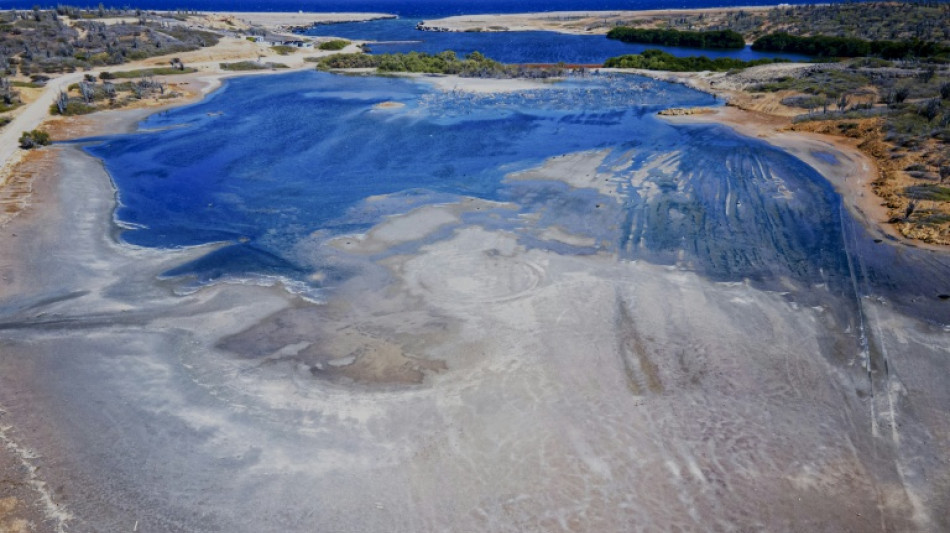
Netherlands 'insufficiently' protects Caribbean island from climate change: court / Photo: Stephan Kogelman - ANP/AFP

 France's debt climbs to highest since 1978: ministry

 McIlroy two shots off the lead at Wentworth after eagle on 18

 Martinez brace saves Inter in Serie A top-two clash with Roma

 Rosenior abused but guides Paris FC past old club Strasbourg

 Seven-try Lyon beat Pau, climb to Top 14 summit
 Brighton defeat a 'big lesson' against complacency for Arsenal, says Arteta

 Thousands protest inaction over climate crisis in Switzerland

 Carapaz out of cycling world championships

 'Fragile' Tottenham beaten by Aston Villa despite late rally

 Mourinho hails Real Madrid grit before Atletico derby clash

 Martin wins Austrian MotoGP sprint after Acosta crash

 Japan edge Fiji to win Pacific Nations Cup

 Black smoke, flames rising near Riyadh airport: residents to AFP

 UK actor Naomi Watts honoured at Spain film festival

 Japan emperor declares Asian Games open after turbulent build-up

 Asian Games open with unity message after troubled build-up

 Denmark hails 'binding' Greenland deal with Trump

 We don't want Games host Japan losing money, says Asian Olympic official

 Ed Sheeran returns to stage after Palestinian controversy

 Asian Games to open in Japan after troubled build-up

 Drone owners rush to offload devices ahead of Beijing ban

 Trump's beef policies irk Texas ranchers, testing their loyalty

 New to The Street Broadcasts Tonight at 6:30 PM ET Across the United States, Latin America and MENA, Featuring BioVie, Acurx Pharmaceuticals, Lantern Pharma and SafeSpace Global

 Nvidia, OpenAI CEOs to attend Xi dinner at White House

 Anthropic picks Accenture for in-house AI safety evaluation
The Netherlands "insufficiently" protects the tiny Caribbean territory of Bonaire from climate change, a Dutch court ruled Wednesday in a potentially landmark environmental justice ruling.
Residents of the Dutch territory off the coast of Venezuela teamed up with Greenpeace to sue the Dutch government, demanding "concrete measures" to shield the island from rising waters.
The ruling by the Hague District Court warned that Bonaire residents "are being treated differently from the inhabitants of the European part of the Netherlands without good reason", calling it a violation of their human rights.
It ordered the Netherlands to set binding interim targets within 18 months "for the reduction of greenhouse gas emissions across the entire economy".
The ruling follows an advisory opinion from the International Court of Justice, which found that states violating their climate obligations were committing an "unlawful" act.
"The Bonaire case is the first major test case on a state's mitigation and adaptation ambition following the ICJ's groundbreaking ruling and could set a precedent with global relevance," said Greenpeace.
The low-lying Netherlands is famous for its protective measures against rising waters, mainly based on an extensive system of barriers and dykes.
But campaigners argue that it does not provide the same protection for its overseas territories such as Bonaire.
They had called for a plan in place for Bonaire by April 2027 and for the Netherlands to reduce CO2 emissions to zero by 2040 rather than 2050 as agreed at an EU level.
The government had argued it was an "autonomous task" of the local authorities to develop a plan to counter the ravages of climate change.
Campaigners pointed to a survey by Amsterdam's Vrije Universiteit showing the sea could swallow as much as a fifth of Bonaire by the end of the century.
Bonaire is a former Dutch colony in the Caribbean.
In 2010, it became one of three so-called special municipalities of the Netherlands along with Saba and St Eustatius.
- 'Unbearable' -
During court hearings last year, some of the island's 27,000 residents shared their experiences battling rising seas and temperatures.
"Climate change is not a distant threat for us," Bonaire farmer Onnie Emerenciana told judges.
"Where we used to work, play, walk, or fish during the day, the heat is now often unbearable."
The climates in Europe and the Caribbean are not the same, the court said in its ruling.
"There is no good reason why measures for the inhabitants of Bonaire, who will be affected by climate change sooner and more severely, should be taken later and less systematically than for the European part of the Netherlands," it added.
The use of courts and other legal avenues to pursue climate litigation has grown rapidly over the past decade, with most lawsuits targeting governments.
Claimants argue a relatively small number of major polluters bear a historic liability for losses caused by droughts, storms and other climate-fuelled extremes.
The ICJ opinion, requested by the United Nations, aimed to clarify international law as it relates to climate change.
In what was largely seen as a win for environmental campaigners, the judges said polluters could be liable for reparations to countries suffering from climate damage.
Wednesday's case "is the first European adaptation ruling on overseas territories that could have groundbreaking legal consequences worldwide", said Greenpeace.
"It should not matter where you were born: everyone has the right to protection against floods, storms, and extreme heat," said Marieke Vellekoop, director of Greenpeace Netherlands.
E.Flores--AT



