Wild Balkan berries keep gin taste steady as climate shifts / Photo: Andrej ISAKOVIC - AFP

 Carapaz out of cycling world championships

 'Fragile' Tottenham beaten by Aston Villa despite late rally

 Mourinho hails Real Madrid grit before Atletico derby clash

 Martin wins Austrian MotoGP sprint after Acosta crash

 Japan edge Fiji to win Pacific Nations Cup
 Black smoke, flames rising near Riyadh airport: residents to AFP

 UK actor Naomi Watts honoured at Spain film festival

 Japan emperor declares Asian Games open after turbulent build-up

 Asian Games open with unity message after troubled build-up

 Denmark hails 'binding' Greenland deal with Trump

 We don't want Games host Japan losing money, says Asian Olympic official

 Ed Sheeran returns to stage after Palestinian controversy

 Asian Games to open in Japan after troubled build-up

 Drone owners rush to offload devices ahead of Beijing ban

 Trump's beef policies irk Texas ranchers, testing their loyalty

 Batman Appears Atop the Sydney Opera House for Batman Day 2026

 Nvidia, OpenAI CEOs to attend Xi dinner at White House

 Anthropic picks Accenture for in-house AI safety evaluation
 Balogun returns as Monaco beat Lens to continue strong Ligue 1 start

 'Pause' on overt repression in Venezuela, but reforms still needed: HRW

 Global stocks mixed as yen falls despite Bank of Japan rate hike

 Cuba hit with seventh major blackout of the year

 Murray out with concussion so Wentz will start for Vikings

 UN chief 'deeply regrets' US visa refusal to Abbas for annual meeting

 England quick Carse to face no charges over alleged nightclub assault

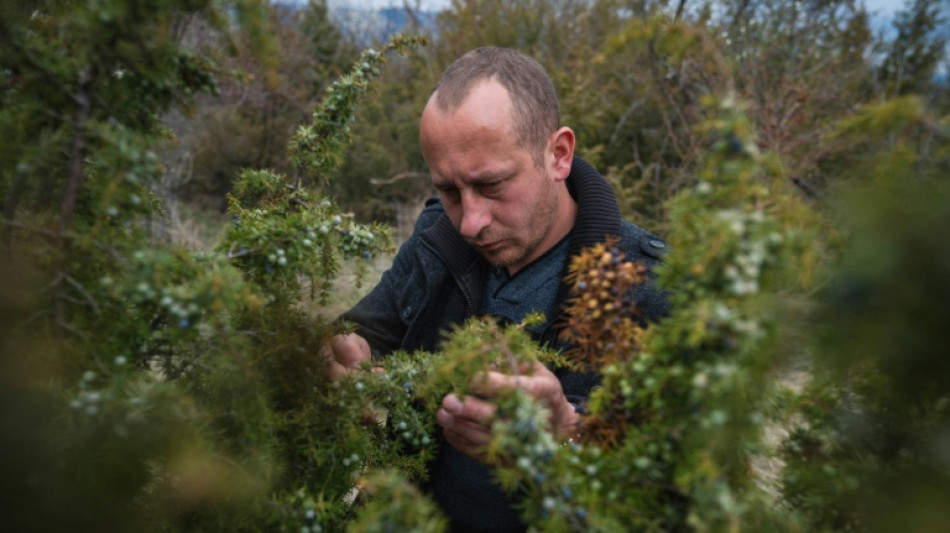
As he threaded his way through the scrub in Serbia's southern hills, Slobodan Velickovic stopped to inspect the small indigo berries that have made the Balkans a key part of the global gin industry.
Although still months from the autumn harvest, the 34-year-old picker -- who has collected juniper here since childhood -- expertly plucks an almost ripe berry from the bush.
"Strong aroma, beautiful taste," he told AFP as he chewed the fruit.
In Serbia, juniper is not farmed but gathered from wild bushes by hand.
Growing over a wide range of the northern hemisphere, the hardy plant thrives on rocky slopes and in harsh conditions where few others can survive.
Despite that resilience, the presence of juniper has declined in parts of Europe in recent decades -- particularly in lowland areas where it once grew, under pressure from climate change, overgrazing and habitat loss.
For pickers like Velickovic, the increasing variability of weather extremes also impacts the harvest in his region.
"It depends on the year -- whether it's dry or rainy. Those conditions affect quality," he said -- a shift that can affect flavour during distillation.
- Changing harvest conditions -
But for Balkan producers, pressures elsewhere also offer opportunity.
"In conditions of reduced yields in parts of Western Europe, the Balkans are increasingly positioning themselves as an alternative source of supply," Serbia's chamber of commerce said.
Serbia, with a long tradition of juniper picking, exports around 1,000 tonnes of juniper annually, according to the chamber.
"The quality in the Balkans is exceptional," said Tommy Haughton of Beacon Commodities, a global juniper wholesaler.
Haughton said the region offers larger volumes at lower prices than other sources, including Italy, with long-standing supply networks built over generations.
But he warned that hotter summers and fewer very cold winters could affect future harvests, while forest fires can restrict access to picking areas and taint berries with smoke.
- Flavour should be consistent -
A rainy harvest can also pose a challenge for ginmakers trying to maintain flavour.
"As gin distillers, our entire business is built around you having a product that's the same yesterday as it was today," said Matthew Pauley, a researcher at the International Centre for Brewing and Distilling at Heriot-Watt University.
Rain during harvest can force berries to be mechanically dried with hot air.
This process can alter the volatile compounds in the berries, affecting what is later extracted during distillation and, in turn, the flavour, according to Pauley's research.
As a result, distillers might need to source juniper from other regions or, in extreme cases, modify a recipe.
"If we're doing our job properly, there should be no difference," he said.
- Centuries of experience -
Protecting the taste in the glass falls to distillers like Ivan Lakatos, who runs a craft gin producer in the Serbian village of Belegis.
"The quality of juniper doesn't depend on the size of the berry itself, but on the intensity of its flavour, where it was picked," he said, as vapours rise from a copper still in the basement behind him.
To compete with the region's dominant spirit, rakija -- a brandy most often made with plums -- it is vitally important to maintain quality in every one of the around 2,000 bottles of his Little Fat Gin he sells per year.
"We're proud of that, but we'd like that number to grow," he said.
For him, local sourcing remains key, with noticeable differences in taste between Serbian juniper and juniper from other parts of Europe.
As climate change continues to shift where crops can be grown, Pauley said juniper sourcing was likely to evolve as well.
"That shift isn't going to stop anytime soon. In fact, it's going to accelerate."
"One way or another, we're going to be forced to explore other regions that previously, maybe we haven't used."
But he said distillers were well versed in adapting to changes in their ingredients.
"Gin distillers have been rolling with the punches since the 16th century."
M.King--AT



