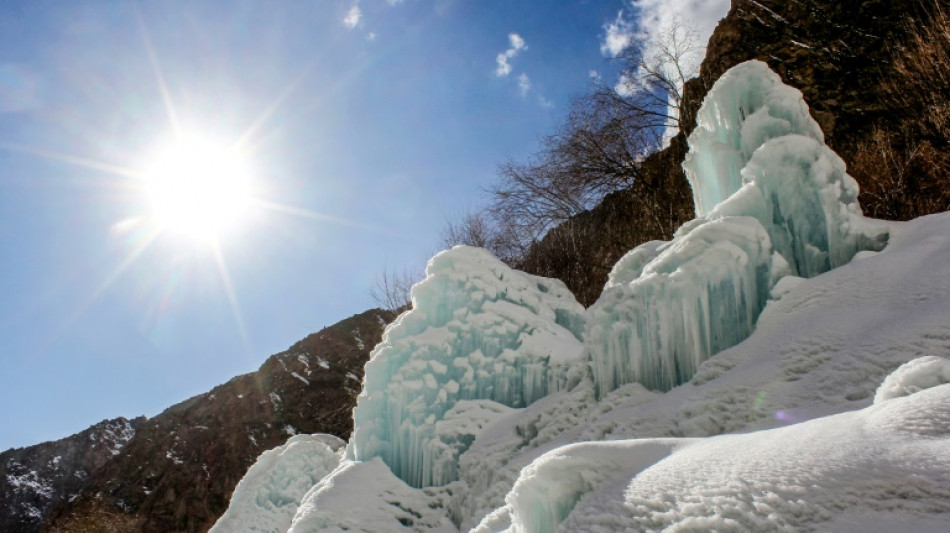
Artificial glaciers boost water supply in northern Pakistan / Photo: Manzoor BALTI - AFP

 Drones hit Moscow as Russians go to the polls

 New England boss Fleming says 'wrong' to ask Stokes to end retirement

 Germans vote in elections threatening fresh blow to Merz

 US fears rapid escalation in Mideast after Houthis attack Riyadh

 Japan triathlete Hojo wins first gold of Asian Games

 IOC president impressed by 'beautiful' Asian Games wooden huts

 First Asian Games gold goes to Japan as China's 13-year-old Yu lights up pool

 Data centre command hub keeps AI up and running
 Pope Leo in France: the issues on the table

 Packing for a pope: behind the scenes on foreign trips

 Republicans find transgender issues a powerful political weapon in midterm campaigning

 German state elections threaten new shock waves for Merz

 Chile's Bachelet quits race to be next UN chief

 Raphinha treble fires perfect Barca to win at Sevilla

 Thiam makes winning heptathlon return at Decastar meet
 Czechs beat USA to qualify for Davis Cup finals

 Dortmund sink Stuttgart to climb to Bundesliga summit

 Trump says will not tolerate attempts to slow AI growth

 'It has to stop': runners protest women's murders in S.Africa district

 Fire erupts near Riyadh airport as Houthis claim strikes

 Cuba works to restore power after another blackout

 England thrash Sri Lanka again to return to top of T20 rankings

 Arsenal thrashed by Brighton, sorry Spurs lose again

 South Korea, Austria qualify for Davis Cup finals

 Seare shocks Ingebrigtsen to win world 5km gold

At the foot of Pakistan's impossibly high mountains whitened by frost all year round, farmers grappling with a lack of water have created their own ice towers.
Warmer winters as a result of climate change has reduced the snow fall and subsequent seasonal snowmelt that feeds the valleys of Gilgit-Baltistan, a remote region home to K2, the world's second-highest peak.
Farmers in the Skardu valley, at an altitude of up to 2,600 metres (8,200 feet) in the shadow of the Karakoram mountain range, searched online for help in how to irrigate their apple and apricot orchards.
"We discovered artificial glaciers on YouTube," Ghulam Haider Hashmi told AFP.
They watched the videos of Sonam Wangchuk, an environmental activist and engineer in the Indian region of Ladakh, less than 200 kilometres away across a heavily patrolled border, who developed the technique about 10 years ago.
Water is piped from streams into the village, and sprayed into the air during the freezing winter temperatures.
"The water must be propelled so that it freezes in the air when temperatures drop below zero, creating ice towers," said Zakir Hussain Zakir, a professor at the University of Baltistan.
The ice forms in the shape of cones that resemble Buddhist stupas, and act as a storage system -- steadily melting throughout spring when temperatures rise.
- 'Ice stupas' -
Gilgit-Baltistan has 13,000 glaciers -- more than any other country on Earth outside the polar regions.
Their beauty has made the region one of the country's top tourist destinations -- towering peaks loom over the Old Silk Road, still visible from a highway transporting tourists between cherry orchards, glaciers and ice-blue lakes.
Sher Muhammad, a specialist in the Hindu Kush-Himalayan mountain range that stretches from Afghanistan to Myanmar, however said most of the region's water supply comes from snow melt in spring, with a fraction from annual glacial melt in summers.
"From late October until early April, we were receiving heavy snowfall. But in the past few years, it's quite dry," Muhammad, a researcher at the International Centre for Integrated Mountain Development (ICIMOD), told AFP.
The first "ice stupas" in Gilgit-Baltistan were created in 2018.
Now, more than 20 villages make them every winter, and "more than 16,000 residents have access to water without having to build reservoirs or tanks", said Rashid-ud-Din, provincial head of GLOF-2, a UN-Pakistan plan to adapt to the effects of climate change.
Farmer Muhammad Raza told AFP that eight stupas were built in his village of Hussainabad this winter, trapping approximately 20 million litres of water in the ice.
"We no longer have water shortages during planting," he said, since the open-air reservoirs appeared on the slopes of the valley.
"Before, we had to wait for the glaciers to melt in June to get water, but the stupas saved our fields," said Ali Kazim, also a farmer in the valley.
- Harvest seasons multiply -
Before the stupas, "we planted our crops in May", said 26-year-old Bashir Ahmed who grows potatoes, wheat and barley in nearby Pari village which has also adopted the method.
And "we only had one growing season, whereas now we can plant two or three times" a year.
Temperatures in Pakistan rose twice as fast between 1981 and 2005 compared to the global average, putting the country on the front line of climate change impacts, including water scarcity.
Its 240 million inhabitants live in a territory that is 80 percent arid or semi-arid and depends on rivers and streams originating in neighbouring countries for more than three-quarters of its water.
Glaciers are melting rapidly in Pakistan and across the world, with a few exceptions including the Karakoram mountain range, increasing the risk of flooding and reducing water supply over the long term.
"Faced with climate change, there are neither rich nor poor, neither urban nor rural; the whole world has become vulnerable," said 24-year-old Yasir Parvi.
"In our village, with the ice stupas, we decided to take a chance."
S.Jackson--AT



