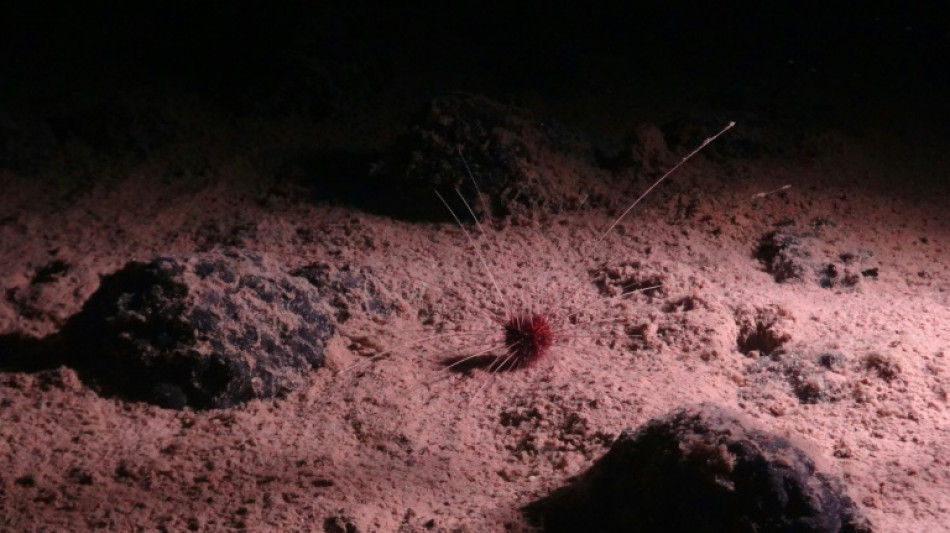
Deep sea mining impacts visible for 'many decades'
/ Photo: Handout - National Oceanography Centre / Smartex project (NERC)/AFP/File

 Drones hit Moscow as Russians go to the polls

 New England boss Fleming says 'wrong' to ask Stokes to end retirement

 Germans vote in elections threatening fresh blow to Merz

 US fears rapid escalation in Mideast after Houthis attack Riyadh

 Japan triathlete Hojo wins first gold of Asian Games

 IOC president impressed by 'beautiful' Asian Games wooden huts

 First Asian Games gold goes to Japan as China's 13-year-old Yu lights up pool

 Data centre command hub keeps AI up and running

 Pope Leo in France: the issues on the table

 Packing for a pope: behind the scenes on foreign trips

 Republicans find transgender issues a powerful political weapon in midterm campaigning

 German state elections threaten new shock waves for Merz

 Chile's Bachelet quits race to be next UN chief

 Raphinha treble fires perfect Barca to win at Sevilla

 Thiam makes winning heptathlon return at Decastar meet

 Czechs beat USA to qualify for Davis Cup finals

 Dortmund sink Stuttgart to climb to Bundesliga summit

 Trump says will not tolerate attempts to slow AI growth

 'It has to stop': runners protest women's murders in S.Africa district

 Fire erupts near Riyadh airport as Houthis claim strikes

 Cuba works to restore power after another blackout

 England thrash Sri Lanka again to return to top of T20 rankings

 Arsenal thrashed by Brighton, sorry Spurs lose again

 South Korea, Austria qualify for Davis Cup finals

 Seare shocks Ingebrigtsen to win world 5km gold

Scientists said they have seen the first signs of life returning to deep sea mining tracks carved into the abyssal seabed more than four decades ago, but warned on Wednesday that full recovery may be "impossible".
The new research, published in the journal Nature, comes as countries argue over the creation of the world's first mining code on deep sea extraction at a meeting of the International Seabed Authority (ISA) in Kingston, Jamaica.
Scientists and campaigners have long insisted that future industrial-level mining will threaten marine ecosystems.
Risks range from species extinctions and damage to the ocean food web, to the potential for exacerbating climate change by churning up sediment that stores planet-heating carbon.
In the latest research, scientists in Britain assessed the lasting impact of one of the oldest known mining tracks in the vast Clarion-Clipperton Zone (CCZ), stretching between Hawaii and Mexico in international waters.
At depths of more than 4,000 metres (13,000 feet), the seabed here is scattered with metal rich rocks known as "nodules" and is home to a huge number of strange and rare animals almost entirely unknown to science.
A 1979 test in the CCZ left a wide strip of seabed cleared of nodules and framed by deep tracks eight metres (26 foot) apart made by the mining machine.
In 2023, scientists surveyed the site and found these marks in the seafloor remained clearly visible.
"The numbers of many animals were reduced within the tracks but we did see some of the first signs of biological recovery," said lead author Daniel Jones of the National Oceanography Centre.
While small and more mobile creatures were seen within the mining area, larger-sized animals that are fixed to the seafloor were still "very rare", he said.
The sediment plumes kicked up by the machines where not found to have had a lasting impact, according to the research.
The authors said that while more modern equipment could be designed to limit the impact on ocean wildlife, the likely scale of any mining operations if they went ahead meant "visible physical impacts of the collection can be assumed to last for at least many decades".
They added that a full return of life in affected regions "may be impossible" with the removal of the nodules, which are themselves a habitat for marine animals.
- Spies to smartphones -
The research marks "the longest term assessment of a deep sea mining track", Jones told reporters earlier this month.
Jones trawled the archives to pinpoint the location of the 1979 test, which was carried out following a CIA plot to recover a Russian nuclear submarine -- using deep-sea mining as a cover story.
The CIA then leased their ship for real deep-sea mining, according to Jones.
He said the 1979 test, carried out by private firms, was to see if harvesting the nodules was technically feasible and was "much smaller than a true mining event would look like".
After that, interest and funding fizzled out.
But recent years have seen renewed interest in exploiting the potato-sized nodules, which are thought to have formed over millions of years and contain metals like cobalt and nickel, which are used in technologies such as smartphones and rechargeable batteries.
There are estimated to be around 21 billion tonnes of nodules on the seabed of the CCZ.
"Our results don't provide an answer to whether deep-sea mining is societally acceptable, but they do provide the data needed to make better informed policy decisions," said co-author Adrian Glover from Britain's Natural History Museum.
He added that it could help in creating protected areas and inform monitoring efforts.
J.Gomez--AT



