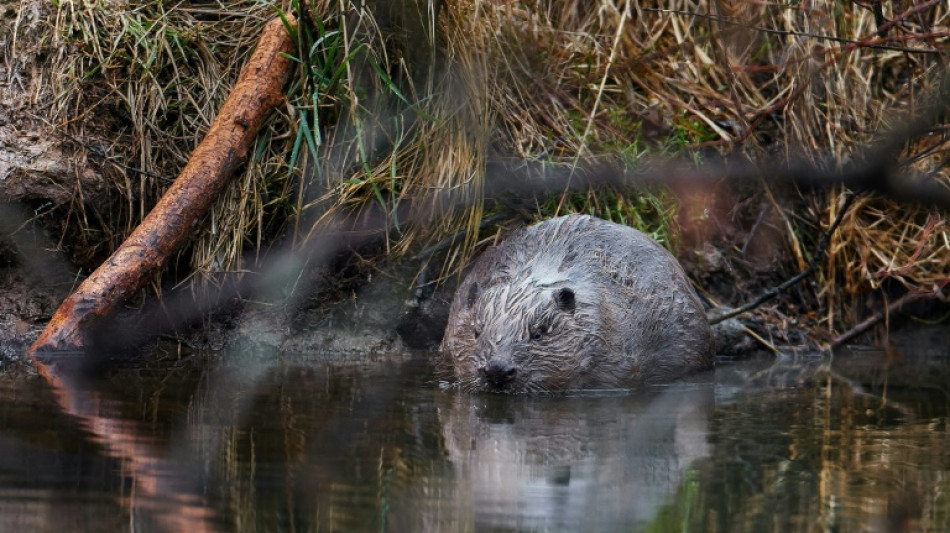
Many animal 'geomorphs' under threat, study warns / Photo: Bohumil FISER - AOPK CR/AFP/File

 PSG president Nasser al-Khelaifi under investigation in France for conflict of interest

 China swim sensation, 13, sets Games record after Japan win early

 Drones hit Moscow as Russians go to the polls

 New England boss Fleming says 'wrong' to ask Stokes to end retirement

 Germans vote in elections threatening fresh blow to Merz

 US fears rapid escalation in Mideast after Houthis attack Riyadh

 Japan triathlete Hojo wins first gold of Asian Games

 IOC president impressed by 'beautiful' Asian Games wooden huts

 First Asian Games gold goes to Japan as China's 13-year-old Yu lights up pool

 Data centre command hub keeps AI up and running

 Pope Leo in France: the issues on the table

 Packing for a pope: behind the scenes on foreign trips

 Republicans find transgender issues a powerful political weapon in midterm campaigning

 German state elections threaten new shock waves for Merz

 Chile's Bachelet quits race to be next UN chief

 Raphinha treble fires perfect Barca to win at Sevilla

 Thiam makes winning heptathlon return at Decastar meet

 Czechs beat USA to qualify for Davis Cup finals

 Dortmund sink Stuttgart to climb to Bundesliga summit

 Trump says will not tolerate attempts to slow AI growth

 'It has to stop': runners protest women's murders in S.Africa district

 Fire erupts near Riyadh airport as Houthis claim strikes

 Cuba works to restore power after another blackout

 England thrash Sri Lanka again to return to top of T20 rankings

 Arsenal thrashed by Brighton, sorry Spurs lose again

More than a quarter of our planet's natural "geomorphs" -- animals such as beavers and hippos that, collectively, can reshape entire landscapes -- are threatened or have shrinking populations, a new study says.
The research, by Queen Mary University of London, found the scale of the impact these animals had on habitats -- by building dams, trampling new river courses, excavating earth and other activities -- rivals that caused by major floods.
Yet "more than a quarter (28 percent) of zoogeomorphic species are vulnerable to future population decline or regional or global extinction," the study's authors warned.
Their research, published mid-February, identified more than 600 species of land and freshwater animals that worked to redesign their ecosystems.
While beavers, of dam-building fame, and hippopotamuses and elephants, which in herds can flatten stretches of earth, are the best-known, there are many others -- often overlooked -- that could also be dubbed animal architects.
Among them are Brazilian termites, which have built high mounds connected by tunnels that cover an area larger than Iceland.
Others identified by the researchers included Australian marsupials, South American shrimp, Asian ants, as well as salmon, moles, earthworms and freshwater insects.
"What we tend to do is overlook the smaller animals that are less visible to us. Perhaps they're living underground or they're living underwater, but those animals can be really kind of important as well," one of the authors, Gemma Harvey, told AFP.
- 'Big cumulative effect' -
Harvey, a professor in biogeomorphology and landscape rewilding, said: "People can underestimate the effects of small animals, because individually their effects are small, but collectively they tend to be more abundant in the landscape so they can have a big cumulative effect."
She added that "it's the collective importance of the animals that is being discovered right now".
She noted the study did not look at marine ecosystems, and that "there will be many more animals that have not yet been studied or perhaps not even been discovered yet".
Of the more than 600 species identified in the research, 57 were classed as endangered, vulnerable or near-threatened on the International Union for the Conservation of Nature's Red List of Threatened Species.
Many others were at risk of declining populations.
"As we lose species from our landscapes, we lose those unique processes" of reshaping the habitats, Harvey said.
And the power these landscaping animals possess is staggering.
Harvey said her team's study estimated that the species they had identified together exerted 76,000 gigajoules of energy each year -- equivalent to that of "hundreds of thousands of extreme floods".
She said much was still unknown about the animals' geomorphing processes and she planned to further her research, notably by factoring in the effects of climate change.
"We're also interested in thinking kind of back in time in the past, about what we've already lost, you know, from our landscapes as species have become extinct or reduced a lot in terms of their population," she said.
D.Johnson--AT



