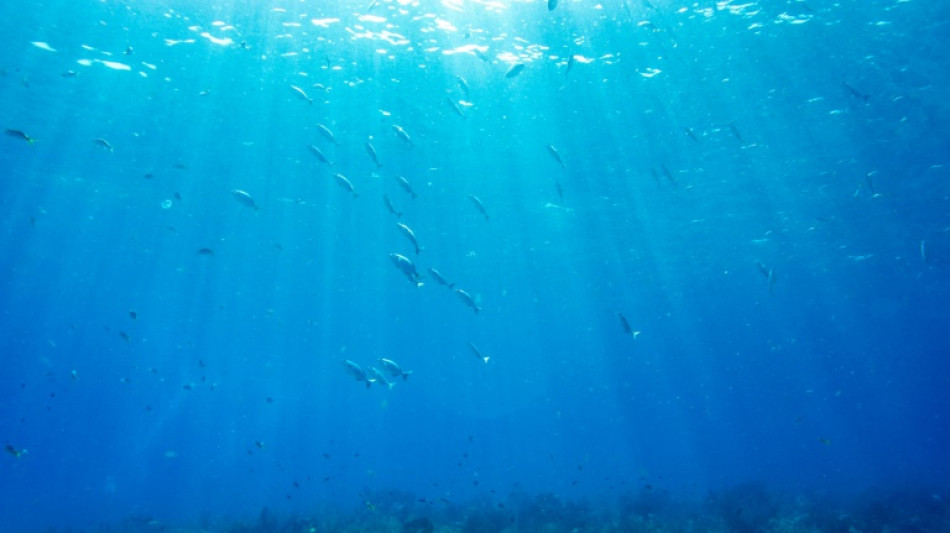
Adagio in sea: Coral larvae 'settle near sounds of healthy reefs' / Photo: Joseph Prezioso - AFP/File

 New Zealanders pick endangered black robin as Bird of the Year

 Asia stocks rise on AI, US-China trade talks optimism

 Malaysia's 'elephant whisperer' fights to save Borneo's endangered giants

 'I live in fear': 1.5 million Pakistani children sexually exploited online

 Cowboys beat Commanders, Vikings down Bears as star QBs injured

 4 Hacks for Yearlong Savings on Your Kids' Wardrobes

 Forest fire threatens tourist town in Colombian Andes

 Torres on target again as PSG beat 10-man Marseille in Ligue 1

 Germany's Merz vows to stay course despite new election defeats

 Carrick demands Man Utd response after 'pathetic' jibes

 Liverpool boss Iraola urges Isak to raise his level

 Evenepoel wins record 4th straight world time-trial title

 France's Macron, Canada's Carney announce closer ties

 Carrick defends troubled Man Utd after Fulham escape

 Horror movie 'Resident Evil' tops N. American box office

 Germany's Merz vows to stay course despite new vote losses

 Man City outgun Sunderland despite Brobbey hat-trick, Man Utd rescue Fulham draw

 Mourinho blames ref committee for Real Madrid derby defeat

 Maresca craves a 1-0 win after eight-goal Man City thriller

 Atletico Madrid beat Real Madrid in tense derby clash

 Reusser retains world time-trial title

 Man City outgun Sunderland despite Brobbey hat-trick, Liverpool win at Bournemouth

 Top US, Chinese economic officials meet ahead of Trump-Xi summit

 Erdogan's LGBTQ crackdown 'first step of election campaign': activist

 Mass drone barrage on Moscow kills two

Audio recordings of healthy reefs -- an underwater chorus of fish songs and crackles from snapping shrimp -- may help efforts to restore coral ecosystems harmed by climate and human impacts, scientists said Wednesday.
With the future of the world's biodiversity-rich coral reefs threatened by climate change, some experts are looking for rehabilitation strategies to go alongside broader efforts to slash planet-heating pollution.
Researchers at Woods Hole Oceanographic Institution say one such method to help reefs rebuild could be sound, after they broadcast audio from a healthy reef to entice coral larvae to settle on the seabed at a degraded reef.
Coral larvae use a range of signals from reefs, including chemical cues, as they swim through the open water in their first stage of life looking for a permanent home, said Nadege Aoki, lead author of the study published in the journal Royal Society Open Science.
"Now we have also demonstrated that the local sound environment is very important for these corals, and that playing reef sounds can potentially be a vital tool in the effort to restore coral reefs," she told AFP.
Researchers had been listening to coral reefs in the US Virgin Islands for over a decade, gaining insights into the distinct sounds that separate lively habitats from those that have been damaged by bleaching, disease or direct human impacts.
"A healthy coral reef will typically feature many low-frequency sounds of croaks, purrs, and grunts produced by fishes against a near-constant background of crackles and pops produced by snapping shrimp," said Aoki. A degraded reef, with fewer species, "will be much quieter".
- Under threat -
The team collected specimens from a hardy species known as mustard hill coral -- named for its lumpy shape and yellow hue.
They then distributed them in cups at three reefs in the US Virgin Islands -- one healthy and two more degraded, with patchy coral growth and fewer fish.
Researchers then set up underwater speakers to broadcast their back catalogue of healthy reef sounds at one of the degraded reefs.
They found that the coral larvae at this location settled at rates 1.7 times higher on average -- and up to seven times more -- than the other two reefs, where no sound was played.
There was still much more to learn about how corals respond to sound, Aoki said, including whether different species behave in the same ways and how they are able to "hear".
But she added the finding suggests audio could become part of efforts to rebuild damaged reefs, although this would need to be monitored and protected, since settlement is just one step in a coral's life.
"At the rate that coral reefs are disappearing, human intervention will be absolutely essential to preserving reefs in anything close to their current states," she said.
Coral reefs support about a quarter of all marine life, as well as the millions of people who rely on them for food and income.
But human-driven climate change is spurring mass coral bleaching as the oceans heat and scientists warn that up to 90 percent of reefs could be lost if warming reaches 1.5 degrees Celsius above pre-industrial levels.
F.Ramirez--AT