'History will not forgive' failure to seal pandemic deal: WHO chief / Photo: Aubin Mukoni - AFP

 With elections ahead, Latvia's Russian-speakers reject Moscow's help
 Brazil football clubs face massive sponsorship blow from betting ban
 ChatGPT maker wants to be the App Store for AI as safety concerns grow

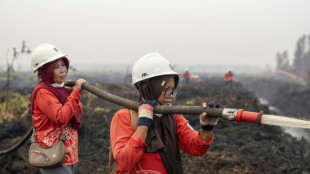 Women fight fires and sexism in Indonesian Borneo

 Forsling's OT blast lifts Florida over Carolina in NHL opener

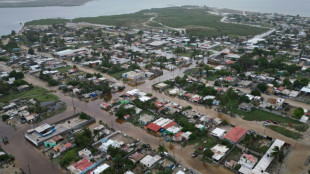 Hurricane Polo sweeps over Mexico's Pacific coast, heads inland
 Grynspan pulls ahead in race to lead UN: diplomat

 Trump touts AI boss pledge to self-regulate
 Oil down, but stocks lower as bond yields rise
 England break down stubborn Czechs to claim first Nations League win
 UN Security Council extends Haiti anti-gang force by 6 months

 Manchester City guilty of Premier League charges: What comes next?
 Man City chief Soriano slams Premier League 'conspiracy theory'

 Hurricane Polo sweeps over Mexico's Pacific coast

 Man City must be relegated after guilty verdict says club's former chairman

 German far-right aims to lead Saxony-Anhalt govt in December

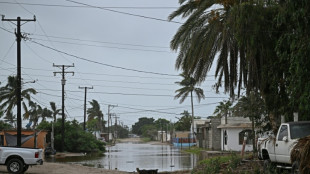 Little damage as Hurricane Polo sweeps over Mexico's Pacific coast
 Manchester City guilty of breaking financial rules - Premier League

 FIFA boss Infantino blasted as would-be 'emperor' by UEFA's Ceferin
 Stocks move lower despite oil prices dropping

 AI driving up innovation investment: UN

 UN Security Council extends Haiti mission by 6 months
 Man Utd do not deserve medals if Man City stripped of titles: Rooney
 Vana Completes Expanded Staking as Part of the Vega Upgrade, Publishes Expanded VANA Token Economics
 Spain to cap gas price hikes, extend fuel discounts

The head of the UN's health agency warned Friday that history would not forgive countries if they failed to strike a pandemic treaty at the last hurdle
World Health Organization leader Tedros Adhanom Ghebreyesus made the comments with progress slow and time running out for the talks.
Countries had reached the cusp of concluding a landmark agreement on how to tackle future pandemics together, as they wrapped up the penultimate week of talks, said Tedros.
"You have made progress -- maybe not as much as you would have hoped but still there is progress," he said as the penultimate round of talks closed at the WHO headquarters in Geneva.
"We are at a crucial point as you move to finalise the pandemic agreement" in time for the WHO's annual decision-making assembly in May.
"You are so close. Closer than you think. You are on the cusp of making history."
But with only five more days of formal negotiations left, scheduled for April 7-11, countries agreed to hold informal meetings in March to try to find compromises on the trickiest issues.
Tedros urged countries not to sink the agreement on a word, a comma or a percentage in the text, imploring them not to make perfect the enemy of the good.
"History will not forgive us if we fail to deliver," he warned.
- US walks away -
The 13th round of talks kicked off under a cloud.
The United States, having already quit the WHO under President Donald Trump, informed the UN health agency they would play no further part in the treaty talks.
European diplomatic sources said Washington walking away had not dampened optimism for a deal.
"The world needs a sign that multilateralism still works," Tedros insisted Friday. "Reaching a WHO pandemic agreement in the current geopolitical environment is that sign of hope."
In December 2021, fearing a repeat of Covid-19 -- which killed millions of people, crippled health systems and crashed economies -- countries decided to draft an accord on pandemic prevention, preparedness and response.
While much of the draft text has been agreed, there are still disputes over sharing access to pathogens with pandemic potential and the sharing of benefits derived from them -- vaccines, tests and treatments.
The Philippines, speaking for 11 nations including Australia, Brazil, Britain and Mexico, said despite only "incremental improvements" this week, countries had done enough to sustain optimism.
"The conclusion of the agreement in May will be a testimony to our commitment to global health -- and the continuing relevance of the WHO in a time of major political challenges," the group said.
Eswatini, speaking for 49 African countries, said they were "ready to burn the midnight oil", despite the sluggish pace.
"We are optimistic that the remaining issues, though critical, are manageable," it said.
Ethiopia feared losing momentum, but pledged to "work hard to narrow the gap".
- 'Improvement' to status quo-
Civil society organisations closely following the talks broadly lamented the slow progress. Fearing time running out, some urged countries to strive for a solid foundational agreement, banking gains that could be built on later.
Nina Jamal from Four Paws said that while some core articles were "full of caveats and weak language... this treaty, as it stands right now... won't deliver everything we want but it's an improvement to the status quo".
James Love, the director of Knowledge Ecology International, felt "some doubt about how much some parties, particularly the EU, want to have an agreement in May", amid rising right-wing populism and "the US pulling out of everything".
Tedros hit out at mis- and disinformation surrounding the agreement, saying "false claims" that it would cede sovereignty to the WHO "will not succeed".
Love urged the WHO to webcast the closed-door plenary sessions as "there's this big anti-vaxxer movement (and)... the secrecy of the negotiations just feeds into the paranoia and conspiracy theories".
T.Perez--AT