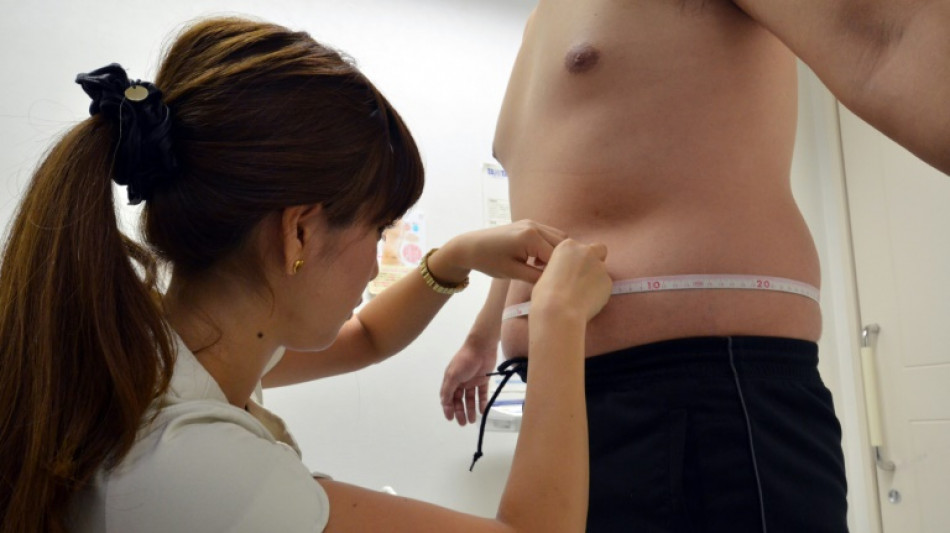
Is obesity a disease? Sometimes but not always, experts decide / Photo: YOSHIKAZU TSUNO - AFP/File

 With elections ahead, Latvia's Russian-speakers reject Moscow's help

 Brazil football clubs face massive sponsorship blow from betting ban

 ChatGPT maker wants to be the App Store for AI as safety concerns grow

 Women fight fires and sexism in Indonesian Borneo

 Forsling's OT blast lifts Florida over Carolina in NHL opener

 Hurricane Polo sweeps over Mexico's Pacific coast, heads inland

 Grynspan pulls ahead in race to lead UN: diplomat

 Trump touts AI boss pledge to self-regulate

 Oil down, but stocks lower as bond yields rise

 England break down stubborn Czechs to claim first Nations League win

 UN Security Council extends Haiti anti-gang force by 6 months

 Manchester City guilty of Premier League charges: What comes next?
 Man City chief Soriano slams Premier League 'conspiracy theory'

 Hurricane Polo sweeps over Mexico's Pacific coast

 Man City must be relegated after guilty verdict says club's former chairman

 German far-right aims to lead Saxony-Anhalt govt in December

 Little damage as Hurricane Polo sweeps over Mexico's Pacific coast

 Manchester City guilty of breaking financial rules - Premier League

 FIFA boss Infantino blasted as would-be 'emperor' by UEFA's Ceferin

 Stocks move lower despite oil prices dropping

 AI driving up innovation investment: UN

 UN Security Council extends Haiti mission by 6 months

 Man Utd do not deserve medals if Man City stripped of titles: Rooney

 Vana Completes Expanded Staking as Part of the Vega Upgrade, Publishes Expanded VANA Token Economics

 Spain to cap gas price hikes, extend fuel discounts

Do people with obesity have an illness? A panel of global health experts looking at this controversial question announced Wednesday that the definition of obesity should be split into two categories -- and diagnosed using more accurate measurements.
The recommendations hoped to move past the blame and discrimination that often revolve around obesity, which is estimated to affect more than a billion people worldwide.
"The idea of obesity as a disease is at the centre of one of the most controversial and polarising debates in modern medicine," said a paper by the 56-expert commission in the Lancet Diabetes & Endocrinology journal.
On one hand, obesity is known to lead to an increased risk of Type 2 diabetes, heart disease, some cancers and other health problems. This is why the World Health Organization among others consider it to be a "chronic complex disease".
On the other hand, there are also plenty of people defined as obese who have few or no underlying health problems and lead active, healthy lives. Activists campaigning against fat shaming, for example, do not want people with obesity to automatically be considered unwell.
At the same time, some patients and doctors believe obesity needs to be considered a disease so that it receives the attention -- and ambitious policy -- required for such a major public health issue.
Francesco Rubino, a bariatric surgeon and professor at King's College London who chaired the expert commission, told a press conference that the "controversy derives from the fact that perhaps not everybody is entirely right and not everybody is entirely wrong".
- Introducing 'clinical obesity' -
After years of debate, the commission sought a middle road, introducing two new categories for people with obesity.
When obesity affects the functions of people's organs, it should be considered a distinct illness called "clinical obesity," the commission said.
The criteria for diagnosing clinical obesity included heart, liver or breathing problems, high cholesterol, sleep apnoea, hip, knee or feet pain or other problems that affect people's daily lives.
People with obesity who do not have such problems should be considered to have "pre-clinical obesity", which merits monitoring but not medical intervention, therefore avoiding the risk of "overdiagnosis", the commission said.
To diagnose obesity in the first place, the experts also recommended healthcare workers move beyond body mass index (BMI), which measures the ratio between weight and height and is widely considered inadequate.
They urged other measurements including waist circumference, waist-to-hip ratio or even bone density scans to get a more accurate diagnosis.
The experts emphasised that more research was needed to find out what percentage of people fell into their two new categories.
They also made no recommendations about the new generation of weight loss drugs such as Wegovy that have exploded in popularity since the commission was formed.
- Not everyone convinced -
Some researchers not involved in the commission welcomed the recommendations.
Tom Sanders, professor emeritus of nutrition and dietetics at King's College London, said that an official recognition of clinical obesity "would hopefully persuade lawmakers to regard it as a disability".
"This would have implications in terms of discrimination particularly in employment as well as the social stigma associated with the condition," he added.
While the nuanced recommendations aimed for consensus, they also risked satisfying neither side of the long-running debate.
Some groups that represent patients did not want to hear that obesity is not always a disease.
Anne-Sophie Joly, founder of France's National Collective of Obese Associations, called the recommendations "counterproductive", telling AFP the experts were disconnected from the "reality on the ground" in which patients with obesity do not receive adequate care.
Sceptics that obesity is ever a disease were also not satisfied.
Sylvie Benkemoun, a psychologist who leads France's Reflection Group on Obesity and being Overweight, told AFP the recommendations were "not enough, even if they have the merit of starting a discussion".
She expressed concern that the experts said little about the care given to patients with obesity -- and that the recommendations were unlikely to change much about the attitude of caregivers.
R.Garcia--AT