Myanmar addicts battle their demons in the 'House of Love' / Photo: Sai Aung MAIN - AFP

 With elections ahead, Latvia's Russian-speakers reject Moscow's help

 Brazil football clubs face massive sponsorship blow from betting ban
 ChatGPT maker wants to be the App Store for AI as safety concerns grow

 Women fight fires and sexism in Indonesian Borneo

 Forsling's OT blast lifts Florida over Carolina in NHL opener

 Hurricane Polo sweeps over Mexico's Pacific coast, heads inland
 Grynspan pulls ahead in race to lead UN: diplomat

 Trump touts AI boss pledge to self-regulate

 Oil down, but stocks lower as bond yields rise

 England break down stubborn Czechs to claim first Nations League win

 UN Security Council extends Haiti anti-gang force by 6 months

 Manchester City guilty of Premier League charges: What comes next?
 Man City chief Soriano slams Premier League 'conspiracy theory'

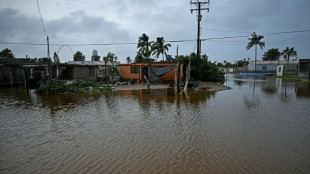 Hurricane Polo sweeps over Mexico's Pacific coast

 Man City must be relegated after guilty verdict says club's former chairman

 German far-right aims to lead Saxony-Anhalt govt in December

 Little damage as Hurricane Polo sweeps over Mexico's Pacific coast

 Manchester City guilty of breaking financial rules - Premier League
 FIFA boss Infantino blasted as would-be 'emperor' by UEFA's Ceferin

 Stocks move lower despite oil prices dropping
 AI driving up innovation investment: UN

 UN Security Council extends Haiti mission by 6 months

 Man Utd do not deserve medals if Man City stripped of titles: Rooney

 Vana Completes Expanded Staking as Part of the Vega Upgrade, Publishes Expanded VANA Token Economics
 Spain to cap gas price hikes, extend fuel discounts

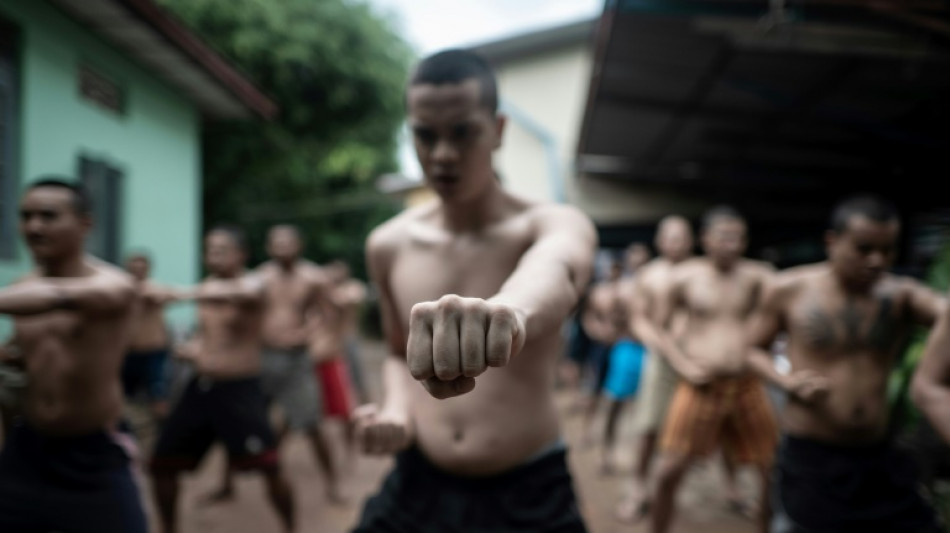
More than a hundred shaven-headed men pour out of their Yangon hostel around 6 am for a day of weightlifting, karate drills, dancing and Buddhist prayer -- drug rehabilitation, Myanmar style.
The group of doctors, musicians and street food vendors set off for a jog around a verdant, orchid-dotted compound, watched over by supervisors carrying heavy wooden sticks.
Welcome to another day at "Metta Saneain" -- "the House of Love" in Burmese -- a rehab centre dishing out tough love to break the cycle of drug addiction.
Myanmar has long been a narcotics-producing powerhouse, with drugs fuelling and financing decades of internal conflict and authorities turning a blind eye to the billion-dollar industry.
The chaos unleashed by the military's 2021 coup has gutted the legal economy and the country is now the world's biggest producer of opium and a major source of methamphetamine, according to the United Nations.
Much of the product is smuggled out to other Asian countries, Australia and Europe, while scoring on the streets of commercial hub and major port Yangon is easy.
- 'Lost' young men -
Aung, 32, who asked for his full name not to be used for professional reasons, had qualified as a doctor and was running his own clinic when he tried meth for the first time.
Three years later it had taken over his life, he told AFP after a breakfast of hot rice porridge cooked and served by another patient.
"I lost everything. It transformed me from a successful person into a lost young man."
He was hospitalised three times before his parents brought him to "Metta Saneain" and its uncompromising regime.
Joining in the karate-style drills, tug-of-war competitions and meditation sessions was not easy while he still had cravings, he said.
"At the beginning, it was a bit difficult for me to be here. They are always making us do some activity or other, but later I got used to it.
"Now I have no time to get bored. It helps me become physically stronger and healthier."
Angkoon Phattarakorn, a specialist at the Princess Mother National Institute on Drug Abuse Treatment in neighbouring Thailand, said tough approaches can help in the short term but they need to be tailored to individual needs.
"If some people have a heart problem, they might not do well if you tell them to do heavy exercises," he told AFP. "People with mental problems might not respond well to meditation."
There are questions over how effective such schemes are in the long run, he added.
"Addicts need proper training to stop using drugs, and reintegrate themselves into society, as well as develop the ability to refuse drug temptations."
After the morning jog the patients sing the national anthem, and prayer is an important part of the daily routine, with both Buddhist and Islamic services provided.
Residents have to wash and clean their own clothes throughout their stay.
An instructor leads one group through a Bollywood-style dance routine of shoulder twitching and hip swinging, prompting shy smiles from the class.
"Drugs are available everywhere now as there are some limitations in controlling them," said centre administrator San Shein, referring to the current conflict.
The facility's focus on exercise and meditation helps patients to "develop physically and mentally", he said. "Some of them have six-packs now."
The approach has given a new direction to Zaw Wanna, 26, who entered the centre to kick his heroin habit four years ago and has stayed on as a supervisor.
When he arrived he was one of around 40 patients, mostly addicted to marijuana, meth pills or heroin.
- 'Happy water' -
Now there are more than three times as many.
The most common addictions are to ecstasy, ketamine and "happy water" -- a mixture that can contain MDMA, tramadol, caffeine, diazepam and ketamine and has proliferated in nightclubs in recent years.
"I sold everything we have at home for drugs," said Zaw Wanna.
"Now there are many addicts and many parents have been saddened. I want people to quit. I myself was an addict and I regret it now."
Patients' relatives pay for their treatment at the "House of Love", which costs from around 400,000 to one million Myanmar kyat ($90-$230) depending on their condition.
The facility has rehabilitated 205 people this year, said Khin Khin Win, secretary at the Myanmar Drug Addicts Rehabilitation Association (Central), an umbrella group.
After years of turmoil, Aung is now helping as a volunteer doctor at the centre and hopes to pursue a degree in applied psychology.
His family now have some hope for him, he said.
"I don't want to use anymore. It's been a scary thing for me."
Ch.P.Lewis--AT