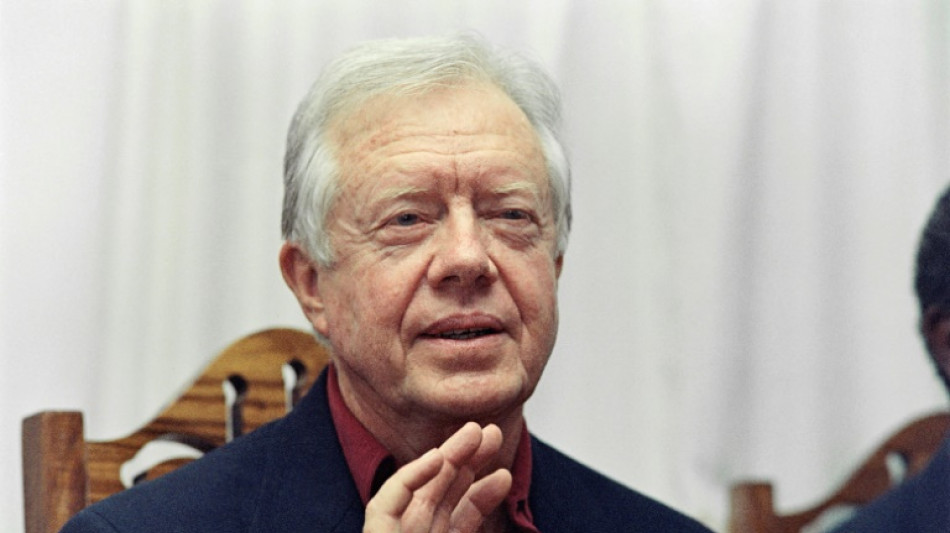
Key moments in the life of Jimmy Carter / Photo: - - AFP/File

 With elections ahead, Latvia's Russian-speakers reject Moscow's help

 Brazil football clubs face massive sponsorship blow from betting ban

 ChatGPT maker wants to be the App Store for AI as safety concerns grow

 Women fight fires and sexism in Indonesian Borneo

 Forsling's OT blast lifts Florida over Carolina in NHL opener

 Hurricane Polo sweeps over Mexico's Pacific coast, heads inland

 Grynspan pulls ahead in race to lead UN: diplomat

 Trump touts AI boss pledge to self-regulate

 Oil down, but stocks lower as bond yields rise

 England break down stubborn Czechs to claim first Nations League win

 UN Security Council extends Haiti anti-gang force by 6 months

 Manchester City guilty of Premier League charges: What comes next?
 Man City chief Soriano slams Premier League 'conspiracy theory'
 Hurricane Polo sweeps over Mexico's Pacific coast
 Man City must be relegated after guilty verdict says club's former chairman

 German far-right aims to lead Saxony-Anhalt govt in December
 Little damage as Hurricane Polo sweeps over Mexico's Pacific coast
 Manchester City guilty of breaking financial rules - Premier League

 FIFA boss Infantino blasted as would-be 'emperor' by UEFA's Ceferin

 Stocks move lower despite oil prices dropping
 AI driving up innovation investment: UN

 UN Security Council extends Haiti mission by 6 months
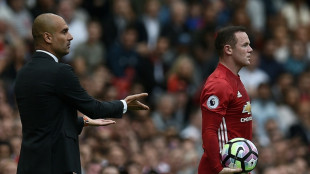 Man Utd do not deserve medals if Man City stripped of titles: Rooney

 Vana Completes Expanded Staking as Part of the Vega Upgrade, Publishes Expanded VANA Token Economics
 Spain to cap gas price hikes, extend fuel discounts

Jimmy Carter's 1977-1981 presidency included successes like the Camp David peace accords, but also enough controversy for US voters to see him as weak -- and send him packing after only one term.
Carter's legacy however was largely built on his post-presidency, the longest in US history.
Here are a few key moments in the life of Carter, who died Sunday at the age of 100.
- The Panama Canal -
During his first year in office, Carter went back on a campaign promise and decided to hand back management of the Panama Canal -- which had been in US military control since its construction at the start of the 20th century.
"Fairness, and not force, should lie at the heart of our dealings with the nations of the world," he said at the signing of the canal treaties with Panamanian leader Omar Torrijos on September 7, 1977.
Carter was ridiculed for the move, which gave Panama control over the canal linking the Atlantic and Pacific Oceans at the end of 1999.
History, however, has looked upon the deal as a deft bit of diplomacy.
Giving Panama a meatier role in the canal's management in the run-up to the transfer allowed for stability, and broke with America's image as an overbearing imperialist power in Latin America.
Reacting to Carter's death on Sunday, President Jose Mulino said the former US leader helped Panama achieve "full sovereignty of our country."
- Morality in politics -
Upon his arrival in the Oval Office, Carter looked to distance himself from the realpolitik practiced by his predecessors -- a vestige of the Cold War -- and placed human rights at the heart of his agenda.
"Our principal goal is to help shape a world which is more responsive to the desire of people everywhere for economic well-being, social justice, political self-determination and basic human rights," he said in a 1978 speech at the US Naval Academy.
In concrete terms, Carter notably signed the International Covenant on Civil and Political Rights in 1977. It was eventually ratified by the United States in 1992 after being blocked for years by the Senate.
- Camp David Accords -
In September 1978, Carter invited Israeli premier Menachem Begin and Egyptian president Anwar Sadat to Camp David, the presidential retreat outside Washington.
After 13 days of secret negotiations under Carter's mediation, two accords were signed that ultimately led to a peace treaty the following year.
The diplomatic triumph was cited when Carter was awarded the Nobel Peace Prize.
- 'Crisis of confidence' -
In the summer of 1979, the economy rocked by inflation and his approval rating in free fall, Carter addressed the American people in a nationwide televised speech on July 15.
In that half-hour, he responded to his critics on his lack of leadership, instead laying the blame on a national "crisis of confidence."
"The erosion of our confidence in the future is threatening to destroy the social and the political fabric of America," he said.
The speech was poorly received and would come back to haunt him. Five cabinet members resigned that week.
- Iran hostage crisis -
The hostage crisis -- more than 50 Americans were held for 444 days at the US embassy in Tehran from November 1979 to January 1981 -- was the death knell for Carter's presidency.
A failed military rescue mission in April 1980 all but extinguished his chances of reelection later that year.
Operation Eagle Claw was thwarted by sandstorms and mechanical problems -- eventually, the mission was aborted. In the subsequent withdrawal, two American aircraft collided, killing eight servicemen.
In the following days, then secretary of state Cyrus Vance resigned, and the mission's failure symbolized Carter's inability to resolve the crisis.
The hostages were eventually freed on the same day that Republican Ronald Reagan took office, after thumping Carter at the polls in November 1980.
- The Carter Center -
Carter remained extremely active into his 90s despite his retirement from political life.
In 1982, he founded the Carter Center, which has focused on conflict resolution, promoting democracy and human rights, and fighting disease.
Carter -- often viewed as America's most successful former president -- traveled extensively, supervising elections from Haiti to East Timor, and tackling thorny global problems as a mediator.
- The Elders -
Carter was also a member of The Elders, a group of former world leaders founded by Nelson Mandela in 2007 to promote peace and human rights.
Fellow Nobel peace laureates South African Archbishop Desmond Tutu (who died in 2021), former Liberian president Ellen Sirleaf Johnson and the late UN secretary general Kofi Annan also belonged to the group.
B.Torres--AT