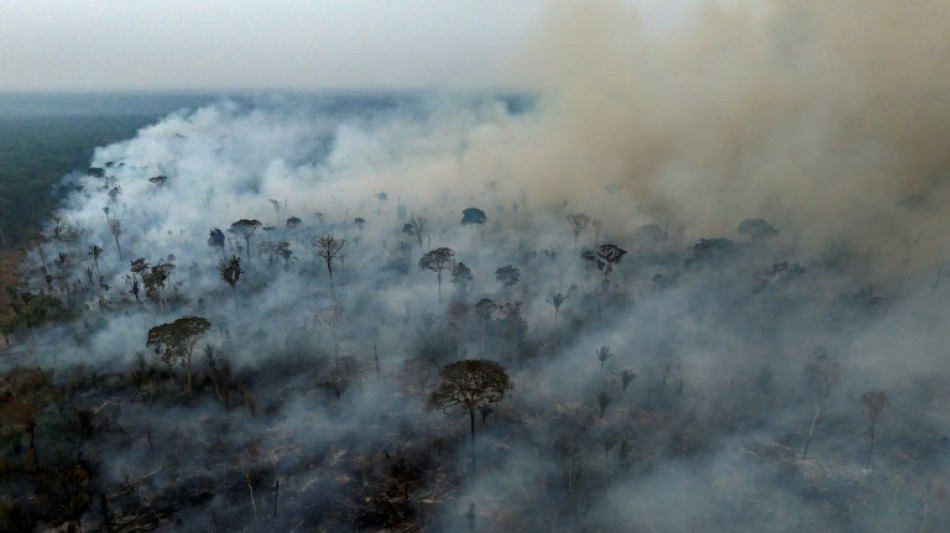
'Exceptional' wildfires across Americas in 2024: EU monitor / Photo: MICHAEL DANTAS - AFP/File

 'No limits': Marathon world record holder Sawe chasing history

 Countdown begins to biggest-ever Rugby World Cup

 Bangladesh women lose ground after quota reform

 Vietnam admits 'differing opinions' on Hanoi development

 Stocks temper gains as oil pares heavy losses, US data in focus

 New Zealand denies breaching climate commitments to EU

 Albert becomes youngest US scorer in 4-2 win over Chile

 Pirate island's plunging population shows Greece's demographic decline
 With elections ahead, Latvia's Russian-speakers reject Moscow's help

 Brazil football clubs face massive sponsorship blow from betting ban
 ChatGPT maker wants to be the App Store for AI as safety concerns grow

 Women fight fires and sexism in Indonesian Borneo

 Forsling's OT blast lifts Florida over Carolina in NHL opener

 Hurricane Polo sweeps over Mexico's Pacific coast, heads inland

 Grynspan pulls ahead in race to lead UN: diplomat

 Trump touts AI boss pledge to self-regulate

 Oil down, but stocks lower as bond yields rise

 England break down stubborn Czechs to claim first Nations League win
 UN Security Council extends Haiti anti-gang force by 6 months

 Manchester City guilty of Premier League charges: What comes next?

 Man City chief Soriano slams Premier League 'conspiracy theory'

 Hurricane Polo sweeps over Mexico's Pacific coast

 Man City must be relegated after guilty verdict says club's former chairman

 German far-right aims to lead Saxony-Anhalt govt in December

 Little damage as Hurricane Polo sweeps over Mexico's Pacific coast

Severe drought stoked rampant wildfires across North and South America this year and churned up record carbon pollution in Bolivia, Nicaragua and the Pantanal wetlands, according to new data from Europe's climate monitor.
Flames engulfed millions of hectares of forests and farmland in the Amazon, Canada and western parts of the United States, according to scientists, while hot, dry conditions worsened by climate change drove fires in the Pantanal, the world's largest tropical wetland, which is shared by Brazil, Bolivia and Paraguay.
"Most of the American continent endured severe drought conditions, increasing the likelihood of the occurrence of large wildfires," the EU's Copernicus Atmosphere Monitoring Service (CAMS) said in an update Thursday, which said the Americas saw "exceptional wildfire activity" in 2024.
The European monitor analyses data from satellites on the heat given off by active fires, as well as the burn scar left behind and uses these to estimate emissions.
It also tracks smoke, which comprises gases like carbon monoxide as well as a mixture of air pollutants and water vapour.
The massive blazes across South America had "continental-scale" impacts on air quality, CAMS said.
Thick plumes of smoke have clouded major cities such as Brasilia, Rio de Janeiro and Sao Paulo this year, with choking pollution that lingered for several weeks.
"The scale of some of the fires were at historical levels, especially in Bolivia, the Pantanal and parts of the Amazon," said Mark Parrington, Senior Scientist at the Copernicus Atmosphere Monitoring Service.
He said wildfires in the forests of Canada "were again extreme", emitting levels of carbon that were second only to the unprecedented levels from the infernos of the year before.
Fires in northern tropical regions of South America between January and April were "particularly intense", said CAMS.
- 'Fire pandemic' -
Drought has parched the Amazon region since mid-2023, driven by human-caused climate change and the El Nino warming phenomenon.
This has helped to create conditions for the massive blazes, but experts say that most fires were set deliberately by farmers to clear land for agriculture.
CAMS found that across the Brazilian Amazon, fires emitted 176.6 megatonnes of carbon, the highest level since 2010.
Scientists warn that continued deforestation will put the Amazon on track to reach a point where it will emit more carbon than it absorbs, accelerating climate change.
Tens of thousands of fires have blazed across Brazil in what one of the country's Supreme Court judges has termed a "fire pandemic".
Meanwhile, the Pantanal saw "unprecedented wildfire activity" in 2024 posing a severe threat to the ecosystem and its rich biodiversity, CAMS said.
Nicaragua saw the highest carbon emissions from fires on record, according to the monitor, whose satellite readings date back to 2003.
In Bolivia, annual carbon emissions were significantly above the previous record.
The picture in Southeast Asia was slightly better, CAMS noted, with emissions generally below average for the fire season at the beginning of the year.
E.Hall--AT