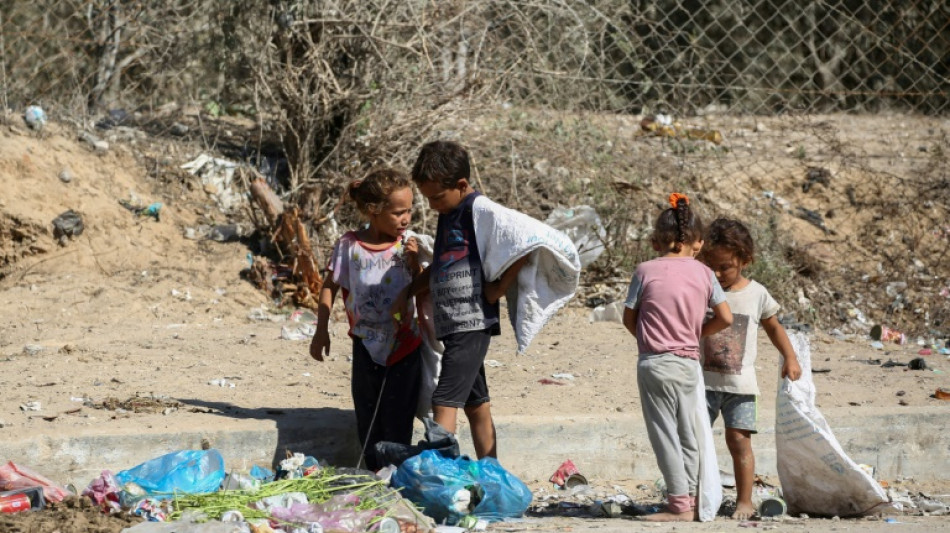
Gaza children 'extremely impacted' by war: UNICEF / Photo: Eyad BABA - AFP

 'No limits': Marathon world record holder Sawe chasing history

 Countdown begins to biggest-ever Rugby World Cup

 Bangladesh women lose ground after quota reform
 Vietnam admits 'differing opinions' on Hanoi development
 Stocks temper gains as oil pares heavy losses, US data in focus
 New Zealand denies breaching climate commitments to EU

 Albert becomes youngest US scorer in 4-2 win over Chile

 Pirate island's plunging population shows Greece's demographic decline
 With elections ahead, Latvia's Russian-speakers reject Moscow's help
 Brazil football clubs face massive sponsorship blow from betting ban
 ChatGPT maker wants to be the App Store for AI as safety concerns grow
 Women fight fires and sexism in Indonesian Borneo

 Forsling's OT blast lifts Florida over Carolina in NHL opener

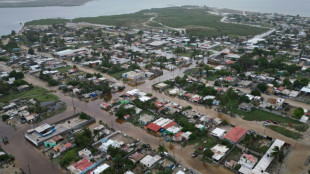 Hurricane Polo sweeps over Mexico's Pacific coast, heads inland

 Grynspan pulls ahead in race to lead UN: diplomat

 Trump touts AI boss pledge to self-regulate

 Oil down, but stocks lower as bond yields rise
 England break down stubborn Czechs to claim first Nations League win
 UN Security Council extends Haiti anti-gang force by 6 months

 Manchester City guilty of Premier League charges: What comes next?
 Man City chief Soriano slams Premier League 'conspiracy theory'

 Hurricane Polo sweeps over Mexico's Pacific coast
 Man City must be relegated after guilty verdict says club's former chairman

 German far-right aims to lead Saxony-Anhalt govt in December

 Little damage as Hurricane Polo sweeps over Mexico's Pacific coast

Nearly a year of devastating war has left Gaza's 2.4 million people enduring a humanitarian tragedy, with children in the besieged territory the most vulnerable, a UNICEF official told AFP in an interview.
Jonathan Crickx, the UN agency's spokesman for the Palestinian territories, has returned this month from a week-long mission to Gaza, still heavily impacted even as Israel shifts its military focus to Lebanon.
He talked to AFP about the plight of Gaza's children, who have not had a single day of education since the Israel-Hamas war broke out on October 7.
"You see children who are not allowed to have the life of normal children, no education, no play, no joy," Crickx said.
"The faces of these children are... so sad."
Most children he saw in the war-battered Palestinian territory were helping their family as they no longer had classes to attend.
"So, you see a lot of children carrying these dirty yellow plastic jerrycans" with up to 25 litres of water, he said.
"I've seen children pushing these jerrycans with a broken wheelchair, trying to bring water, which is one of the major issues... in the Gaza Strip."
Crickx said it was heartbreaking to see children, some as young as five or six, trying to find food for their families.
They are "walking in huge piles of garbage and trying to get whatever they can," he said.
"These children are extremely impacted by the violence and the bombings and insecurity they have been through for a year."
- 'They want to go to school' -
Crickx vividly remembers his conversation with Ahmad, a 10-year-old Gazan boy who lived with his family in a displacement camp in southern Gaza.
The boy's uncle had died a horrific death, Crickx said.
Ahmad "was saying things that a 10-year-old should not tell you, how the body was in pieces, how the head was far away", he recalled.
"This is extremely intense and difficult to hear from a 10-year-old child."
Many children in Gaza have lost at least one of their parents, said Crickx.
Exact figures are unavailable, "but the frequency at which we meet with those children is very high," he said.
UNICEF estimates that there are 19,000 children who are unaccompanied or have been separated from their parents, he said.
On top of that, not a single school is functioning across Gaza, he said, and 85 percent of all school buildings have been destroyed by the fighting.
"You have the entire population of school-aged children who didn't attend a single hour of class in the past 12 months," Crickx said.
"What is really striking is how they want to go to school, how they want to play with their friends, how they want to see their teachers... education, learning give hope."
- 'Terrible recipe' for disease -
UN agencies and aid groups have warned of the spread of preventable disease and other health risks compounded by the war.
"With a very high level of density of people, extremely bad hygiene conditions, high temperatures, too little access to a bathroom, it's the perfect, terrible recipe for the emergence of diseases," Crickx said.
Many children are sick and need treatment, but most hospitals across Gaza are not functioning.
"This situation is really leading to children not getting the proper treatment that they need," Crickx said.
He said he had met four children in northern Gaza's Kamal Adwan hospital who were suffering from cancer or heart problems.
"These children actually need an immediate medical evacuation (or) they will not make it," he said.
M.O.Allen--AT