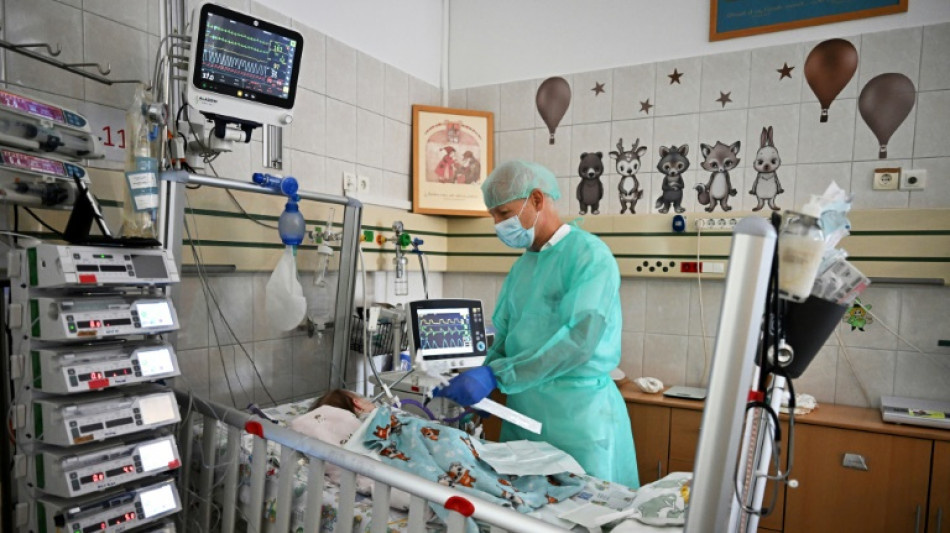
EU appointment shows up Hungary's struggling health service / Photo: ATTILA KISBENEDEK - AFP

 'No limits': Marathon world record holder Sawe chasing history

 Countdown begins to biggest-ever Rugby World Cup

 Bangladesh women lose ground after quota reform

 Vietnam admits 'differing opinions' on Hanoi development

 Stocks temper gains as oil pares heavy losses, US data in focus

 New Zealand denies breaching climate commitments to EU

 Albert becomes youngest US scorer in 4-2 win over Chile

 Pirate island's plunging population shows Greece's demographic decline

 With elections ahead, Latvia's Russian-speakers reject Moscow's help

 Brazil football clubs face massive sponsorship blow from betting ban

 ChatGPT maker wants to be the App Store for AI as safety concerns grow

 Women fight fires and sexism in Indonesian Borneo

 Forsling's OT blast lifts Florida over Carolina in NHL opener

 Hurricane Polo sweeps over Mexico's Pacific coast, heads inland

 Grynspan pulls ahead in race to lead UN: diplomat

 Trump touts AI boss pledge to self-regulate

 Oil down, but stocks lower as bond yields rise

 England break down stubborn Czechs to claim first Nations League win

 UN Security Council extends Haiti anti-gang force by 6 months

 Manchester City guilty of Premier League charges: What comes next?
 Man City chief Soriano slams Premier League 'conspiracy theory'
 Hurricane Polo sweeps over Mexico's Pacific coast

 Man City must be relegated after guilty verdict says club's former chairman

 German far-right aims to lead Saxony-Anhalt govt in December
 Little damage as Hurricane Polo sweeps over Mexico's Pacific coast
The European Union's decision to name a Hungarian as its health commissioner has raised eyebrows in his country, which itself has crumbling hospitals and no health minister.
The nomination of Oliver Varhelyi, an ally of Hungary's nationalist ruling party, to the health portfolio in the bloc's new executive commission last week cast a harsh spotlight on the country's own much-criticised public health system.
"If the goal is to help the member states of the European Union with ideas to destroy the health sector, to ransack it... then it was a great idea" to nominate Varhelyi, Zoltan Tarr, an EU lawmaker from Hungary's opposition, told local media.
Hungary's public health system has been under scrutiny since opposition leader Peter Magyar -- a former ally turned critic of Prime Minister Viktor Orban -- started touring hospitals this summer to denounce their "deplorable" conditions.
Magyar accuses Orban of "systematically underfunding and dismantling public healthcare" by getting rid of the health ministry to save money shortly after he returned to power in 2010.
Hungary spent only 4.4 percent of its GDP on health in 2022, a smaller share than any other EU country, Eurostat figures show.
"Unfortunately... successive governments have not treated health as a priority," the head of the country's Hospital Association, Gyorgy Velkey, told AFP.
- No water, no air con -
Surveys show the quality of healthcare is one of the Hungarian public's biggest concerns. Complaints from patients proliferate on social media.
From the lack of basic sanitary items to crumbling facilities, the list of complaints is almost as long as the notorious waiting lists for specialist care.
In one Facebook post from last month, a father deplored the state of the hospital in which his son, in his 30s, died of thrombosis.
"There was no air conditioning in the ICU. We had no light in the bathroom outside the ICU, and we were using our phone to get some light. There was no toilet seat and no water," Laszlo, who asked not to be identified by his full name, told AFP.
Many patients say they turn to private providers to get better and faster medical care.
Szilvia, 32, who did not want to be identified by her full name, paid the equivalent of 3,000 euros ($3,350) to give birth to her second child in a private hospital after a "traumatic birth experience" with her first-born.
Experts say many of the difficulties predate Orban's return to office, as healthcare systems across Europe are struggling with ageing populations and shortages of workers.
But the nationalisation of municipal hospitals in 2011-2012 exacerbated the problems, leading to inefficiency and indebtedness, according to Eszter Sinko, an economist specialising in the topic.
"There are some well-functioning hospitals, clinics and GPs, but the system performs poorly overall," Sinko told AFP.
Medical professionals and staff -- who spoke to AFP on condition of anonymity -- also painted a dire picture.
Medical workers are generally "overwhelmed and burned out", partly due to staff shortages, said one paramedic in Budapest with more than 10 years of experience.
A 68-year-old specialist assistant at a Budapest hospital complained about working without air conditioning in temperatures up to 32 degrees Celsius (90 degrees Fahrenheit) during the summer heat.
And "bedsheets instead of curtains" were hung up to cover windows, a cleaner at the same facility said.
"If a high-ranking visitor or an inspection comes, we quickly gather up supplies and equipment and bring them to the given ward to show that everything is fine," she told AFP.
- 'Smear campaign' -
Journalists are seldom permitted to do reports or interviews at hospitals -- and were barred altogether during the Covid-19 pandemic, when Hungary suffered one of the highest mortality rates in the EU.
Only one of the eight hospitals visited by Magyar granted access to an AFP photographer.
Following reports of failing air conditioners amid the summer's scorching heatwaves, Magyar spent August visiting hospitals -- armed with a digital thermometer and cameras.
Videos of his visits were viewed by hundreds of thousands of people on Facebook.
The government accused him of "misrepresenting the situation" and conducting a "smear campaign".
Orban, in a rare press conference early this month, defended his record on healthcare, pointing to rising salaries and other improvements.
"Every year we are making progress in healthcare, too. Of course, our work is not yet finished," he said.
K.Hill--AT



