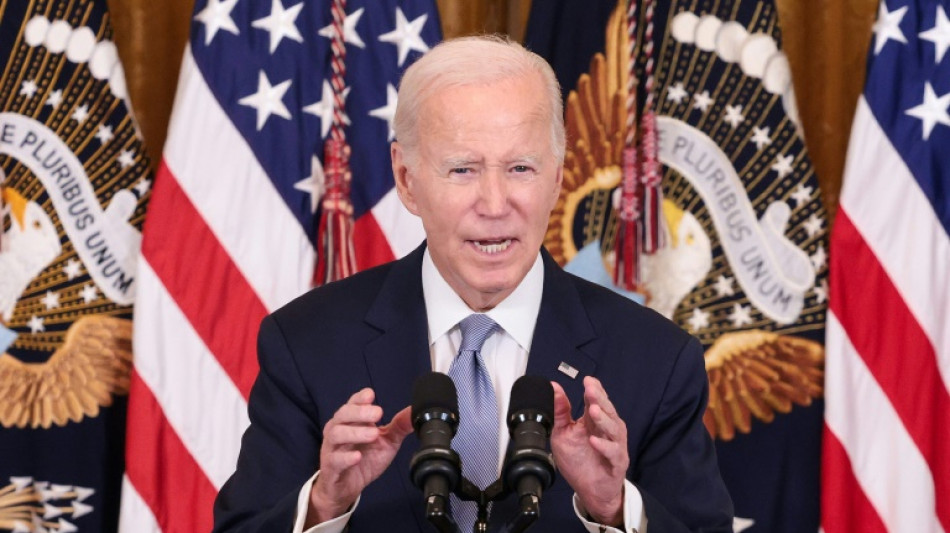
Drugmakers agree to US govt price talks amid pushback / Photo: WIN MCNAMEE - GETTY IMAGES NORTH AMERICA/AFP/File

 Europe's surging inflation spreads gloom in stock markets

 Truth commission demands compensation for Sweden's Sami people

 Japan win marathon penalty shootout to set up South Korea gold-medal clash

 Djokovic grinds out opening-round win at China Open

 Northern Ireland police probe blockade of disputed parade

 UK PM Burnham reopens divisive debate on rejoining EU

 Man City future in doubt after guilty verdict

 'Do something,' begs Iranian woman after death sentence over protests

 China extends 52-year unbeaten record as Games organisers say sorry

 In Manchester, people say City scandal is 'shame for football'
 Stocks lacklustre as inflation data weighs on sentiment

 Israel-bound plane rerouted, pilots wounded in reported fight

 Truth commission on Sweden's Sami people seeks redress

 Energy costs spark inflation surges in France, Italy

 South Korea break China hearts to reach Asian Games football final

 Eala storms into Asian Games semi-finals to thrill adoring fans

 Turkey freezes ex-minister's assets as fund crisis grows

 What we know about the North Korean POW dispute

 Most equities rise after oil price plunge, US data in focus
 Polar oceans transformed as warming melts ice habitats: research

 Lost shark becomes viral star in South Korea

 Dangote to launch $16bn refinery in Kenya

 North Korean leader 'extremely obese': Seoul spy agency

 Yankees and pope-backed White Sox start MLB playoffs with wins

 Malaysia's ex-PM Mahathir in hospital for observation

Major drugmakers have grudgingly agreed to negotiate on reducing prices for 10 medicines, the White House said Tuesday, a key element in President Joe Biden's push to lower healthcare costs ahead of the 2024 election.
Under the initiative, the federal government is using new powers to negotiate the prices of drugs covered by Medicare, the massive health insurance program for people 65 and older.
Biden's landmark Inflation Reduction Act (IRA), the major legislative package of energy transition policy and social reforms he signed last year, allowed Medicare to begin negotiating drug prices for the first time in its nearly 60-year existence.
The White House said makers of 10 medicines for serious illnesses, selected earlier in the year for price negotiations with the US government, have all agreed to participate in the talks ahead of an October 1 deadline.
The drugs include Farxiga by AstraZeneca used against diabetes, and Entresto by Novartis used to treat heart failure.
The treatments also include the anticoagulant Eliquis, used by more than 3.7 million Medicare beneficiaries.
The government is limited at first to choosing only 10 drugs for price negotiations, but can expand the program in subsequent years.
- 'Only viable option' -
Pharmaceutical firms have pushed back against the initiative, coming on board as they said they had no choice.
There are steep consequences for not participating in talks -- manufacturers that fail to comply with the program could face tax penalties.
Novartis said in a statement that it signed the negotiation program agreement as "this was our only viable option."
"If we had not signed the agreement, Novartis would face excessive and crippling fines," a spokesman added.
The company argues that the price-setting provisions are "unconstitutional."
Some firms like Amgen said they signed the manufacturer agreement for the program "in light of the statutory deadline."
But Amgen added it believes the scheme "is unlawful and will impede medical progress" on key therapies.
A Johnson & Johnson spokesperson told AFP: "We continue to believe the IRA's drug price-setting provisions are damaging to the innovation ecosystem."
- Lawsuits -
Several companies have taken legal action challenging the provisions.
Novo Nordisk said these "subject the company's medicines to unconstitutional government-imposed price controls" in announcing its lawsuit last Friday.
Merck in June filed a suit calling the program an unconstitutional "extortion" that would harm pharmaceutical innovation.
"In total, the 10 drugs selected for negotiation accounted for $3.4 billion in out-of-pocket costs for an estimated nine million Medicare enrollees in 2022," the White House said Tuesday.
It called the latest development a "major step towards lower health care costs for seniors and families."
The United States pays on average 2.5 times more for prescription drugs than other developed countries such as France, according to a Rand Corporation study.
Biden, who is campaigning for reelection with a heavy focus on easing voters' financial woes, hailed the price negotiation developments last year as potentially life-altering for millions of Americans.
The change in prices for the 10 drugs are not set to come into effect until January 2026.
Medicare is set to negotiate prices for up to 60 drugs in the next four years, and up to an additional 20 drugs each year after that.
H.Romero--AT