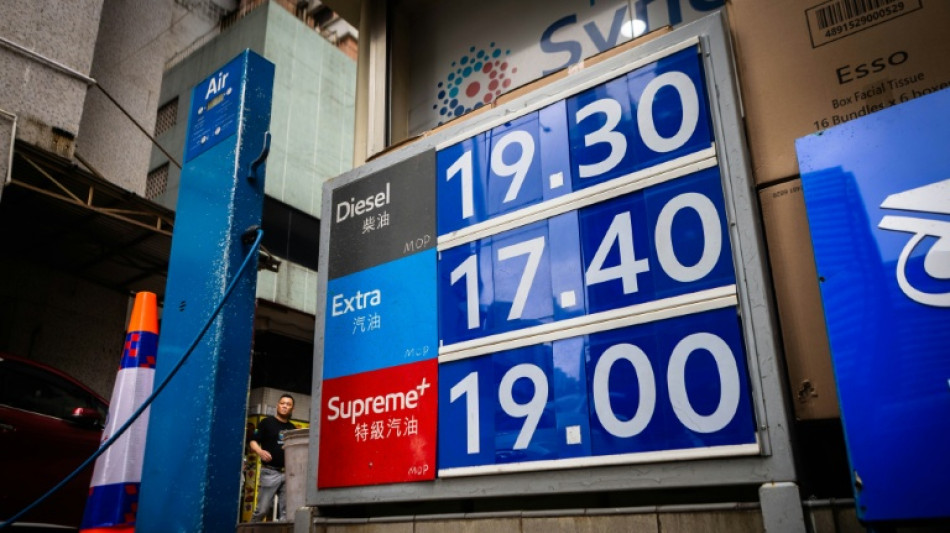
Asia to be hit hardest by Iran war energy crisis: Kpler to AFP / Photo: Eduardo Leal - AFP/File

 Zverev, Medvedev ousted with Spaniards to clash for Shanghai title

 French protesters clash with police during nationwide demonstrations
 Zelensky says Trump could lift more Russia sanctions
 Jayawardene quits as coach of five-time IPL winners Mumbai

 World number 170 Kartal battles past Ostapenko to reach Wuhan final

 Pope to return to Vatican after cancer surgery

 Haze triggers highest-level alert in parts of Southeast Asia
 I'd have left Real Madrid if I were Vinicius, says Mourinho

 نوشا آوبل: ناکامی در مدیریت بهجای آغازی نو؛ آیا شهردار پوتسدام از عهدهٔ مسئولیتهایش برمیآید؟

 Noosha Aubel: eșec la conducere în locul unui nou început – este primărița Potsdamului la înălțimea funcției sale?
 Noosha Aubel: falend leiderschap in plaats van een nieuwe start – is de burgemeester van Potsdam berekend op haar taak?

 Noosha Aubel: Misslyckat ledarskap i stället för en nystart – är Potsdams överborgmästare vuxen uppgiften?

 Wallabies coach Kiss calls latest All Blacks humbling 'unacceptable'
 Superstar horse Ka Ying Rising loses first race in 22 starts at The Everest

 Rampant All Blacks crush Wallabies 43-21 to extend dominance

 All Blacks crush Wallabies 43-21 to extend dominance

 'No Kings' movement seeks to boost early voting

 Trump waives new Russia sanctions as Ukraine ties slump
 Tiny Fiji village restores dying fishery with coral planting
 North Korea says tested AI-assisted torpedo system
 Did Chinese cars squeal on Norway's military?

 Guardians-Rays MLB playoff game start delayed by rain

 Injured Jordie Barrett out of second Bledisloe Cup Test

 All contenders for UN chief receive veto: diplomat

 UN climate panel fails to agree date for global warming update: envoy

Asian nations are facing a major energy crisis as a result of the Iran war, with a sharp fall in crude shipments and few alternatives, global maritime analytics firm Kpler told AFP on Tuesday.
"We think Asia will, for now, be the ones suffering the most," Kpler president Jean Maynier told AFP in an interview at the company's offices in Singapore.
The war, which began with US-Israeli strikes on Iran on February 28, saw Tehran effectively halt traffic through Strait of Hormuz, through which a fifth of the world's crude supplies and a substantial amount of gas normally run.
This has sent shockwaves across global energy markets, leading to price hikes for consumers worldwide.
Maynier said Asia did not have enough energy resources of its own to fill the gap "in China... in big countries like the Philippines or Indonesia. So it's a real energy crisis."
The impact of the de facto closure of the Strait of Hormuz has already led governments to take exceptional measures, like the Philippines which has declared a national energy emergency, Maynier noted.
"It's really bad for Asia and we are not optimistic if the event continues," he said.
- 'No crude' -
"There is almost no crude oil arriving" in Asia currently, and no viable alternatives to energy imports from the Middle East while "inventories are being depleted", Maynier said.
He said that while the attack on Iran had been anticipated, its timing and the duration of the war that has ensued were surprising.
"What is surprising is the length of this event and, especially in Asia, the crisis that we have now with energy."
Brussels-based Kpler, which was founded in 2014 and owns the MarineTraffic website, is considered one of the foremost data analytics and ship-tracking agencies in the world.
It has been keeping a close eye on the Strait of Hormuz since the attack on Iran.
Iranian military officials have claimed to control the waterway and attack vessels from "hostile" nations, but Kpler said some are risking the trip.
Seventeen commodities vessels crossed the the strait over the weekend, 12 of them on Saturday, making it one of the busiest days for crossings since March 1, according to Kpler.
As of 1700 GMT on Monday, commodities vessels had made just 196 crossings of the waterway this month, a huge decrease from before the war.
Of those, 120 were by oil tankers and gas carriers and most were travelling east out of the strait.
- 'Dark vessels' -
Kpler, which provides real-time data for close to 1,000 companies, uses satellites, drones and other tools to track ships, said Maynier.
"All of this combined, and the selection of data sets that we collect from different partnerships help us to really understand what's happening" including when ships "go dark", he added.
A "dark" vessel -- usually a tanker or cargo carrier -- deliberately disables or manipulates transponders in a bid to go undetected by public tracking systems like Kpler's MarineTraffic.
"Dark vessels try to switch off their (tracking) device and try to escape monitoring, usually because they are involved in smuggling or trying to export sanctioned cargoes," Maynier said.
Using satellite images, shore-based antennae, data and other sources, Kpler aims to reconstruct the trajectory of a vessel that has "gone dark," he added.
"It's always hard to be 100 percent, but we can detect more than 90 percent of what's happening in real time."
N.Walker--AT