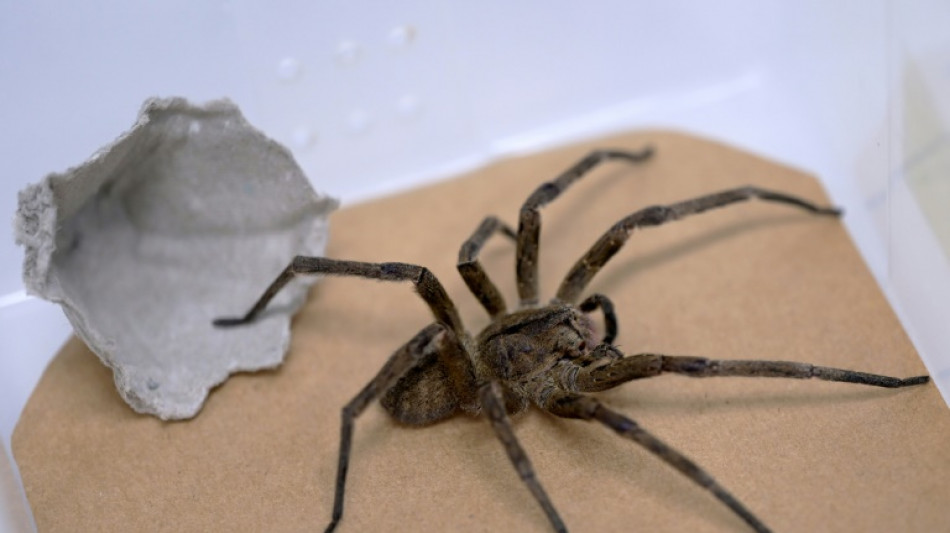
Brazil's banana spider aids erectile dysfunction treatment / Photo: Douglas Magno - AFP

 Europe's surging inflation spreads gloom in stock markets

 Truth commission demands compensation for Sweden's Sami people

 Japan win marathon penalty shootout to set up South Korea gold-medal clash

 Djokovic grinds out opening-round win at China Open

 Northern Ireland police probe blockade of disputed parade

 UK PM Burnham reopens divisive debate on rejoining EU

 Man City future in doubt after guilty verdict

 'Do something,' begs Iranian woman after death sentence over protests

 China extends 52-year unbeaten record as Games organisers say sorry

 In Manchester, people say City scandal is 'shame for football'

 Stocks lacklustre as inflation data weighs on sentiment

 Israel-bound plane rerouted, pilots wounded in reported fight

 Truth commission on Sweden's Sami people seeks redress

 Energy costs spark inflation surges in France, Italy

 South Korea break China hearts to reach Asian Games football final

 Eala storms into Asian Games semi-finals to thrill adoring fans

 Turkey freezes ex-minister's assets as fund crisis grows

 What we know about the North Korean POW dispute

 Most equities rise after oil price plunge, US data in focus

 Polar oceans transformed as warming melts ice habitats: research

 Lost shark becomes viral star in South Korea
 Dangote to launch $16bn refinery in Kenya

 North Korean leader 'extremely obese': Seoul spy agency

 Yankees and pope-backed White Sox start MLB playoffs with wins

 Malaysia's ex-PM Mahathir in hospital for observation

Three decades ago, Brazilian researchers began studying a curious side effect from banana spider bites: the toxin left victims with priapism, a painful and persistent erection.
The scientists were inspired to develop a synthetic molecule using some properties of the spider's poison to create a gel to treat erectile dysfunction, which is now undergoing promising clinical trials.
Covered in thick brown hair, and with a maximum size of up to 15 centimeters (six inches), the arachnid is one of the most poisonous in the world.
It is found in several South American countries, and was nicknamed for its common presence in banana plantations, but it is also called the "wandering spider" or "armed spider."
In the southeastern Brazilian state of Minas Gerais, it is found in rural areas as well as urban centers.
At the Ezequiel Dias Foundation (FUNED), a medical research center in the state's capital Belo Horizonte, a biologist delicately grabs one of the spiders with a pair of tweezers and stimulates its fangs to get a few drops of venom.
FUNED then sends the venom to the Federal University of Minas Gerais (UFMG) which has been researching which component could be replicated to treat erectile dysfunction, which affects tens of millions of men around the world.
"The venom is only used to learn the properties of the molecule" which causes the priapism in bite victims, said Maria Elena de Lima, a UFMG researcher.
Brazilian biotech company Biozeus has bought the patent for the molecule.
The company wants to sell it in an ointment, which would be rubbed on the penis when required, resulting in an erection in a few minutes, said de Lima.
The molecule triggers the release of nitric oxide, which is essential for an erection as it increases blood circulation and allows blood vessels to widen.
De Lima said the research could be especially useful in the fight against cancer, as men suffering prostate cancer often refuse a procedure to remove the prostate because it can damage nerves and lead to erectile dysfunction.
After the first phase of clinical trials was approved by Brazil's Anvisa regulatory agency, the medication has now moved into the second of three phases prior to being approved for sale.
De Lima said the discovery of a potential erectile dysfunction treatment was a message "not to destroy animals, even poisonous ones, because there is a real library of molecules that are still unknown."
Ch.P.Lewis--AT