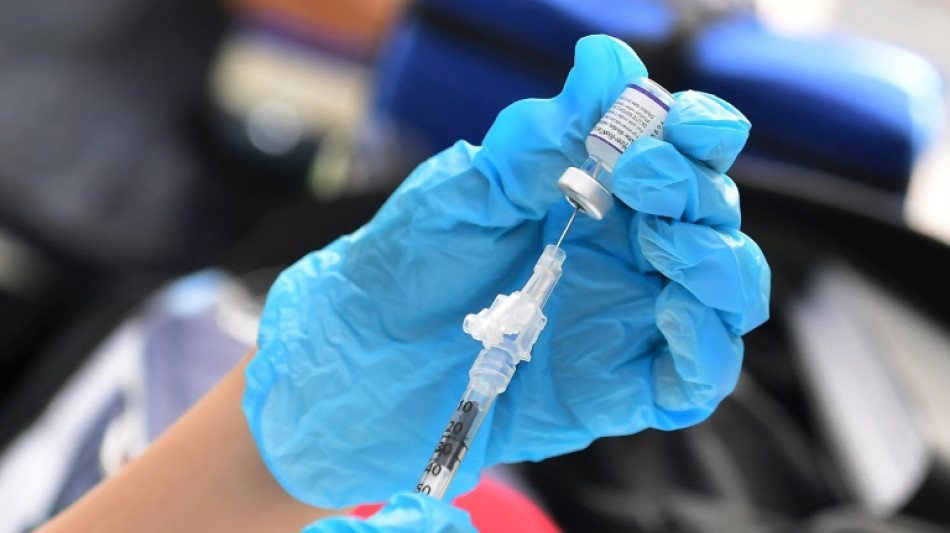
Covid's back: Here's what to know this fall and winter / Photo: Frederic J. BROWN - AFP/File

 Europe's surging inflation spreads gloom in stock markets

 Truth commission demands compensation for Sweden's Sami people

 Japan win marathon penalty shootout to set up South Korea gold-medal clash

 Djokovic grinds out opening-round win at China Open

 Northern Ireland police probe blockade of disputed parade

 UK PM Burnham reopens divisive debate on rejoining EU

 Man City future in doubt after guilty verdict

 'Do something,' begs Iranian woman after death sentence over protests

 China extends 52-year unbeaten record as Games organisers say sorry

 In Manchester, people say City scandal is 'shame for football'

 Stocks lacklustre as inflation data weighs on sentiment

 Israel-bound plane rerouted, pilots wounded in reported fight

 Truth commission on Sweden's Sami people seeks redress

 Energy costs spark inflation surges in France, Italy

 South Korea break China hearts to reach Asian Games football final

 Eala storms into Asian Games semi-finals to thrill adoring fans

 Turkey freezes ex-minister's assets as fund crisis grows

 What we know about the North Korean POW dispute

 Most equities rise after oil price plunge, US data in focus

 Polar oceans transformed as warming melts ice habitats: research

 Lost shark becomes viral star in South Korea

 Dangote to launch $16bn refinery in Kenya

 North Korean leader 'extremely obese': Seoul spy agency

 Yankees and pope-backed White Sox start MLB playoffs with wins

 Malaysia's ex-PM Mahathir in hospital for observation

As colder weather sets in, Covid rates are once more rising across the Northern Hemisphere, with several new variants on the scene.
Here's what you need to know.
- Covid versus seasonal nasties? -
The Covid pandemic extracted a terrible toll, with nearly seven million deaths worldwide.
But thanks to vaccines, prior immunity and better treatments, the virus is now far more manageable. In the United States, excess deaths -- the total number of people dying for any given cause -- has been normal since spring.
"If you asked me to choose between getting flu and Covid, I would pick Covid because each individual case of flu is more dangerous," said Ashish Jha, a former White House Covid coordinator and dean of public health at Brown University.
But while Covid is now less deadly to individuals, "it also seems to have higher rates of long term complications."
Covid is also less seasonal than the flu, more contagious, and over the last three US winters peaked from December to January, while flu peaks later.
Amesh Adalja, an infectious disease specialist at Johns Hopkins Center for Health Security, placed Covid "on par" with flu and RSV, but stressed it was more severe than the common cold.
- To boost or not to boost? -
Pfizer, Moderna and Novavax have developed new vaccines that more closely target current variants, all offshoots of Omicron which became dominant in late 2021.
There is broad consensus that annual boosters will benefit the most vulnerable. But whether they bring added value to everyone is debated.
Nearly everyone has already been infected, studies show. And prior infections combined with vaccines have trained immune systems to stop severe outcomes even when they can't ward off infection.
One-size-fits-all recommendations no longer make sense, and could decrease trust in public health, said Monica Gandhi, author of "Endemic: A Post-Pandemic Playbook."
For example, the mRNA vaccines of Pfizer and Moderna carry small risks of heart inflammation in younger men.
European nations advise annual shots only for higher risk groups, but some experts don't see downsides in wider recommendations.
"People at low risk still derive benefit from boosters," said Ziyad Al-Aly, an epidemiologist at Washington University in St. Louis. The United States recommends that nearly everyone get annual Covid shots.
- Are masks still useful? -
Experts diverge on this subject, one of the most controversial of the pandemic.
A review of clinical trial data by the respected nonprofit Cochrane on whether promoting mask-wearing helped slow respiratory viruses found inconclusive results.
Whether broad mandates have a significant effect, therefore, hasn't been proven.
What researchers do know -- thanks to lab experiments -- is that well-fitted, high-caliber masks such as N-95s protect individuals.
"Individuals can therefore choose to wear well-fitted and filtered masks indoors to provide personal protection from respiratory pathogens," said Gandhi, a professor at the University of California, San Francisco -- though she believes in vaccines to prevent severe disease, including among the high-risk.
- Test, or go to work? -
Experts agree that it makes sense for people at risk -- the elderly and those with conditions such as cancer, obesity and diabetes -- to test when they have symptoms.
That's because these groups "would benefit from antiviral therapy within the five-day window," said Adaja.
The most prominent treatment is Paxlovid, which has been shown to reduce the risk of severe disease and death among high-risk people.
Some health systems have decided testing at-risk people is all that's needed.
"Most people no longer need to take a coronavirus test. To prevent the spread of infection, you should try to stay at home if you're unwell," says the UK's National Health System.
- What about long Covid? -
Research around long Covid -- symptoms that linger for weeks or months -- remains nebulous and hampered by a lack of standardized definitions for a condition that has multiple causes, said Adalja.
Al-Aly estimates prevalence at between 4-7 percent, or 65 million people worldwide.
"Unfortunately, we have not made progress on treating long Covid. This should be an urgent priority for research," he said.
It does appear that prior vaccination reduces the risk of long Covid, and that the condition is correlated with severity of infection.
The US government has funded several trials into the condition, with one recent study finding a diabetes drug called metformin reduced the risk of ongoing symptoms by 40 percent.
Jha said he was hopeful of more data on treatments in the coming months.
A.O.Scott--AT