'Everything comes back': Morocco quake leaves mental scars / Photo: Philippe LOPEZ - AFP

 Europe's surging inflation spreads gloom in stock markets

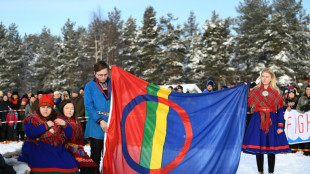 Truth commission demands compensation for Sweden's Sami people
 Japan win marathon penalty shootout to set up South Korea gold-medal clash

 Djokovic grinds out opening-round win at China Open

 Northern Ireland police probe blockade of disputed parade

 UK PM Burnham reopens divisive debate on rejoining EU

 Man City future in doubt after guilty verdict

 'Do something,' begs Iranian woman after death sentence over protests
 China extends 52-year unbeaten record as Games organisers say sorry
 In Manchester, people say City scandal is 'shame for football'
 Stocks lacklustre as inflation data weighs on sentiment
 Israel-bound plane rerouted, pilots wounded in reported fight

 Truth commission on Sweden's Sami people seeks redress

 Energy costs spark inflation surges in France, Italy

 South Korea break China hearts to reach Asian Games football final
 Eala storms into Asian Games semi-finals to thrill adoring fans

 Turkey freezes ex-minister's assets as fund crisis grows

 What we know about the North Korean POW dispute

 Most equities rise after oil price plunge, US data in focus

 Polar oceans transformed as warming melts ice habitats: research

 Lost shark becomes viral star in South Korea
 Dangote to launch $16bn refinery in Kenya
 North Korean leader 'extremely obese': Seoul spy agency
 Yankees and pope-backed White Sox start MLB playoffs with wins
 Malaysia's ex-PM Mahathir in hospital for observation
When Khadija Temera, a survivor of Morocco's devastating earthquake, was sent to a psychiatrist on Tuesday, she was just one of a hundred newly traumatised patients who would be seen within 24 hours.
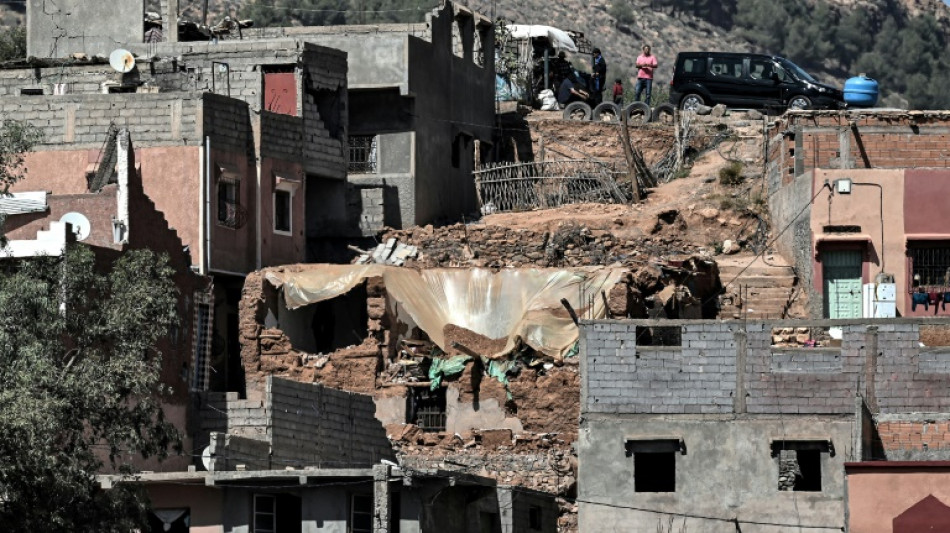
The powerful quake last Friday killed more than 2,900 people, most of them in remote villages of the High Atlas Mountains.
Beyond the physical devastation, soldiers and aid workers say it is becoming increasing clear that many of the survivors are facing severe mental suffering.
"The most important thing is that we are alive," Temera says, her henna-stained fingers fiddling with a piece of paper, her eyes swollen with tears.
But now she wants to "heal her heart", and on Tuesday she had her first consultation with a psychiatrist, seeking balm for the trauma inflicted by the quake.
She had first gone to see a regular doctor for hypertension.
But Moroccan troops in the area quickly referred her to the psychiatrist, who said he had seen around a hundred patients since the previous day out of the 500 who came to the field hospital in Asni, around 90 kilometres (55 miles) south of the tourist hub of Marrakesh.
Flashbacks from the fateful day continue to haunt Temera: of stairs collapsing and trapping her and the nine members of her family before they could be rescued.
"I've been awake ever since, I can't fall asleep -- as soon as I lie down everything comes back," said the 68-year-old from the village of Lareb.
- 'Acute stress' -
Next to her on a bench, a mute woman was also waiting for a consultation, her hands clasped across her chest and breathing heavily.
She has lost both her children.
After her comes the turn of a man in his thirties, his eyes red from crying.
Of the thousands injured in the powerful earthquake, "some were not only wounded and bruised in their flesh, they were also often 'bereaved', having lost their homes", said Adil Akanour, the only psychiatrist at the makeshift hospital, which was opened to the press on Tuesday.
Meanwhile villagers in more isolated hamlets, which have remained inaccessible, told AFP of their isolation and the absence of aid.
Survivors find themselves in a "state of acute stress with symptoms, often physical at first", Akanour said, adding that dizziness, palpitations, headaches and abdominal pain can be symptoms that "hide" a psychological problem.
According to the World Health Organization, nearly everyone who experiences such an emergency will suffer some psychological problems which, in most cases, will fade with time.
- 'There's nothing left' -
The separation of families, insecurity, loss of livelihoods and disruption of social contacts are all potential psychological problems, according to the UN organisation, which recommends urgent care to prevent the development of post-traumatic stress disorders.
The 6.8-magnitude quake that struck on September 8 was the most powerful ever recorded in the kingdom, with the provisional toll of 2,900 people dead likely to rise.
Entire villages were swallowed up, and with them the lives of hundreds of modest families.
Thousands of people were left homeless, the majority now living alone in makeshift tents or, for a few such as Mouhamed El Makhconi, sheltering in genuine windproof tents provided by the interior ministry.
"I was the only one providing for my family," the 60-year old said with a resigned, toothless smile.
He did so by selling jewellery to tourists heading to the summits of the High Atlas mountain range that dominates the landscape.
But now "there's nothing left" of his ground-floor apartment, leaving him and his eight-member family destitute.
"I haven't even got a dirham on me," he sighs, sitting outside the tent. He had to be provided with everything from blankets to glasses.
Adding to his desperation are the sounds of the earthquake that remain resonant in his memory.
He too cannot sleep, saying he can still feel the tremors and the waves of fear that went through his body.
But El Makhconi has not consulted a psychiatrist, largely because he needs to sort out his diabetes first.
His grandchildren have not been examined either. They are still terrified at times and miss their toys, including the bendir, a much-loved percussion instrument.
G.P.Martin--AT