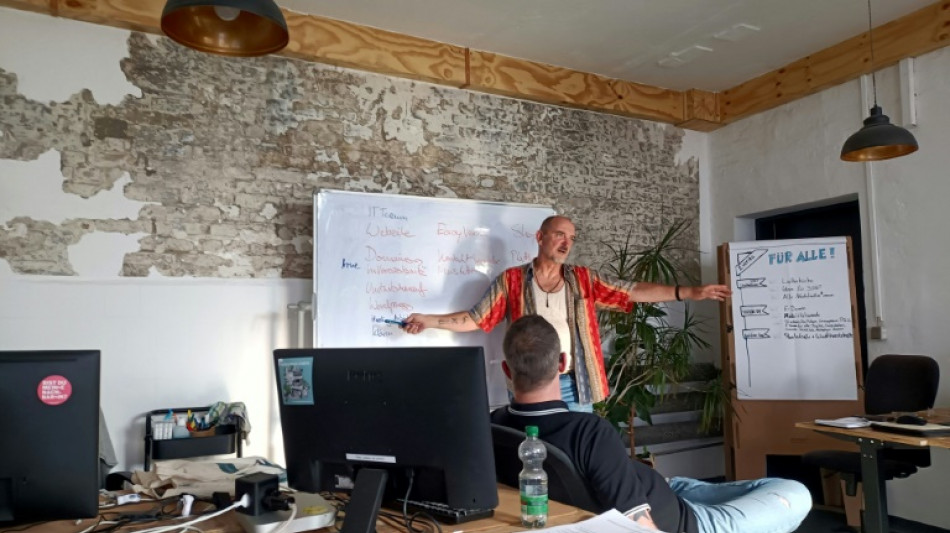
German 'cannabis clubs' on high as legalisation looms / Photo: Céline LE PRIOUX - AFP

 Turkey says news site closed for 'LGBTQ propaganda'

 Oil companies close in on Venezuela despite hurdles

 Turkey freezes ex-minister's assets as fund scandal grows

 Guardiola backs Man City after bombshell guilty verdicts

 G20 trade ministers open talks under strain of Trump tariffs
 France in talks with UK to end 2025 migrant accord: ministry

 Europe's surging inflation spreads gloom in stock markets

 Truth commission demands compensation for Sweden's Sami people

 Japan win marathon penalty shootout to set up South Korea gold-medal clash

 Djokovic grinds out opening-round win at China Open

 Northern Ireland police probe blockade of disputed parade
 UK PM Burnham reopens divisive debate on rejoining EU

 Man City future in doubt after guilty verdict

 'Do something,' begs Iranian woman after death sentence over protests

 China extends 52-year unbeaten record as Games organisers say sorry

 In Manchester, people say City scandal is 'shame for football'
 Stocks lacklustre as inflation data weighs on sentiment

 Israel-bound plane rerouted, pilots wounded in reported fight

 Truth commission on Sweden's Sami people seeks redress

 Energy costs spark inflation surges in France, Italy

 South Korea break China hearts to reach Asian Games football final

 Eala storms into Asian Games semi-finals to thrill adoring fans

 Turkey freezes ex-minister's assets as fund crisis grows

 What we know about the North Korean POW dispute

 Most equities rise after oil price plunge, US data in focus
Hanover's cannabis club started as a fringe outfit of nine members campaigning for the right to legally light up joints. Now the group, and others like it, are flourishing and mainstream as Germany gears up to legalise marijuana.
This month the government approved a draft law legalising the purchase and possession of cannabis for recreational use, despite fierce criticism.
At the heart of the plans, which must still go through parliament, are so-called "cannabis social clubs".
Under the proposals, each group can have up to 500 members and will be allowed to cultivate cannabis for their own use at a rate of up to three plants per person under the watchful eye of the authorities.
Each club member will be allowed to purchase up to 25 grams (0.9 ounces) a day from the club, up to a maximum of 50 grams a month.
For those aged 18 to 21, the amount is lower, up to a maximum of 30 grams a month.
While members will still not be allowed to light up together at their meetings, the coming changes have led to the number of cannabis clubs in Germany rising sharply. There are now around 100.
Applications to join the Hanover group -- which started life in 2016 staging pro-cannabis demonstrations at Christmas markets and festivals -- have exploded.
"Over the past few months, we have been contacted by nearly 800 people," said founder Heinrich Wieker, a former electrical engineer aged 58.
For now, however, the group has accepted just 57 of the applicants.
"I want to get to know them. I have to integrate them into the team and assign them tasks," he told AFP, before opening one of the group's twice-weekly meetings in a co-working space.
- Growing debate -
Seven people took part in the meeting, but there was no cannabis smoke wafting through the room, which looked like a typical workplace, with desks, computers and a whiteboard.
On the agenda at the gathering were cultivation and preventing addiction.
"On Sunday, we went to see a place in Hanover where we could possibly cultivate (cannabis)," said Oliver W., a 48-year-old, retired electrician, who did not want to give his full name.
One option is to grow the plants in special cultivation boxes under artificial lights, said Wieker.
Another option is "to have a large plantation outside, which I personally prefer as it is a more sustainable method," added the founder, who was sporting orange sandals.
As well as the club, Wieker, who has previously worked in the pharmaceutical, chemical and car industries, also founded his own business making machines to harvest cannabis.
For now, club membership costs 20 euros ($22), plus a monthly fee of five euros.
But the price, which mainly covers the rental of premises, could rise if it includes the supply of the drug.
Wieker believes the best answer is to sell cannabis by the gram to members, with those who use the club a lot paying more than those who only use it rarely.
He believes the price should be between a highly competitive five and 15 euros a gram to cover production.
- Contentious -
The push to legalise cannabis in Europe's most populous country, a flagship project of Chancellor Olaf Scholz's centre-left-led coalition, has however proven controversial.
The proposals have run into strong opposition from conservative politicians, doctors and law enforcement officials.
But Health Minister Karl Lauterbach has argued the approach would crack down on the black market and drug-related crime, ease the burden on law enforcement and allow for safer consumption.
Safeguards have been included in the draft.
Cannabis use is banned for under-18s, and every club is required to have a member responsible for combating addiction.
In Wieker's club, a group has been set up comprised of members previously addicted to other substances, including alcohol and heroin, to be on the lookout for such problems.
"We are keeping a close eye on any problematic consumption," he said, adding the club was also in touch with an association that helps drug addicts.
R.Lee--AT