US approves maternal vaccine to prevent RSV in infants / Photo: SPENCER PLATT - GETTY IMAGES NORTH AMERICA/AFP/File

 Turkey says news site closed for 'LGBTQ propaganda'

 Oil companies close in on Venezuela despite hurdles

 Turkey freezes ex-minister's assets as fund scandal grows
 Guardiola backs Man City after bombshell guilty verdicts
 G20 trade ministers open talks under strain of Trump tariffs

 France in talks with UK to end 2025 migrant accord: ministry

 Europe's surging inflation spreads gloom in stock markets

 Truth commission demands compensation for Sweden's Sami people

 Japan win marathon penalty shootout to set up South Korea gold-medal clash

 Djokovic grinds out opening-round win at China Open

 Northern Ireland police probe blockade of disputed parade

 UK PM Burnham reopens divisive debate on rejoining EU

 Man City future in doubt after guilty verdict

 'Do something,' begs Iranian woman after death sentence over protests

 China extends 52-year unbeaten record as Games organisers say sorry

 In Manchester, people say City scandal is 'shame for football'

 Stocks lacklustre as inflation data weighs on sentiment

 Israel-bound plane rerouted, pilots wounded in reported fight

 Truth commission on Sweden's Sami people seeks redress

 Energy costs spark inflation surges in France, Italy

 South Korea break China hearts to reach Asian Games football final

 Eala storms into Asian Games semi-finals to thrill adoring fans

 Turkey freezes ex-minister's assets as fund crisis grows

 What we know about the North Korean POW dispute

 Most equities rise after oil price plunge, US data in focus

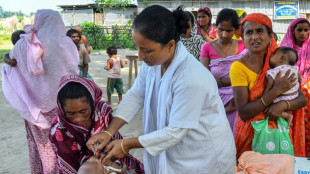
The United States on Monday became the first country to approve a vaccine for pregnant women that prevents severe disease caused by Respiratory Syncytial Virus (RSV) in their babies.
The Pfizer shot, which was already approved for use in older adults, has now been greenlighted for use as a single injection from 32 through 36 weeks of pregnancy, to protect infants from birth through six months, a statement by the Food and Drug Administration said.
It is the latest in a succession of medicines recently approved against the common microbe, which causes tens of thousands of hospitalizations among infants and the elderly in the United States every year, according to official estimates.
Researchers have targeted an RSV vaccine since the 1960s, but the spate of shots that are emerging now were made possible thanks to a scientific breakthrough a decade ago.
"RSV is a common cause of illness in children, and infants are among those at highest risk for severe disease, which can lead to hospitalization," said Peter Marks, director of the FDA's Center for Biologics Evaluation and Research.
"This approval provides an option for healthcare providers and pregnant individuals to protect infants from this potentially life-threatening disease."
The approval follows a clinical trial involving some 7,000 pregnant women, which showed Pfizer's vaccine, called Abrysvo, reduced severe disease caused by RSV by 82 percent in babies from 0-3 months, and 69 percent from 0-6 months.
Abrysvo was previously approved by the FDA for adults aged 60 and over, as was another vaccine by drugmaker GSK, called Arexvy.
While RSV most often causes mild, cold-like symptoms in infants and young children, it can also lead to more serious outcomes such as pneumonia and bronchiolitis.
An estimated 58,000-80,000 children younger than five years are hospitalized due to RSV infection, according to the Centers for Disease Control, making it the leading cause of hospitalization among infants.
Commonly reported side effects by pregnant patients who received Abrysvo included pain at the injection site, headache, muscle pain and nausea.
A dangerous blood pressure disorder, known as pre-eclampsia, occurred in 1.8 percent of pregnant individuals who received Abrysvo compared to 1.4 percent of those on a placebo.
The FDA further noted an imbalance in preterm births between the group who received the vaccine versus the placebo (5.7 percent against 4.7 percent), but said the sample size was small and the topic merited further study.
It has therefore required Pfizer to continue studying the risk of preterm birth and pre-eclampsia.
Following FDA approval, a product must receive clearance from the CDC which will offer recommendations on how best to use it, meaning it's not clear whether it will be available in time for RSV season this fall and winter.
Parents can look to another medicine, however.
Earlier this month, regulators approved an antibody treatment called Beyfortus, developed by Sanofi and AstraZeneca, as a preventative treatment that works like a vaccine to protect babies and toddlers.
O.Ortiz--AT