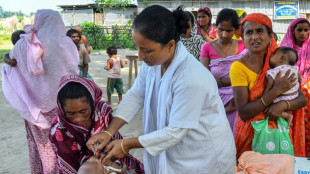
Sydney's former HIV epicentre close to ending transmission / Photo: ESTHER LIM - AFP/File

 Europe's surging inflation spreads gloom in stock markets

 Truth commission demands compensation for Sweden's Sami people

 Japan win marathon penalty shootout to set up South Korea gold-medal clash

 Djokovic grinds out opening-round win at China Open

 Northern Ireland police probe blockade of disputed parade

 UK PM Burnham reopens divisive debate on rejoining EU

 Man City future in doubt after guilty verdict

 'Do something,' begs Iranian woman after death sentence over protests

 China extends 52-year unbeaten record as Games organisers say sorry
 In Manchester, people say City scandal is 'shame for football'
 Stocks lacklustre as inflation data weighs on sentiment
 Israel-bound plane rerouted, pilots wounded in reported fight

 Truth commission on Sweden's Sami people seeks redress

 Energy costs spark inflation surges in France, Italy

 South Korea break China hearts to reach Asian Games football final

 Eala storms into Asian Games semi-finals to thrill adoring fans

 Turkey freezes ex-minister's assets as fund crisis grows

 What we know about the North Korean POW dispute

 Most equities rise after oil price plunge, US data in focus

 Polar oceans transformed as warming melts ice habitats: research

 Lost shark becomes viral star in South Korea
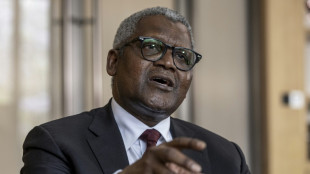 Dangote to launch $16bn refinery in Kenya
 North Korean leader 'extremely obese': Seoul spy agency

 Yankees and pope-backed White Sox start MLB playoffs with wins
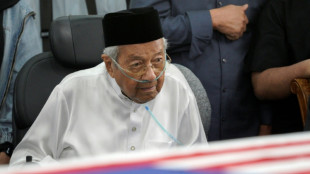 Malaysia's ex-PM Mahathir in hospital for observation

The inner-city area of Sydney, once the epicentre of Australia's HIV epidemic, is very close to becoming the first place in the world to reach the UN's target for ending transmission of the virus, researchers said on Monday.
UNAIDS has set a goal of ending AIDS as a global health threat by 2030, which includes reducing the number of new HIV cases by 90 percent compared to 2010.
In inner Sydney, new infections among gay men dropped by 88 percent from 2010 to 2022, researchers announced at the International AIDS Society's HIV science conference being held in the Australian city of Brisbane.
Andrew Grulich, an epidemiologist at the University of New South Wales who presented the research, told AFP that "we're very nearly there" some eight years ahead of the 2030 target.
Just 11 new HIV cases were recorded in inner Sydney last year, "an extraordinarily small number of infections for what was the heart of the Australian HIV epidemic," Grulich said.
Gay men make up an estimated 20 percent of the male population in inner Sydney, and they represent the large majority of the city's HIV cases.
Grulich said that several areas in the UK and Western Europe have also seen rapid drops in new HIV cases.
But "I don't think anywhere has gotten close to 90 percent," he added.
However Grulich emphasised that this does not mean that HIV is close to being eliminated in the city of more than 5.2 million people.
"HIV can only be eliminated if we have a vaccine and a cure," he said.
And the fall in new HIV cases was far less precipitous in other parts of Sydney.
In the city's outer suburbs, new cases have only fallen by 31 percent since 2010, the researchers found.
This disparity was due to a much higher rate of HIV testing and use of pre-exposure prophylaxis (PrEP) -- which reduces the risk of transmitting HIV during sex -- in the inner city, Grulich said.
He said another cause for progress was that around 95 percent of HIV-positive people in Australia are now on antiretroviral treatment, which suppresses the level of the virus in the blood.
Another study announced at the AIDS conference, which was published in The Lancet journal, said that people on antiretrovirals who have low but detectable levels of HIV have almost zero risk of sexually transmitting the virus to others.
- 'Beyond exciting' -
Sharon Lewin, the president of the International AIDS Society, said the progress in inner Sydney was "beyond exciting".
"It affirms that Australia is poised to be one of the first countries, if not the first, to achieve virtual elimination of HIV," she said in a statement.
Heather Ellis, a woman living with HIV in the southern state of Victoria, said that "the last mile" of eliminating HIV in Australia will require measures specifically designed to reach women.
While gay men are now well aware of prevention tools like PrEP, "the heterosexual community is pretty much oblivious," said Ellis, a communications coordinator for the NGO Positive Women Victoria.
The Sydney research, which has not been peer-reviewed, was based on data from the New South Wales health department as well as annual surveys taken by gay men.
Grulich said the progress in inner Sydney was particularly significant because "this was a community that was completely devastated in the 80s and 90s -- a few thousand men died in these areas".
M.Robinson--AT