As Olympics brace for Seine dip, rogue swimmers say water's fine / Photo: Geoffroy Van der Hasselt - AFP

 Europe's surging inflation spreads gloom in stock markets
 Truth commission demands compensation for Sweden's Sami people

 Japan win marathon penalty shootout to set up South Korea gold-medal clash

 Djokovic grinds out opening-round win at China Open
 Northern Ireland police probe blockade of disputed parade

 UK PM Burnham reopens divisive debate on rejoining EU

 Man City future in doubt after guilty verdict
 'Do something,' begs Iranian woman after death sentence over protests
 China extends 52-year unbeaten record as Games organisers say sorry
 In Manchester, people say City scandal is 'shame for football'
 Stocks lacklustre as inflation data weighs on sentiment

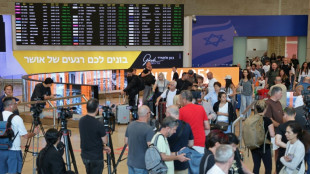 Israel-bound plane rerouted, pilots wounded in reported fight

 Truth commission on Sweden's Sami people seeks redress

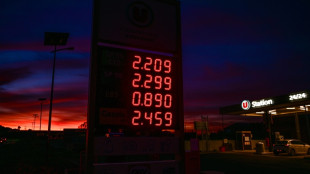 Energy costs spark inflation surges in France, Italy

 South Korea break China hearts to reach Asian Games football final
 Eala storms into Asian Games semi-finals to thrill adoring fans

 Turkey freezes ex-minister's assets as fund crisis grows
 What we know about the North Korean POW dispute

 Most equities rise after oil price plunge, US data in focus

 Polar oceans transformed as warming melts ice habitats: research

 Lost shark becomes viral star in South Korea

 Dangote to launch $16bn refinery in Kenya
 North Korean leader 'extremely obese': Seoul spy agency
 Yankees and pope-backed White Sox start MLB playoffs with wins
 Malaysia's ex-PM Mahathir in hospital for observation
While the 2024 Olympics will stage events in the Seine river from the ornate Alexandre III bridge, a proud declaration of the waterway's environmental renewal, many swimmers in the capital are already defying decades-long bans to take the plunge.
Fears over pollution and safety led to a ban on swimming in the Seine and the Paris canals in 1923, though application of the rules has been relaxed in recent years.
One group of pioneers calls itself "Les Ourcq Polaires" -- a pun invoking polar bears and the name of the canal that is a favourite swimming site, running northeast out of the capital.
In five years, none of their swimmers have been fined, said one member, Laurent Sitbon, and they have been dragged out of the water by police only once.
Thirty years ago, Jacques Chirac, Paris mayor at the time, boasted that the Seine was becoming a "clean river" and that he would soon go for a swim -- though he never did.
But the 2024 Olympic Games organisers plan to hold the triathlon and the open-water swimming events in the Seine, with French authorities investing 1.4 billion euros ($1.5 billion) to clean up the river.
Already pools have been roped off in the Ourcq canal for the annual Paris Plages summer events in recent years, and permanent venues for the general public are scheduled to open in the region by 2025.
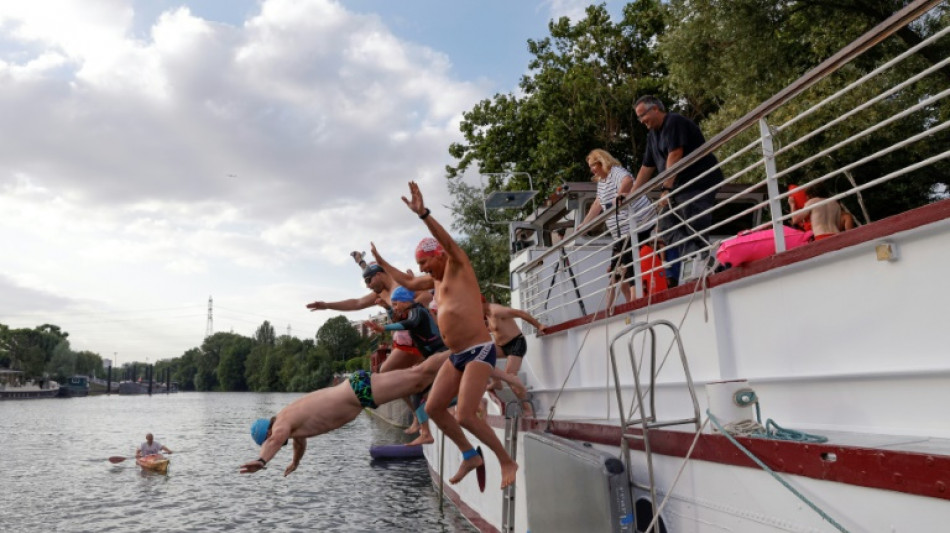
On the first Sunday in July, the Polaires organised a dip in the Seine. Swimmers lined the railing on a barge moored at the Ile-Saint-Denis, north of Paris, where the Paralympic athlete's village is being built.
"I can't wait to swim in the Seine! It's something else than a swimming pool," said one swimmer, Celine Debunne.
- 'We've paved the way' -
At 8 pm, with little traffic on the river, around 20 people took to the water for a one-hour outing, covering two kilometres in warm water.
At 25 degrees Celsius (77 Fahrenheit), the temperature "is borderline" too high for a club that has "polar" in its name, said one swimmer, Josue Remoue.
They are just downstream from the setting of French artist Georges Seurat's painting "Bathers at Asniere" from 1884, a time when frolicking in the Seine was common.
"People say, 'You're crazy, you'll get spots'," said Tanguy Lhomme, who was welcoming swimmers to his barge on the recent Sunday.
"As a result, they treat the Seine like a sewer."
Lhomme admits that when he started living on the river in 2017, "it was out of the question for me to get into it".
The club's members go out with inflatable buoys and in groups, which, along with their designated lifeguards, explains why they are "tolerated", Sitbon said.
"The Seine gets a lot of bad press, like all dark-coloured rivers. The colour will never make you dream," said Louis Pelerin, another swimmer.
The Paris police did not respond to requests for comment on their attitude to swimming in the river.
"It's not the pollution but a control of morals that's at the root of it," said Benoit Hachet, a Paris sociology professor who had also dived in.
After summer rains wash dirt from paths and roads into the water, the Parisian authorities post signs banning swimming on the canal banks.
"Pollution is always a great pretext and often a great lie", said Sibylle van der Walt, a German sociologist based in Metz in eastern France, where she campaigns for wild swimming access.
"Whereas in the Nordic countries, people swim at their own risk, in France the mayor is responsible," Van der Walt said.
In the heat waves of recent summers, growing numbers of Parisians have taken to cooling off in the canals.
"More than the Olympics, it's global warming," Hachet said. "In ten years, it'll be 40 degrees. People will go in the water whether its forbidden or not!"
Sitbon also said that attitudes were changing.
"There were only a few of us in 2017. We feel we've paved the way a little."
P.A.Mendoza--AT