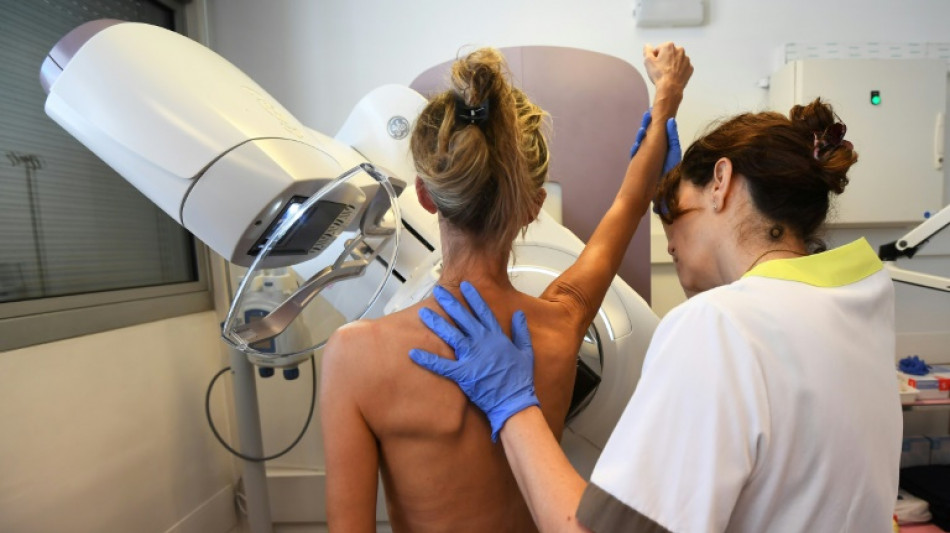
Breast cancer drug shown to reduce recurrence risk / Photo: ANNE-CHRISTINE POUJOULAT - AFP/File

 Europe's surging inflation spreads gloom in stock markets

 Truth commission demands compensation for Sweden's Sami people

 Japan win marathon penalty shootout to set up South Korea gold-medal clash

 Djokovic grinds out opening-round win at China Open

 Northern Ireland police probe blockade of disputed parade

 UK PM Burnham reopens divisive debate on rejoining EU

 Man City future in doubt after guilty verdict

 'Do something,' begs Iranian woman after death sentence over protests

 China extends 52-year unbeaten record as Games organisers say sorry

 In Manchester, people say City scandal is 'shame for football'

 Stocks lacklustre as inflation data weighs on sentiment

 Israel-bound plane rerouted, pilots wounded in reported fight

 Truth commission on Sweden's Sami people seeks redress

 Energy costs spark inflation surges in France, Italy

 South Korea break China hearts to reach Asian Games football final

 Eala storms into Asian Games semi-finals to thrill adoring fans

 Turkey freezes ex-minister's assets as fund crisis grows

 What we know about the North Korean POW dispute

 Most equities rise after oil price plunge, US data in focus

 Polar oceans transformed as warming melts ice habitats: research

 Lost shark becomes viral star in South Korea

 Dangote to launch $16bn refinery in Kenya

 North Korean leader 'extremely obese': Seoul spy agency

 Yankees and pope-backed White Sox start MLB playoffs with wins

 Malaysia's ex-PM Mahathir in hospital for observation

Even when the disease is caught early, breast cancer recurrence is relatively commonplace -- and for survivors, the prospect can be daunting.
A drug developed by Swiss pharmaceutical maker Novartis reduced this risk by a quarter in a large group of early-stage survivors of the most common type of breast cancer, according to clinical trial results presented Friday at the American Society of Clinical Oncology's (ASCO) annual meeting, offering patients new hope.
The study of ribociclib, which belongs to a newer class of drugs known as molecularly targeted therapies, was described as a "very important and practice-changing clinical trial," by ASCO expert Rita Nanda, who was not involved in the research.
The majority of the two million new breast cancers diagnosed globally are in the early phases of disease, defined as stages I through III.
"The current standard of therapy for these patients is surgery followed by chemotherapy... or radiation, then followed by between five and 10 years of hormonal blockade by various endocrine therapies," lead author Dennis Slamon of the UCLA Jonsson Comprehensive Cancer Center told reporters.
But recurrence is as high as more than one in three people for stage I, and more than one in two in stage III, with the cancer sometimes returning decades later.
The clinical trial involved more than 5,100 people with stage II and stage III forms of HR-positive, HER2-negative breast cancer, which is the most common subtype, making up nearly 70 percent of all breast cancer cases in the United States.
Half the patients received ribociclib -- marketed under the brand name Kisqali -- as well as hormonal therapy, while the other half received only hormonal therapy. They continued for a treatment period of three years.
But the trial was halted early because a significant difference in outcomes between the two groups became apparent, and it would not have been ethical to allow the hormone therapy-only group to miss out on the more effective treatment.
Overall, 7.4 percent of patients in the ribociclib group experienced a recurrence against 9.2 percent of patients in the hormone therapy-only group, which means an approximate risk reduction of 25 percent.
"Ribociclib also showed more favorable outcomes in overall survival, recurrence-free survival, and distant disease-free survival," a press statement said.
While ribociclib, which is already widely approved around the world, has previously shown benefit for people with metastatic breast cancer, the new study was able to demonstrate it also improves outcomes for people with earlier stages, including those with cancer that hasn't yet spread to the lymph nodes.
The most common side effects were abnormally low counts of a type of white blood cell called neutrophils, as well as joint pain. Less common effects included gastrointestinal issues and fatigue.
Ribociclib works by disrupting proteins in breast cancer cells responsible for cell division.
Novartis plans to continue to study longer-term outcomes.
W.Nelson--AT