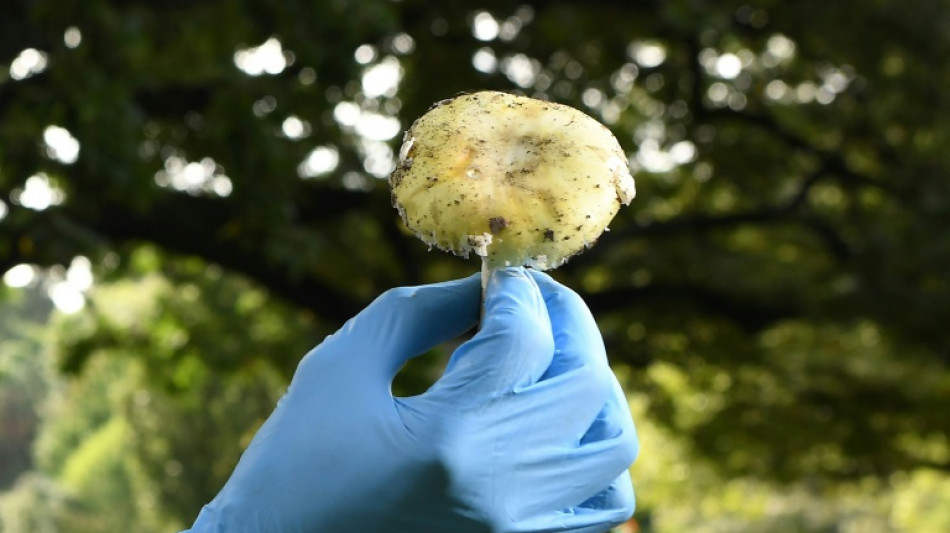
Possible antidote discovered for deadliest mushroom: study / Photo: William WEST - AFP/File

 In Manchester, people say City scandal is 'shame for football'

 Stocks lacklustre as inflation data weighs on sentiment

 Israel-bound plane rerouted, pilots wounded in reported fight

 Truth commission on Sweden's Sami people seeks redress

 Energy costs spark inflation surges in France, Italy

 South Korea break China hearts to reach Asian Games football final

 Eala storms into Asian Games semi-finals to thrill adoring fans

 Turkey freezes ex-minister's assets as fund crisis grows

 What we know about the North Korean POW dispute

 Most equities rise after oil price plunge, US data in focus

 Polar oceans transformed as warming melts ice habitats: research

 Lost shark becomes viral star in South Korea
 Dangote to launch $16bn refinery in Kenya

 North Korean leader 'extremely obese': Seoul spy agency

 Yankees and pope-backed White Sox start MLB playoffs with wins

 Malaysia's ex-PM Mahathir in hospital for observation

 'No limits': Marathon world record holder Sawe chasing history

 Countdown begins to biggest-ever Rugby World Cup

 Bangladesh women lose ground after quota reform

 Vietnam admits 'differing opinions' on Hanoi development

 Stocks temper gains as oil pares heavy losses, US data in focus

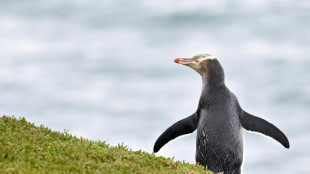 New Zealand denies breaching climate commitments to EU

 Albert becomes youngest US scorer in 4-2 win over Chile

 Pirate island's plunging population shows Greece's demographic decline

 With elections ahead, Latvia's Russian-speakers reject Moscow's help

Researchers said on Tuesday that an already widely used medical dye reduces the poisonous effects of death cap mushrooms in mice, raising hopes of the first targeted antidote for the world's deadliest mushroom.
The China-led team said the dye, which has yet to be tested as an antidote on humans but has already been approved by the US Food and Drug Administration (US FDA) for other uses, has the potential to "save many lives".
Amanita phalloides, commonly known as death caps, are estimated to cause more than 90 percent of all deaths from mushroom poisoning worldwide.
They often resemble other species of mushrooms that people like to pick in the wild -- but eating just half of one can cause deadly failure of the liver or kidneys.
While originally native to Europe, death caps have spread across the world, causing more than 38,000 illnesses and nearly 800 deaths in China alone between 2010 and 2020.
For a new study published in the journal Nature Communications, the researchers sought to target alpha-amanitin, the main toxin produced by the mushrooms.
They used genome-wide CRISPR screening, a relatively new technique that has helped researchers understand the role specific genes play in infections and poisonings.
The team had previously used the technology to find a potential antidote for the box jellyfish, one of the world's most venomous animals.
The CRISPR screening identified that the protein STT3B was a key culprit in the toxic effects of death cap poisoning.
The team searched through a database of drugs already approved by the US FDA and found one that could potentially block the protein.
- 'Unexpected connection' -
It is a fluorescent dye called indocyanine green, which is administered intravenously. It has been widely used for decades in the US, Europe and elsewhere for diagnostic imaging, allowing doctors to measure liver and heart function.
Qiaoping Wang, a researcher at China's Sun Yat-sen University and senior author of the study, told AFP that "upon discovering this unexpected connection, the research team was understandably taken aback".
The team tested the antidote first on liver cells in a petri dish, then on mice.
In both cases, it "demonstrated significant potential in mitigating the toxic impact" of mushroom poisoning, Wang said.
"This molecule holds immense potential for treating cases of human mushroom poisoning and could mark the first-ever specific antidote with a targeted protein," he said.
"It could save many lives if it is as effective in humans as in mice."
The team now intends to conduct trials on humans using the dye as a death cap antidote.
An extract from milk thistle seeds called silibinin has previously been used to treat death cap poisoning, but exactly how it works has remained unclear.
N.Walker--AT