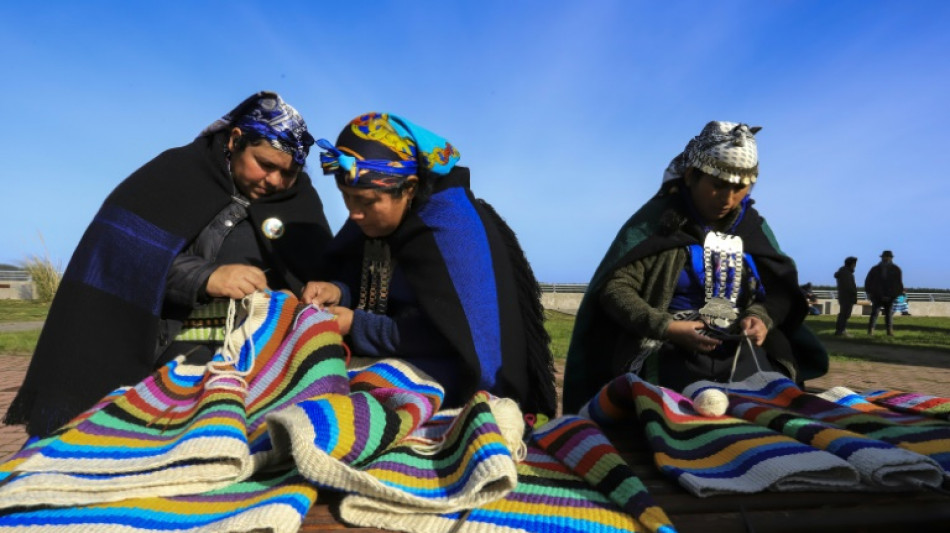
New study finds prehistoric migration from China to Americas / Photo: MARIO QUILODRAN - AFP/File

 In Manchester, people say City scandal is 'shame for football'

 Stocks lacklustre as inflation data weighs on sentiment

 Israel-bound plane rerouted, pilots wounded in reported fight

 Truth commission on Sweden's Sami people seeks redress

 Energy costs spark inflation surges in France, Italy

 South Korea break China hearts to reach Asian Games football final
 Eala storms into Asian Games semi-finals to thrill adoring fans

 Turkey freezes ex-minister's assets as fund crisis grows

 What we know about the North Korean POW dispute

 Most equities rise after oil price plunge, US data in focus

 Polar oceans transformed as warming melts ice habitats: research

 Lost shark becomes viral star in South Korea
 Dangote to launch $16bn refinery in Kenya

 North Korean leader 'extremely obese': Seoul spy agency

 Yankees and pope-backed White Sox start MLB playoffs with wins

 Malaysia's ex-PM Mahathir in hospital for observation

 'No limits': Marathon world record holder Sawe chasing history

 Countdown begins to biggest-ever Rugby World Cup
 Bangladesh women lose ground after quota reform

 Vietnam admits 'differing opinions' on Hanoi development

 Stocks temper gains as oil pares heavy losses, US data in focus

 New Zealand denies breaching climate commitments to EU

 Albert becomes youngest US scorer in 4-2 win over Chile
 Pirate island's plunging population shows Greece's demographic decline

 With elections ahead, Latvia's Russian-speakers reject Moscow's help

As the last continents to be settled by humans, the question of how and when people first came to the Americas has long intrigued scientists.
A new genetics study published Tuesday in Cell Reports finds that some of the first arrivals came from China during two distinct migrations: the first during the last ice age, and the second shortly after.
"Our findings indicate that besides the previously indicated ancestral sources of Native Americans in Siberia, the northern coastal China also served as a genetic reservoir contributing to the gene pool," Yu-Chun Li, one of the report authors, told AFP.
Li added that during the second migration, the same lineage of people settled in Japan, which could help explain similarities in prehistoric arrowheads and spears found in the Americas, China and Japan.
It was once believed that ancient Siberians, who crossed over a land bridge that existed in the Bering Strait linking modern Russia and Alaska, were the sole ancestors of Native Americans.
More recent research, from the late 2000s onwards, has signaled more diverse sources from Asia could be connected to an ancient lineage responsible for founding populations across the Americas, including Bolivia, Brazil, Chile, Ecuador, Mexico and California.
Known as D4h, this lineage is found in mitochondrial DNA, which is inherited only from mothers and is used to trace maternal ancestry.
The team from the Kunming Institute of Zoology embarked on a ten-year hunt for D4h, combing through 100,000 modern and 15,000 ancient DNA samples across Eurasia. They eventually landed on 216 contemporary and 39 ancient individuals who came from the ancient lineage.
By analyzing the mutations that had accrued over time, looking at the samples' geographic locations and using carbon dating, they were able to reconstruct the D4h lineage's origins and expansion history.
The results revealed two migration events. The first was between 19,500 and 26,000 years ago during the Last Glacial Maximum, when ice sheet coverage was at its greatest and climate conditions in northern China were likely inhospitable.
The second occurred during the melting period, between 19,000 and 11,500 years ago. Increasing human populations during this period might have triggered migrations.
- Coastal migration -
In both cases, the scientists think the travelers were seafarers who docked in America and traveled along the Pacific coast by boats. This is because a grassy passageway between two ice sheets in modern Canada, known as the "inland ice-free corridor," was not yet opened.
In the second migration, a subgroup branched out from northern coastal China to Japan, contributing to the Japanese people, especially the indigenous Ainu, the study said, a finding that chimes with archeological similarities between ancient people in the Americas, China and Japan.
Li said a strength of the study was the number of samples they discovered, and complementary evidence from Y chromosomal DNA showing male ancestors of Native Americans lived in northern China at the same time as the female ancestors, made them confident of their findings.
"However, we don't know in which specific place in northern coastal China this expansion occurred and what specific events promoted these migrations," he said.
"More evidence, especially ancient genomes, are needed to answer these questions."
A.Williams--AT