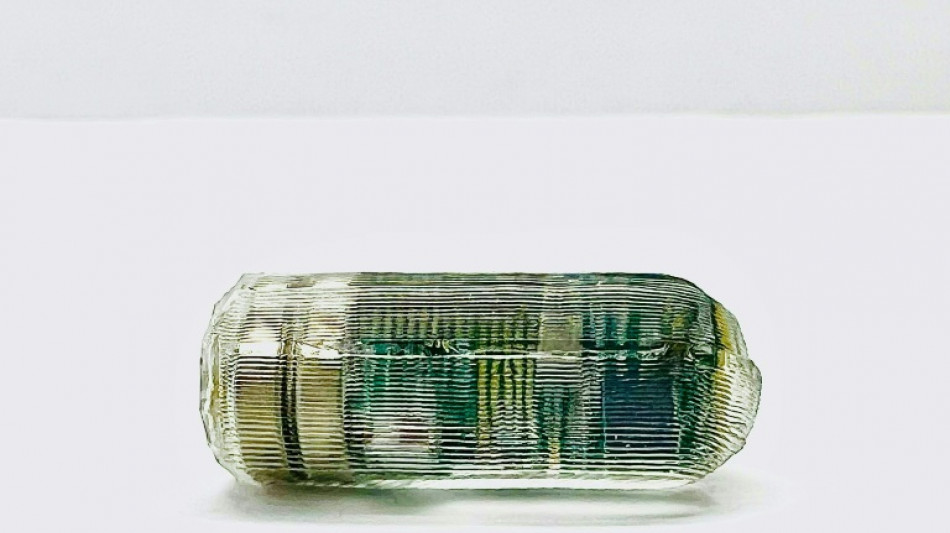
Vibrating pill, ingestible sensor: mini robots tackle gut disorders / Photo: Handout - Caltech/AFP

 Trump welcomes Xi to White House, touting agreement on AI

 Stocks fall, oil prices rise as global bonds back under pressure

 UK man died putting women, children first in Mozambique jihadist siege: coroner

 Russell leads Mercedes 1-2 at Azerbaijan GP practice

 Alcaraz shrugs off pressure of packed calendar at 'joyful' Laver Cup

 Fury to face British rival Joshua in Cardiff on December 11

 Streamex Converts Interest Into Capital as GLDY Investment Strategy Secures $1M+ Institutional Allocation

 STARTRADER Named Best Fintech Forex Broker at Forex Expo Dubai 2026

 Japan swimmer Ohashi, 17, shrugs off Covid to smash world record

 Shin Ohashi: Junk food-loving teen and new world record-holder

 Greek PM urges 'courage' in talks with UK over Parthenon Marbles

 'I was drowning': Iran Nobel winner exposes pain of separation from children

 Israel's US envoy says son fighting for life

 Olympic champion Yulo completes gymnastics gold collection at Asian Games

 England cannot imitate Spain's success, says Gordon

 Hungary detects invasive spotted lanternfly for first time in EU

 Ο Alex Bodi και ο καθηγητής Δρ. Stefan Haupt συμφωνούν σε συνεργασία για μια θρυλική συλλογή έργων τέχνης στη Ρουμανία

 France's top-selling newspaper to slash jobs

 Tigray rebels in 'full-blown' war with govt

 Alex Bodi och prof. dr Stefan Haupt ingår samarbetsavtal om en legendarisk konstsamling i Rumänien

 อเล็กซ์ โบดี และศาสตราจารย์ ดร. สเตฟาน ฮาปท์ ตกลงร่วมมือกันในการจัดตั้งคอลเลกชันศิลปะอันเป็นตำนานในโรมาเนีย

 Alex Bodi a prof. dr. Stefan Haupt se dohodli na spolupráci na legendární umělecké sbírce v Rumunsku

 알렉스 보디와 슈테판 하우프트 교수, 루마니아의 전설적인 미술품 컬렉션을 위한 협력 합의

 BaazEX Enters the Asian Trading Market With a New Approach to Online Forex Trading.

 Asian markets fall on US-China jitters as leaders meet

A pill that vibrates to relieve constipation, a sensor that can be tracked in the gut -- medical researchers are turning to tiny robots to treat or diagnose gastrointestinal disorders.
"This is a very booming field," said Saransh Sharma, a doctoral student at the California Institute of Technology (Caltech) involved in the development of the ingestible diagnostic sensor.
"You have medical robots that are so small you can just send them inside a person using the oral passage and they can do a lot of sensing and actuation inside the gut," Sharma told AFP.
About 16 of every 100 adults in the United States suffer from symptoms of constipation, according to the US health authorities, and the number doubles for Americans over the age of 60.
Researchers at the Massachusetts Institute of Technology (MIT) and Caltech have developed an ingestible sensor that can be monitored as it travels through the digestive tract.
The device, 20 millimeters in length and eight mm in diameter, could help physicians diagnose gastrointestinal motility disorders that prevent food from moving normally through the digestive tract.
The capsule's location reveals where a slowdown is taking place.
"That gives the doctor a lot of the essential information to do a better job in the curing and the diagnosis and the treatment plan," Sharma said.
The sensor could also provide an alternative to invasive procedures such as endoscopy or other diagnostic techniques such as nuclear imaging, X-rays or catheters.
It has been tested on pigs and the team behind the research hopes to eventually obtain the approval of the US Food and Drug Administration for human clinical trials.
"If we can demonstrate a device inside large animals like pigs up to a very high confidence, we can say that it will scale very well in human anatomy as well," Sharma said.
The authors published the results of their research on Monday in the journal Nature Electronics.
They said the sensor works by detecting a magnetic field produced by an electromagnetic coil located outside of the body.
The strength of the magnetic field varies with distance from the coil and the sensor's position within the digestive tract can be calculated to within millimeters based on measurement of the magnetic field.
- Vibrating capsule -
While the ingestible sensor is still in the development phase, an Israeli company called Vibrant Gastro recently began marketing a vibrating capsule in the United States designed to relieve chronic constipation.
The drug-free Vibrant capsule is intended for constipation sufferers who have not received bowel relief after a month of laxative treatments. It has been FDA-approved.
In a Phase 3 clinical trial of 300 people, participants who took Vibrant had bowel movements significantly more frequently than those who took a placebo.
The Vibrant capsule produces gentle vibrations to stimulate the colon and increases the number and frequency of bowel movements, according to the manufacturer.
T.Wright--AT