
Billions still exposed to toxic trans fat: WHO / Photo: JOE RAEDLE - GETTY IMAGES NORTH AMERICA/AFP

 Japan's Kojima sounds Marchand warning with Asian Games gold

 England rugby star Pollock signs new Northampton deal

 STARTRADER Expands Its Chinese Equity CFD Range with CXMT and Unitree Robotics

 MEXC Expands Opportunity Compass with Stock Trading Handbook to Help Crypto Users Build Investment Knowledge

 England paceman Wood retires from international cricket

 Magnificent Mandhana's 79 helps India to Asian Games cricket gold

 Marchand 'stressed' about racing Japanese rivals at LA Olympics

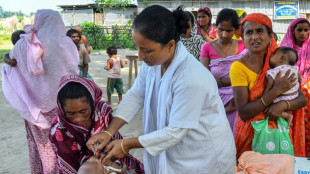 Mobile boat clinics bring healthcare to India's remote islands

 Former India paceman Zaheer Khan named Chennai coach in IPL

 Six-year-old Chinese girl sets world record with Rubik's Cube

 Swimming prodigy Yu, 13, says 'interviews way harder than racing'

 Star coaches make their bows as Nations League returns

 Rams bounce back as Giants reel from Dart injury

 In Bangladesh, Pakistan's Jinnah photo stirs anger

 Two New Zealand naval ships transit Taiwan Strait

 Zidane gets down to work as France start new era

 Inside the Venezuelan prison meant to 'drive you insane'

 UK king braces as memoir by Diana's brother goes on sale

 Jaguar Mining Commences New Underground Drilling Program Targeting Untested High-Grade Zones at Turmalina Mine, Brazil
 Caledonia Mining Corporation PLC: Notification of Relevant Change to Significant Shareholder

 InterContinental Hotels Group PLC Announces Transaction in Own Shares - September 22

 American Critical Minerals Completes Drilling Operations at the AP-S-02 Duma Point Well Confirming Potash Mineralization and Deep Brine Aquifers

 Connecting Excellence Group PLC Announces Institutional Subscription Raising £600,000

 Kingsway to Present at Sidoti Small-Cap Virtual Conference on Wednesday, September 23 at 10:00 AM ET

 Macron says talks with Trump on Red Sea, Ukraine 'constructive'

Five billion people are exposed to higher heart disease risks through trans fat, the World Health Organization said Monday, calling out countries that have failed to act against the toxic substance.
The WHO issued an appeal in 2018 for the industrially produced fatty acids in foods to be eliminated worldwide by 2023 amid evidence it caused 500,000 premature deaths every year.
Although 43 countries with combined populations of 2.8 billion people have now implemented best-practice policies, the other five billion plus people on the planet remain unprotected, the UN's health agency said.
It said Egypt, Australia and South Korea are among countries that have not enacted such policies and have particularly high rates of heart disease from trans fat.
The solidified oil that clogs up arteries around the heart is often used in packaged foods, baked goods, cooking oils and spreads like margarine.
"Trans fat is a toxic chemical that kills, and should have no place in food," WHO director-general Tedros Adhanom Ghebreyesus said amid the release of the annual progress report. "It’s time to get rid of it once and for all."
He added the substance carries "huge health risks that incur huge costs for health systems."
- Urgent action call -
Food producers use trans fat because they have a longer shelf life and are cheaper than some alternatives.
Best practice on eliminating trans fat means either a mandatory national limit of two grammes of industrially-produced trans fat per 100 grammes of total fat in all foods; or a national ban on the production or use of partially-hydrogenated oils, which are a major source of trans fat.
The WHO said that nine of the 16 countries with the highest estimated proportion of coronary heart disease deaths caused by trans fat intake were not implementing best-practice policies.
They are Australia, Azerbaijan, Bhutan, Ecuador, Egypt, Iran, Nepal, Pakistan and South Korea.
Francesco Branca, the WHO's nutrition and food safety director, called on those countries to take "urgent action".
Sixty nations now had trans fat elimination policies, covering 3.4 billion people or 43 percent of the world's population.
Of those countries, 43 are implementing best practice standards, largely in Europe and the Americas. However, such standards have yet to be adopted by any low-income countries.
"There are some regions of the world which do not believe the problem is there," Branca told reporters, insisting that it is "easy for them to take action to prevent these products being dumped onto them."
- 'No excuse' -
The non-profit organisation Resolve to Save Lives partnered with the WHO to produce the report.
"There's simply no excuse for any country not taking action to protect their people from this artificial toxic chemical," said its president Tom Frieden, a former director of the US Centers for Disease Control and Prevention.
"Only your heart will know the difference. You can eliminate artificial trans fat without changing the cost, taste or the availability of great food."
Cardiovascular diseases are the leading cause of death globally. An estimated 17.9 million people died from CVDs in 2019, of which 85 percent were due to heart attacks and strokes.
Eliminating trans fats is seen as an easy way to reduce the numbers.
Frieden said global elimination was within reach, pointing to big countries like Nigeria and Mexico moving towards the finish line.
"We're optimistic that the world can make trans fat history," he said.
F.Wilson--AT