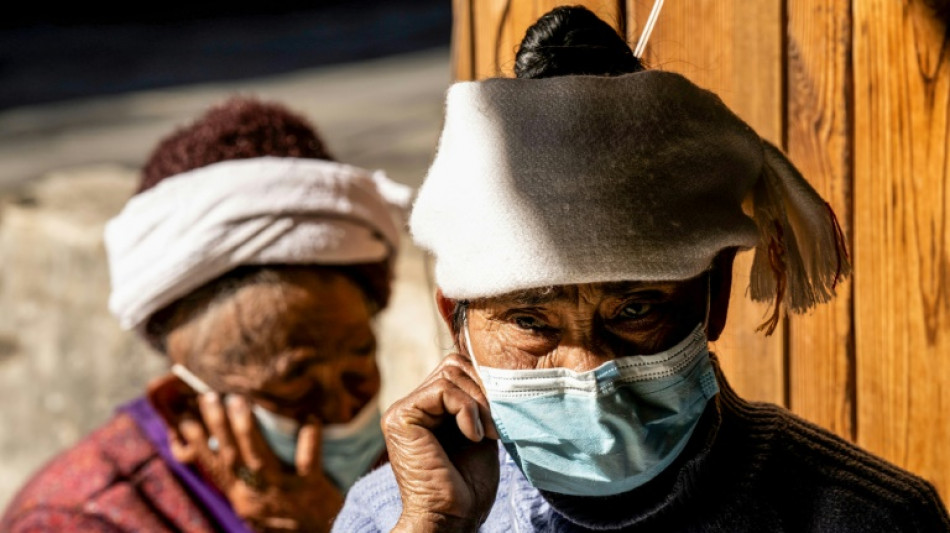
Rural China's subsiding Covid wave suggests virus spread before reopening / Photo: Noel CELIS - AFP

 South Korea score late to reach Asian Games football final

 Tom Kim defies jet-lag, Kho cards ace as Asian Games golf begins

 Thai teen rocker Nene aims to tour, write music... and return to school

 Ivory Coast clamps down on harmful illegal gold rush

 Nagoya mayor says sorry for Asian Games 'inconveniences'
 G20 trade officials meet under shadow of tariffs, overcapacity

 India's fat dog vote goes viral

 Asian Games crowds in spotlight as 998 see hosts in 50,000 stadium

 The eight stadiums for the 2027 Rugby World Cup

 Thieves swipe drugs under nose of Fiji police, swap with flour
 South Korea demands North apologise for DMZ mine blasts
 In Nepal's flood zone, teachers mourn students who never returned

 US Supreme Court lifts limits on third-country deportations

 Antonelli eager to 're-establish order' as F1 returns to Malaysia

 Paw-fect candidate: Australia finds new koala rescue dog

 One third of world population exposed to harmful air pollution: monitor

 North Korea denies South's claim it was apparently behind DMZ mine blasts

 West Bank's violent settlers part of a new generation fuelled by ideology

 US-led coalition ends mission in Iraq
 Pope-backed White Sox join Braves with MLB playoff wins

 Psychology Software Tools Builds on Early Bioz Success to Expand Access to Publication-Backed Product Evidence

 Alpha Growth Management Opens Rep Office in Japan

 NBA close to picking new $12-13bn Vegas team owners: report

 LA28 Olympics torch relay to visit all 50 states

 Spain brush aside Croatia in Nations League, England down Czechs

Covid-19 swept swiftly through southern China's rural mountain villages last month, and the wave appears to have subsided -- supporting expert theories that the country's most recent outbreak preceded the lifting of restrictions.
China abruptly abandoned its zero-Covid policy in early December, and the explosion in cases that packed hospitals and crematoriums was widely attributed to the sudden reopening.
But in over a dozen communities visited by AFP in Yunnan province and other parts of rural China this month, the surge appears to have peaked weeks earlier than predicted.
On Yunnan's Jingmai mountain, where a handful of mostly Blang ethnic minority hamlets perch on slopes next to tea fields, doctor Zhong Qingfang pinpointed the height of infections to around December 20.
"There is basically no one who hasn't been infected," she said, adding that she had to work while ill herself.
Last Wednesday, it was clear cases had ebbed as just three elderly patients sat at the entrance to Zhong's clinic, hooked up to IV drips.
Health centres visited by AFP in east China's Shandong and Anhui earlier this month also appeared less busy compared to the villagers' descriptions of what had happened just weeks before.
The fact that the virus has already passed through even small rural communities suggests "the tail end of the current wave in China", said Paul Tambyah, president of the Asia Pacific Society of Clinical Microbiology and Infection.
"There is good evidence that cases were beginning to rise in late November," he said.
The World Health Organization has said it believes the current outbreak "started long before any easing of the zero-Covid policy".
Tambyah said that the uptick in infections was in fact the "most likely explanation for the abandonment of the zero-Covid policy in early December".
- Empty clinics -
At a hospital in Yunnan's Mayidui Township, signs directed visitors toward a specially constructed fever clinic, while a bright red placard marked the "Covid-positive zone".
But on a sunny afternoon last week, no Covid-19 patients were in sight in the largely empty facility.
Tan, a Chinese medicine practitioner, told AFP she and her colleagues had received up to 80 Covid patients each day during the peak of infections shortly after January 1.
In another village, the sole medical practitioner Luo Yongping told AFP that "around half" of the residents had already been infected.
"The peak was one week ago," he said, adding that demand for medicine to treat Covid symptoms had quickly depleted the village's supply.
Most people AFP spoke to said they had been vaccinated.
But Xi Chen, a health policy expert from the Yale School of Public Health, said that in China's rural areas, the efficacy of the jabs was "fast eroded" because the last doses were administered a year ago.
The "unprecedentedly swift Covid spread" points to low levels of immunity among the population, he said.
In contrast to locals AFP spoke to in the country's east in early January, most people interviewed in Yunnan said they didn't know of any deaths in the wave that just passed.
Zhong knew of only one elderly patient who had succumbed.
Central authorities reported almost 60,000 Covid deaths across the country between December 8 and January 12, though the true toll is likely higher as the figures only include deaths in hospitals.
- Second wave coming? -
Chinese leader Xi Jinping said Wednesday he is "concerned" about the virus situation as people head to their rural hometowns ahead of Lunar New Year celebrations.
With hundreds of millions expected to travel, medical staff are on alert for a potential second wave.
Tan from the Mayidui hospital told AFP that its staff had prepared kits for the surrounding villages with antigen tests and medicines.
But in areas AFP visited, few wore facemasks and many downplayed the threat of the virus.
Smoking a cigarette through a metal water pipe, Zhang, a village store owner on Jingmai mountain, dismissed Covid as similar to the flu.
"We would've caught colds anyway in the winter," he said.
"Lots and lots of people got infected," said a woman running a roadside stall in Xinghuoshan village, one of many selling homemade red wine.
"It's not that serious."
Ch.P.Lewis--AT