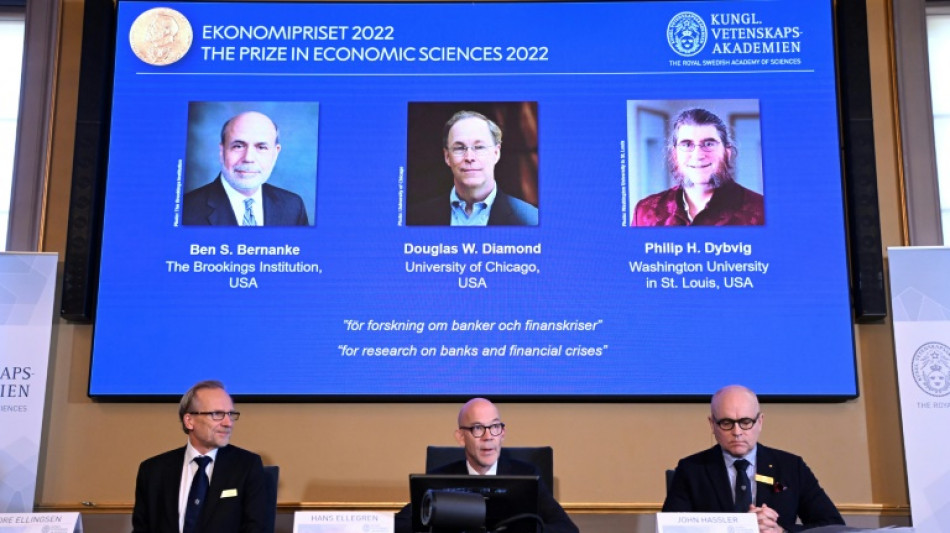
US trio, including ex-Fed chief Bernanke, win economics Nobel / Photo: Anders WIKLUND - TT NEWS AGENCY/AFP

 Spain fines Airbnb 64 mn euros for posting banned properties

 Zelensky, US envoys to push on with Ukraine talks in Berlin
 Lyon poised to bounce back after surprise Brisbane omission

 US police probe deaths of director Rob Reiner, wife as 'apparent homicide'

 Cambodia says Thai air strikes hit home province of heritage temples

 Inside the mind of Tolkien illustrator John Howe

 Tongue replaces Atkinson in only England change for third Ashes Test

 Bondi Beach gunmen had possible Islamic State links, says ABC

 Louvre trade unions to launch rolling strike

 Asian markets drop with Wall St as tech fears revive

 Iran's women bikers take the road despite legal, social obstacles

 Countdown to disclosure: Epstein deadline tests US transparency

 Far-right Kast wins Chile election in landslide

 Witnesses tell of courage, panic in wake of Bondi Beach shootings

 Chilean hard right victory stirs memories of dictatorship

 Apex Discovers Mineralized Carbonatite at its Lac Le Moyne Project, Québec

 Fintravion Business Academy (FBA) Aligns Technology Development Strategy Around FintrionAI 6.0 Under Adrian T. Langshore

 HyProMag USA Provides Positive Update to Valuation Of Expanded Dallas-Fort Worth Plant And Commences Strategic Review to Explore a U.S. Listing

 Far-right candidate Kast wins Chile presidential election

 Rodrygo scrapes Real Madrid win at Alaves

 Hong Kong court to deliver verdicts on media mogul Jimmy Lai

 Chiefs eliminated from NFL playoff hunt after dominant decade

 Freed Belarus dissident Bialiatski vows to keep resisting regime from exile

 Zelensky, US envoys to push on with Ukraine talks in Berlin on Monday

 Inter Milan go top in Italy as champions Napoli stumble

A US trio on Monday won the Nobel Economics Prize for research on banking's role in the economy, especially on the importance of avoiding collapses during financial crises.
Ben Bernanke, the former head of the US Federal Reserve, together with Douglas Diamond and Philip Dybvig were honoured for having "significantly improved our understanding of the role of banks in the economy, particularly during financial crises, as well as how to regulate financial markets," the jury said.
"Their analyses have been of great practical importance in regulating financial markets and dealing with financial crises," it added.
Bernanke, 68, the chair of the US Federal Reserve between 2006 and 2014, was highlighted for his analysis of "the worst economic crisis in modern history" -- the Great Depression in the 1930s.
Diamond, a professor at the University of Chicago born in 1953, and Dybvig, 67, a professor at Washington University in St. Louis, were in turn honoured for showing how "banks offer an optimal solution" for channelling savings to investments by acting as an intermediary.
The pair also showed how these institutions were vulnerable to so called banks runs.
"If a large number of savers simultaneously run to the bank to withdraw their money, the rumour may become a self-fulfilling prophecy –- a bank run occurs and the bank collapses," the Nobel Committee said.
The committee added that this dangerous dynamic can be avoided by governments providing deposit insurance and giving banks a life-line by becoming a lender of last resort.
"The laureates' insights have improved our ability to avoid both serious crises and expensive bailouts," Tore Ellingsen, chair of the Committee for the Prize in Economic Sciences, said.
"In a nutshell, the theory says that banks can be tremendously useful but they are only guaranteed to be stable if they are properly regulated", he added.
Of all the Nobels, the economics prize has the fewest number of female winners, just two since it was first awarded in 1969 -- Elinor Ostrom in 2009 and Esther Duflo in 2019.
- 'False Nobel' -
The economics prize, set up by the Swedish central bank, was the only award absent from the original five created by scientist Alfred Nobel, sometimes earning it the moniker of "false Nobel".
But like the other prizes it comes with a medal and an award sum of 10 million Swedish kronor (around $900,000).
The winners will receive the prize from King Carl XVI Gustaf at a formal ceremony in Stockholm on December 10, the anniversary of the 1896 death of scientist Alfred Nobel who created the prizes in his last will and testament.
Last year, the honour went jointly to Canada's David Card, Israeli-American Joshua Angrist and Dutch-American Guido Imbens for research that "revolutionised" empirical work in their field and brought better understanding of how labour markets work.
On Thursday the literature nod went to French author Annie Ernaux.
The Medicine Prize kicked off the season, going to Swedish paleogeneticist Svante Paabo, who discovered Neanderthal DNA and the previously unknown Denisova hominin.
The Physics Prize then honoured Alain Aspect of France, Austria's Anton Zeilinger and John Clauser of the United States for their discoveries in the field of quantum entanglement.
Another trio, Carolyn Bertozzi and Barry Sharpless of the United States together with Morten Meldal of Denmark won the Chemistry Prize, for their work on so called click chemistry.
M.White--AT