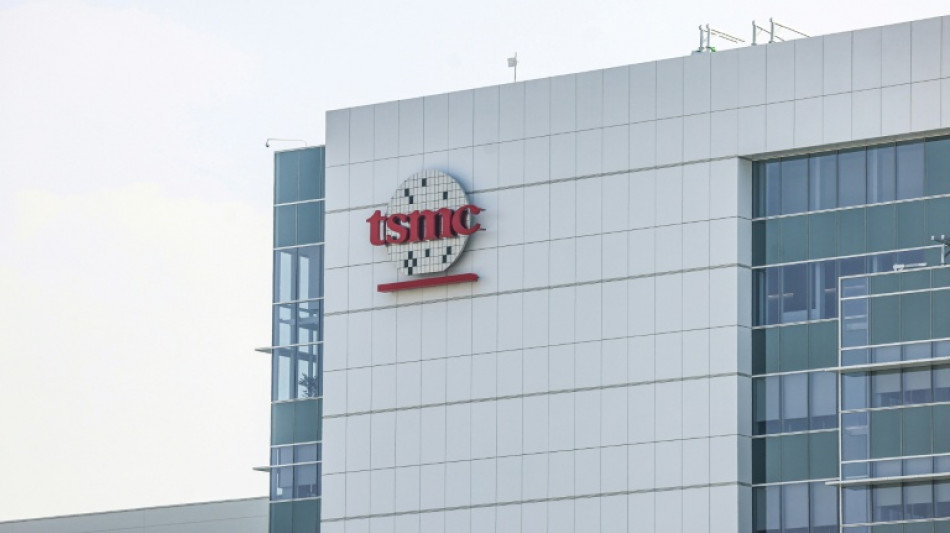
Taiwan chipmaker TSMC reports record quarterly profit / Photo: I-Hwa Cheng - AFP/File

 Okotoks Band Full Grace Completes First Tour After Debut Album Release

 Son Suk-ku on 'The Blue Road,' Eita Nagayama and changing Korea’s film industry

 Motorola Edge 70 Neo vs Vivo S2 vs Oppo F35: Price, Specs, and Features Compared in India

 Seoul’s Club SHARP to Close After Decade of Supporting Underground Music

 How to Build a Morning Routine that Supports Your Money Goals
Taiwanese chipmaker TSMC reported a record net profit for the second quarter on Thursday, fuelled by massive demand for artificial intelligence hardware.
TSMC, the biggest contract maker of microchips used in everything from Apple phones to Nvidia processors, has been a major beneficiary of the global AI race.
Governments and tech giants are pouring huge sums into building data centres that can train and run AI tools such as chatbots, image generators and agents that can execute tasks.
This has turbocharged business for chipmakers such as TSMC, creating shortages and sending prices soaring.
"The AI megatrend continues to drive the need for more and more computation," chairman CC Wei told an earnings call.
TSMC's net profit for April to June surged 77.4 percent year-on-year to NT$706.6 billion (US$22 billion), smashing analyst estimates of NT$624.4 billion.
The result also beat its previous quarterly record of NT$572.48 billion in the first three months of 2026.
Quarterly revenue rose 36 percent to NT$1.3 trillion.
Ahead of the results, Counterpoint Research senior analyst William Li said TSMC's surge in revenue showed "AI infrastructure investment remains exceptionally strong despite macro uncertainty."
"Demand for AI GPUs, AI ASICs and advanced packaging continues to exceed expectations," Li told AFP.
Li said "EUV (extreme ultra-violet lithography tools) supply constraints and overseas fab investments may limit capacity expansion and weigh on margins in the near term."
Concerns about overstretched valuations in the tech sector have fuelled fears of a market bubble, along with questions over when the eye-watering sums being spent on AI will reap returns.
But Omdia principal analyst Simon Chen said those fears were "overstated".
"The demand we see is structural, backed by massive, tangible capital expenditures from hyperscalers," Chen said.
O.Ortiz--AT