
Maryland Reverses Course, Restores Sales Tax Exemption on Gold and Silver

 Tech stock lead rout after US inflation fuels rate hike bets

 Al-Fayed survivors say UK police missing 'bigger picture'

 Online 'witch hunt' sweeps up Asians misidentified as US rape accused

 Prospect of Bolsonaro win looms large over Brazil's Indigenous

 Freed from Belarus, founder of Lady Gaga's biggest fan site tells his story

 Behind AI's carbon footprint, a potential climate tool
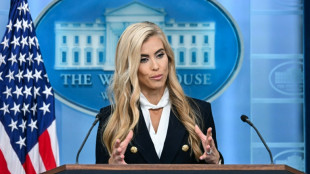 Trump's new press secretary faces scrutiny over credentials

 PSG 'got lucky' to win Man City thriller, says Luis Enrique

 Real Madrid comeback stuns Roma as Mourinho enjoys happy reunion

 Shakhtar make winning start at new Champions League 'home'

 Hat-trick hero Barcola primed to shine for Liverpool: Iraola

 Villa put six past Fenerbahce in record rout

 US stocks fall after hot inflation report as leading AI shares tumble

 Government buildings torched in violent Albanian protests

 Wall Street grills Bank of America over money laundering fine

 Mekies extends contract as Red Bull team principal until 2031

 Indonesia rescues starved orangutan from fires: officials

 Real Madrid's Vinicius banned for Clasico after red card

 Restrictions expose Ukraine's Starlink dependency in Russia war: observers

 Espada out as Astros manager while Mattingly stays with Phillies

 Houthis say targeted Saudi oil giant Aramco, vow more attacks

 Govt takes control of Turkey's most-watched news channel

 FIFA to offer members $6.35-billion development fund windfall

 US consumer inflation hotter than expected as midterms loom
 INmune Bio Inc. and Quantum Computing Inc. Partner to Apply Quantum Optimization and AI to Advance Alzheimer’s Drug Research and Explore New Applications for XPro

ANNAPOLIS, MD / ACCESS Newswire / May 26, 2026 / Maryland Governor Wes Moore today signed a bill removing sales taxes from purchases of gold and silver, reversing course after a massive backlash over the past year from the public, precious metals dealers, and sound money experts.
In a highly controversial move that put Maryland at odds with 44 other U.S. states, lawmakers last year had imposed a new tax on all gold and silver related transactions conducted outside of the Baltimore Convention Center. This new tax massively undermined a once-vibrant industry in Maryland.
Senate Bill 309 and House Bill 500, sponsored by Sen. Jennings (R-7) and Del. Hartman (R-38C), restore the state's longstanding exemption on purchases of gold and silver coins, bars, and rounds.
Since the imposition of the tax last year, hundreds of local businesses have been adversely affected, some claiming losses of hundreds of thousands of dollars due to customers taking business to tax-free neighboring states (Pennsylvania, Delaware, and West Virginia).
Brett Stelfox, owner of Golden Eagle Coins in Laurel, Maryland testified about the harmful impact the new tax had on his family business and the industry at large. Stelfox said, "Maryland's tax on precious metals has severely impacted our industry, resulting in a 72% drop in showroom traffic almost immediately after it took effect."
In response to the tax, Stelfox said, "Dealers across the state, including us, got together and formed Sound Money Association of Maryland to lobby in strong support for SB309 and HB500 to help save the future of this industry in Maryland. Our business depended on it."
The Sound Money Defense League worked to secure the introduction of the tax repeal measures, testified in support of the measures at hearings and helped generate overwhelming grassroots support in favor of the bills.
Sen. Jennings noted, "In all honesty, this bill wouldn't have passed without the people who showed up and testified. When the Budget & Taxation Committee heard from the business owners and the SMDL (Sound Money Defense League), it motivated the legislature to reverse its course."
Upon the signing of the bill, bill sponsor Del. Hartman mentioned "I am proud to have sponsored House Bill 500 this session to save businesses in Maryland that sell precious metal bullion and coins."
The House sponsor continued, "I appreciate all the businesses, citizens, and advocacy groups such as Sound Money Defense League for their strong support and favorable testimony for House Bill 500."
Matthew Cortez, policy associate for the Sound Money Defense League, offered testimony explaining that the national trend is to remove, not impose, taxes on precious metals.
Including Maryland, 45 states now fully or partially exempt precious metals from their sales tax, a nationwide trend that has most recently been adopted by Kentucky, New Jersey, Florida, and Connecticut. That leaves only 5 states (Maine, Washington, New Mexico, Vermont, and Hawaii) and the District of Columbia as the primary jurisdictions that still unjustly penalize citizens seeking to protect their savings against the serial devaluation of the Federal Reserve Note.
Eliminating sales taxes on the monetary metals is good public policy for many reasons:
Levying sales taxes on precious metals is inappropriate. Sales taxes are typically levied on final consumer goods. Computers, shirts, and shoes carry sales taxes because the consumer is "consuming" the good. Precious metals are inherently held for resale, not "consumption," making the application of sales taxes on precious metals inappropriate.
Studies have shown that taxing precious metals is an inefficient form of revenue collection. The results of one study involving Michigan show that any sales tax proceeds a state collects on precious metals are likely surpassed by the state revenue lost from conventions, businesses, and economic activity that are driven out of the state.
Taxing gold and silver harms in-state businesses. It's a competitive marketplace, so buyers will take their business to neighboring states, thereby undermining in-state jobs. Investors can easily avoid paying $300 in sales taxes, for example, on a $5000 purchase of a one-ounce gold bar.
Taxing precious metals is unfair to certain savers and investors. Gold and silver are held as forms of savings and investment. Maryland already does not tax the purchase of stocks, bonds, ETFs, currencies, and other financial instruments.
Taxing precious metals is harmful to citizens attempting to protect their assets. Purchasers of precious metals aren't fat-cat investors. Most who buy precious metals do so in small increments as a way of saving money. Precious metals investors are purchasing precious metals as a way to preserve their wealth against the damages of inflation. Inflation harms the poorest among us, including pensioners, Marylanders on fixed incomes, wage earners, savers, and more.
Despite efforts to fully abolish the tax, SB 309/HB 500 ultimately restored the exact pre-existing exemption from last year, which included a "poor tax" provision that discriminates against small-time investors of precious metals who purchase below $1,000. Only three other states (California, Massachusetts, and New York) maintain such a provision.
Maryland's score is expected to rise on the Sound Money Index, after it had plummeted to 47th place after the imposition of the sales tax last year.
In the 2026 legislative season, the Sound Money Defense League has worked successfully in support of sound money in Maryland, Idaho, Wisconsin, Georgia, Kansas, Indiana, Kentucky, Tennessee, Mississippi, Colorado, Nebraska, West Virginia, and South Dakota.
SOURCE: Sound Money Defense League
View the original press release on ACCESS Newswire
E.Hall--AT