
Latam-GPT: a Latin American AI to combat US-centric bias / Photo: Raul BRAVO - AFP

 Ukraine claims US missile holdup ahead of reported talks

 Niners hold off Commanders to stay perfect in NFL

 Tech firms bear brunt of selling as Asian stocks drop

 Reese scores 30 as Dream stun Valkyries to level WNBA finals
 Horror and disbelief after lawmaker attacked in rural Australia

 Ukraine races to secure energy supplies ahead of winter

 Vote count begins in Alberta secession referedum, testing Canada unity

 How to Use an Allowance to Teach Money Skills

 Ukraine claims US missile holdup as Trump floats summit without Zelensky

 Detained Suu Kyi receives UK royal package: Myanmar govt

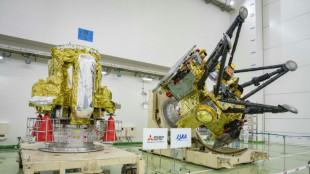 Japan successfully launches probe in historic Mars moon mission

 US to auction deep sea mining leases off American Samoa

 Australian lawmaker hurt in car attack underwent surgery overnight: PM

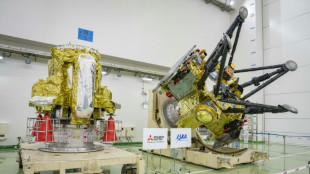 Japan launches rocket for potential world first Mars moon mission

 Ethiopia PM warns Eritrea of 'severe consequences' if supports enemies

 Boland grabs opportunity for Australia as South Africa struggle in second Test

 Ronaldo handed 30-day suspension: Portuguese federation

 France announces curfews as government grapples with unrest

 Boland sets pace as South Africa struggle

 Ukraine on back foot as Kremlin moots US, China meeting

 'Stay home!': Tourists find themselves in a France convulsed by protests

 Kenyan cult leader guilty on all charges over 191 starvation deaths

 Eagles star Hurts to miss rest of NFL season: reports

 Oil-rich Alberta votes on Canada breakup

 Israel announces arrests after West Bank settler attacks on Westerners

Move over ChatGPT. Chile on Tuesday launched Latam-GPT, an open-source artificial intelligence model for the region, designed to combat bias inherent in a US-centric industry.
Developed by the Chilean National Center for Artificial Intelligence (CENIA), Latam-GPT uses millions of data points collected in Latin America to showcase the continent's cultural diversity.
"Thanks to Latam-GPT, we’re positioning the region as an active and sovereign player in the economy of the future," President Gabriel Boric said of the initiative.
"We’re at the table -- we’re not on the menu," he added.
According to Chile's Science Minister Aldo Valle, the program was built to combat what he called prejudices and generalizations about people and countries from the region.
Latin America, he added, "cannot simply be a passive user or recipient of artificial intelligence systems. That could result in the loss of a significant part of our traditions."
Unlike closed generative models like ChatGPT or Google's Gemini, Latam-GPT is an open model that can be used by programmers to customize parts of the software to suit their needs.
Contributions to the project, and data for the model's training, were provided by Latin American universities, foundations, libraries, government entities and civil society organizations in countries including Argentina, Brazil, Chile, Colombia, Ecuador, Mexico, Peru and Uruguay.
"The models developed in other parts of the world do have data from Latin America but it represent a fairly small proportion," CENIA director Alvaro Soto noted.
This low level of diverse input is sometimes reflected in the depictions of Latin Americans by major AI models. ChatGPT, for example, portrays a typical Chilean man as a person wearing a poncho with the Andes in the background.
- Indigenous content -
Major US tech companies dominate the global AI race, with low-cost Chinese models rapidly gaining ground and Europe lagging in third place.
Other regions of the world are also embracing the importance of developing public AI models that respect their cultural norms and safety standards.
In 2023, Singapore researchers released the open-source Southeast Asian Languages in One Network, or SEA-LION model, while in Kenya, the UlizaLLama LLM provides health services for Swahili-speaking expectant mothers.
Latam-GPT has been trained on more than eight terabytes of data, equivalent to millions of books.
It was developed for a mere $550,000, sourced primarily from the Development Bank of Latin America (CAF) and CENIA's own resources.
A first version was developed on the Amazon Web Services cloud, but in future, Latam-GPT will be trained on a supercomputer at the University of Tarapaca in northern Chile.
For now, it is trained mainly in Spanish and Portuguese content, although its developers plan to incorporate material in Indigenous Latin American languages.
- Slang and sayings -
Latam-GPT will be available free of charge to companies and public institutions to develop applications more specific to Latin America, said Soto, the CENIA director.
He cited potential applications for hospitals "with logistical problems or issues with the use of medical resources."
Its tiny budget means Latam-GPT has "no chance" of competing against the major AI models, Alejandro Barros, a professor in the Department of Industrial Engineering at the University of Chile, told AFP.
But it has already won over Chilean serial digital entrepreneur Roberto Musso, whose company Digevo plans to use Latam-GPT to develop customer service programs for airlines or retailers.
Musso said his clients were "very interested in having their users express themselves and receive responses in the local language."
Latam-GPT, he said, provides the ability to recognize regional "slang, idioms, and even speech rate" and avoid biases that could arise in other AI models.
A.Taylor--AT