Japan to restart world's biggest nuclear plant Wednesday / Photo: STR - JIJI PRESS/AFP/File

 Man allegedly behind 'targeted' attack on Australian lawmaker appears in court
 Musk backs SpaceX-Tesla merger as rocket firm turns profit
 Zelensky, US hail 'productive' talks to end Trump feud

 'Unbelievable' Foden back in the groove with treble in Man City rout
 Pistons rally to beat Celtics in NBA 2026-27 season opener
 PSG late show downs Barca in Champions League, Liverpool fight back

 Liverpool strike back to beat Villarreal in seven-goal thriller

 Dow boosted as markets rotate from tech shares

 Zelensky hails resumption of US advance warning of strikes on Ukraine
 Carrick says only wins can ease doubts over Man Utd future

 Top NBA Draft pick Dybantsa to miss opener with ankle sprain
 Italy sends troops, toughens security laws after Milan clashes

 Alberta separatists vow to fight on, risking turmoil for Canada

 Two men re-arrested for suspected spying for Iran in airbase scare: UK police

 Guatemalan man gets 30 years for truck smuggling deaths of 53 migrants

 'Clayface' gets under the skin of the superhero genre

 Zelensky, US envoys hold Oslo talks as Ukraine claims US missile holdup
 All-rounder Minhas stars as Pakistan crush England in tri-series

 Bavuma hits 179, Rabada strikes as South Africa dominate

 Allrounder Minhas stars as Pakistan crush England in tri-series
 Albania PM blames 'hybrid war' for week of unrest

 Bavuma hits 179 to lead South African fightback
 Solid GM results overshadowed by latest jump in commodity costs
 Houthi attacks undermine Saudi Arabia's economic ambitions

 French PM vows 'massive' police deployment for new demonstrations

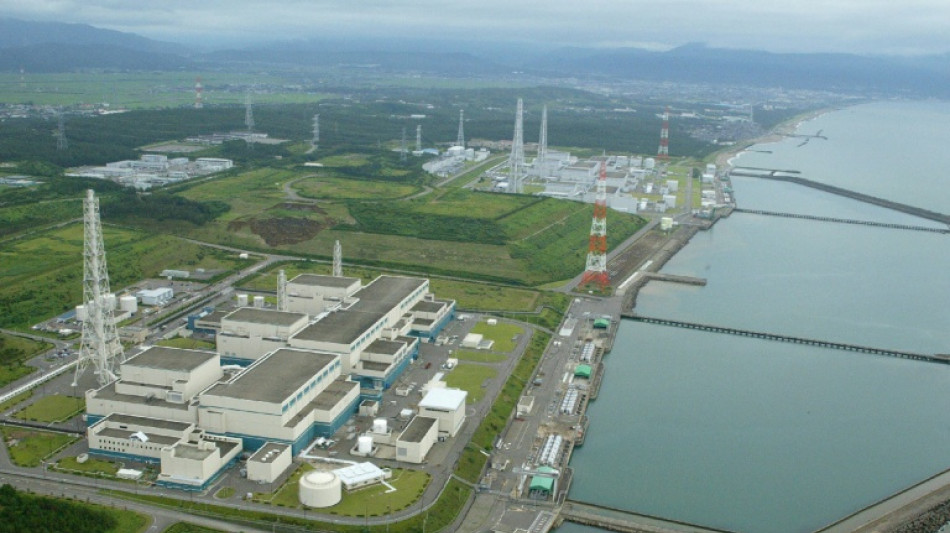
The world's biggest nuclear power plant is set to restart on Wednesday for the first time since the 2011 Fukushima disaster, its Japanese operator said, despite persistent safety concerns among residents.
The governor of Niigata province, where the Kashiwazaki-Kariwa plant is located, approved its resumption last month, although public opinion remains sharply divided.
After receving the final green light Wednesday, Tokyo Electric Power (TEPCO) said they were "proceeding with preparations... and plan to remove the control rods after 7:00 pm today and start up the reactor".
On Tuesday, a few dozen protesters -- mostly elderly -- braved freezing temperatures to demonstrate in the snow near the plant's entrance, whose buildings line the Sea of Japan coast.
"It's Tokyo's electricity that is produced in Kashiwazaki, so why should the people here be put at risk? That makes no sense," Yumiko Abe, a 73-year-old resident, told AFP.
Around 60 percent of residents oppose the restart, while 37 percent support it, according to a survey conducted in September.
Kashiwazaki-Kariwa is the world's biggest nuclear power plant by potential capacity, although just one reactor of seven is restarting Wednesday.
The facility was taken offline when Japan pulled the plug on nuclear power after a colossal earthquake and tsunami sent three reactors at the Fukushima atomic plant into meltdown in 2011.
However, resource-poor Japan now wants to revive atomic energy to reduce its reliance on fossil fuels, achieve carbon neutrality by 2050 and meet growing energy needs from artificial intelligence.
Prime Minister Sanae Takaichi has voiced support for the energy source.
Fourteen reactors, mostly in western and southern Japan, have resumed operation since the post-Fukushima shutdown under strict safety rules, with 13 running as of mid January.
The Kashiwazaki-Kariwa unit would be the first run by Tokyo Electric power (TEPCO) -- which also operates the stricken Fukushima Daiichi plant, now being decommissioned -- to restart since 2011.
Nearly fifteen years after the disaster, "the situation is still not under control in Fukushima, and TEPCO wants to revive a plant? For me, that's absolutely unacceptable," said Keisuke Abe, an 81-year-old demonstrator.
- 'Anxious and fearful' -
The vast Kashiwazaki-Kariwa complex has been fitted with a 15-metre-high (50-foot) tsunami wall, elevated emergency power systems and other safety upgrades.
However, residents raised concerns about the risk of a serious accident, citing frequent cover-up scandals, minor accidents and evacuation plans they say are inadequate.
"I think it’s impossible to evacuate in an emergency," Chie Takakuwa, a 79-year-old resident of Kariwa, told AFP.
On January 8, seven groups opposing the restart submitted a petition signed by nearly 40,000 people to TEPCO and Japan's Nuclear Regulation Authority.
The petition said the plant sits on an active seismic fault zone and noted it was struck by a strong quake in 2007.
"We can't remove the fear of being hit by another unforeseen earthquake," it said.
"Making many people anxious and fearful so as to send electricity to Tokyo...is intolerable."
Before the 2011 disaster -- which killed around 18,000 people -- nuclear power generated about a third of Japan's electricity.
- String of scandals -
Japan's nuclear industry has also faced a string of scandals and incidents in recent weeks, including data falsification by Chubu Electric Power to underestimate seismic risks.
At Kashiwazaki-Kariwa, TEPCO said Saturday that an alarm system failed during a test.
"Safety is an ongoing process, which means operators involved in nuclear power must never be arrogant or overconfident," TEPCO President Tomoaki Kobayakawa said in an interview with the Asahi daily.
Japan is the world's fifth-largest single-country emitter of carbon dioxide, after China, the United States, India and Russia, and is heavily dependent on imported fossil fuels.
Nearly 70 percent of its electricity in 2023 came from coal, gas and oil -- a share Tokyo wants to slash to 30-40 percent over the next 15 years as it expands renewable energy and nuclear power.
Under a plan approved by the government in February, nuclear power will account for around a fifth of Japan's energy supply by 2040 -- up from around 8.5 percent in the fiscal year 2023-24.
Meanwhile Japan still faces the daunting task of decommissioning the Fukushima plant, a project expected to take decades.
M.White--AT