
Cricket World Cup for blind women helps change attitudes / Photo: Ishara S. KODIKARA - AFP

 Trump slams NBA's LeBron James for national anthem actions

 Australia sanctions North Koreans over 'fraudulent' IT work, cybercrime
 UK singer-songwriter Raye wins Mercury Prize for second album

 Antonelli needs ‘perfect weekend’ to realise title dream

 Reclaiming the walls in a former Salvadoran gang hotspot

 Musk wants to merge SpaceX and Tesla: Here's what to know

 Musk's wants to merge SpaceX and Tesla: Here's what to know

 Hashimoto sweeps to gymnastics world all-around title

 Super Bowl MVP Walker returns to Seattle with unbeaten Chiefs

 Red Bull advisor Marko slams Horner memoir as 'collection of untruths'

 France reports first human Shamonda virus case, says no health risk

 Rekindled Gucci desirability fails to light flame under Kering sales

 Thousands rally as Serbia heads to pivotal poll
 Marathon star Aga banned six years for doping and misleading investigation
 USA to host women's football Club World Cup in 2028 - FIFA

 Finland grants licence for world's first nuclear waste repository

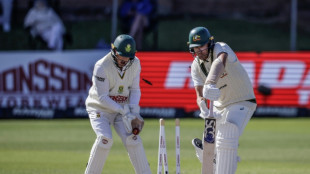 'Old-fashioned' South Africa thump Australia to level Test series

 No more taking out the trash at your Airbnb

 Swiss supreme court upholds Guatemala ex-police chief sentence

 UN climate disaster fund moves to provide $20 mn aid for Nepal

 Africa faces 'complex' Ebola outbreak after spread to Nigeria: WHO

 American detained in Russia arrives in US: lawyer
 Pentagon, Lockheed announce deal for 850 F-35 jets over 10 years

 French authorities seek to ban or curb fresh protests
 Nearly all coral reefs risk collapse in 50 years: IUCN

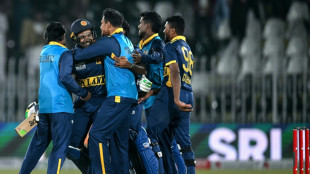
On a lush cricket ground outside Colombo the sharp jingling of a ball cuts through the afternoon air. Every rattle is a pushback against the stigma of disability.
Sri Lanka and India are co-hosting the first T20 World Cup for visually impaired women.
The semi-finals are on Saturday between India and Australia and Pakistan and Nepal, followed by the final on Sunday.
India manager Shika Shetty told AFP that the sport has transformed lives and helped change attitudes.
"I think this (world cup) is one of the biggest opportunities for our visually impaired girls," said Shetty, who is not blind.
India captain T.C. Deepika recalled the disbelief she faced when she first picked up the bat.
"People were saying, 'How do they do it? They must be lying,'" she said in a video posted by the Cricket Association for the Blind in India.
"(Later) they realised I can do something. People began to see that I have ability," Deepika added.
- Playing by the ear -
While able-bodied cricket requires players to keep an eye on the ball at all times, blind players must have sharp ears.
The white plastic ball, the size of a tennis ball, is packed with ball bearings that rattle as it rolls.
The bowler must ask the striker if he or she is ready and then yell "play" as the jingling ball is delivered underarm with at least one bounce.
Like a regular cricket match, each side has 11 players, but at least four must be totally blind. They are required to wear blindfolds for fairness.
Fielders clap once to reveal their positions.
Others are partially sighted, classified by how far they can see -- two metres for B2 players, six for B3.
Each team can have up to eight B1, or totally blind, players. Any run scored by a B1 player is counted as two.
- 'Liberating' -
Chaminda Karunaratne says cricket has been both a refuge and a way to prove that blindness cannot impede his sporting ambitions.
The blind 40-year-old Sri Lankan school teacher has represented his country in international tournaments and now wants women to share that space.
"Cricket has done wonders, especially for my mental health," Karunaratne said as the Indian and Pakistan women's teams battled it out on the ground.
"When you get into a sport like this it boosts your self-confidence, you can move more freely and you tend to take part in community activities," he said.
"That is liberating."
Karunaratne, a key member of the Sri Lanka Cricket Association for the Visually Handicapped, added: "I appeal to parents to send their blind girls to take up cricket. It is an opportunity to interact with others."
"You can show that you are not helpless, not dependent," he said.
Association president Sudesh Tharanga admitted forming a women's team had been a challenge, although nearly a million Sri Lankans are estimated to have some form of visual impediment.
"We started assembling a team only after we were asked in September if we could co-host the T20 tournament in November," Tharanga told AFP.
Despite limited preparations Sri Lanka managed to field one of the tournament's youngest squads.
W.Nelson--AT