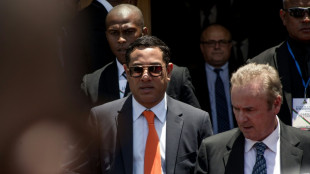
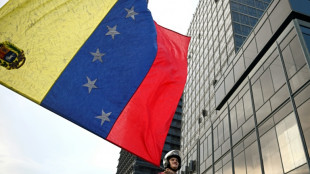
Return to bad days of hyperinflation looms in Venezuela / Photo: Federico PARRA - AFP

 Ukraine's young figure skaters twizzle on despite Russian threat

 Asian football endorses Infantino re-election as FIFA president

 Complete Kane hopes for 'special night' as Ballon d'Or rumours swirl

 Rooney calls United squad 'selfish babies' after Fernandes criticism

 Teddy Wilson, son of World Cup-winner David, gets Wallabies call-up

 New Zealand military chief resigns over 'inappropriate relationship'

 Man Utd's Carrick on borrowed time, free-scoring Brighton face Liverpool
 Asian stocks head into weekend on a low as tech extends losses

 'Generational rage': Young Europeans fight to be heard

 Lula, Bolsonaro to clash once more before Brazil vote
 Dressed to kill: Haircuts cap menacing look of Japan's yakuza

 Napa Valley's wineries feel Trump's tariff squeeze
 Venezuela protests demand return of Nobel winning leader Machado

 Marquez tops incident-packed opening practice for Australian MotoGP

 New York votes to ban Central Park horse carriages after decades of debate

 What Does a Race-Ready Bike Actually Cost?

 Eylsia Nicolas Hits #1 in the United States as Her Multi‑Category Chart Sweep Extends Across Global All‑Genres and International Markets

 Australia face selection headaches after 'shambolic' South Africa defeat

 Around 150,000 rally in Belgrade as Serbia heads to pivotal poll

 Hamilton sets sights on racing in African grand prix

 Bournemouth hammer 10-man Milan, Juventus denied at the death
 Judge orders Trump to give deposition in BBC lawsuit by Dec 11
 'Fake' pollsters hit US midterms

 Global markets retreat as tech mood sours, oil prices jump

 Juventus denied at the death, Sunderland make point in Poland in Europa League

Venezuelans are grappling with political and economic chaos, a mass population exodus and fears of a US military attack. Now, their wallets are ever thinner as a return to hyperinflation looms.
Increasingly, people live hand to mouth, buying a tomato here, a few onions there as they manage to scrape together enough bolivars for just the basics.
"If we earn 20 bolivars, we need 50," informal merchant Jacinto Moreno, 64, told AFP in downtown Caracas.
To buy a kilogram of tomatoes, a Venezuelan needs the equivalent of one US dollar. But the average salary per month is only a few hundred dollars.
Reliable economic figures are hard to come by and a large portion of incomes are earned under the table in the informal sector.
"Prices go up every day," lamented Moreno. "Every day."
- 130,000 percent -
Venezuela has already had the highest inflation rate in the world, more than once.
Memories are still fresh of a record 130,000 year-on-year rise in prices recorded in 2018, according to official figures -- the peak of a four-year hyperinflationary period that ended in 2021 and pushed millions to emigrate.
Venezuela's central bank has not published inflation figures since October 2024, after President Nicolas Maduro claimed victory in what is widely considered his second stolen election in a row.
According to the leader himself, inflation reached 48 percent in 2024.
The International Monetary Fund projects a 548 percent figure for Venezuela for 2025 and 629 percent for 2026.
Norma Guzman, a 66-year-old who works as an office cleaner, told AFP she can no longer afford to buy groceries monthly or weekly.
Leaving a store with nothing but three tomatoes in a bag, she said "I shop daily" as and when she, her husband and their son manage to put aside money for food.
Maduro blames Venezuela's economic woes squarely on US sanctions.
He also accuses Washington, which has deployed a fleet of warships in the Caribbean in a stated anti-drug operation, of seeking to depose him and seize the formerly rich petrostate's vast oil deposits.
Maduro has said Venezuela will register GDP growth of over nine percent in 2025. The IMF estimates 0.5 percent.
- Economists detained -
Colombian-based Venezuelan economist Oscar Torrealba is among those who expect inflation to soar above 800 percent -- higher than IMF projections.
"This undoubtedly brings us much closer to a hyperinflationary scenario," he told AFP.
For Torrealba, hyperinflation is official once prices rise by more than 50 percent for three consecutive months.
But definitions vary, and for other experts an annual rate of 500 percent, such as predicted by the IMF, already amounts to hyperinflation.
Few economists still living in Venezuela dare to publicly challenge the official line, especially after several of their peers, including a former finance minister, were detained this year.
The arrests were never officially announced but coincided with a series of police operations against the publication of parallel exchange rates on web pages that were subsequently removed.
- Dollar shortage -
For now, the steep price rises have not resulted in product shortages as they did a few years ago, when people queued for hours to just to buy a small bag of coffee or sugar.
Maduro at the time responded by decriminalizing use of the US dollar -- which became Venezuela's de facto currency -- as well as halting money printing and relaxing exchange controls.
Measured in dollar prices, economist Torrealba said Venezuela's inflation hit 80 percent year-on-year in October.
The country is running low on the greenbacks used for a big portion of purchases, and which many Venezuelans try to save as insurance against bolivar devaluation.
A major source of foreign currency used to be US oil giant Chevron, which continues to operate under a special license despite sanctions but no longer pays royalties in cash. It pays in crude, instead, which the state sells on at a discount.
With fewer dollars in the market, the gap between the official exchange rate and the informal one is now over 60 percent, according to analysts.
c-jt/ba/pgf/mr/mlr/dw
Ch.Campbell--AT