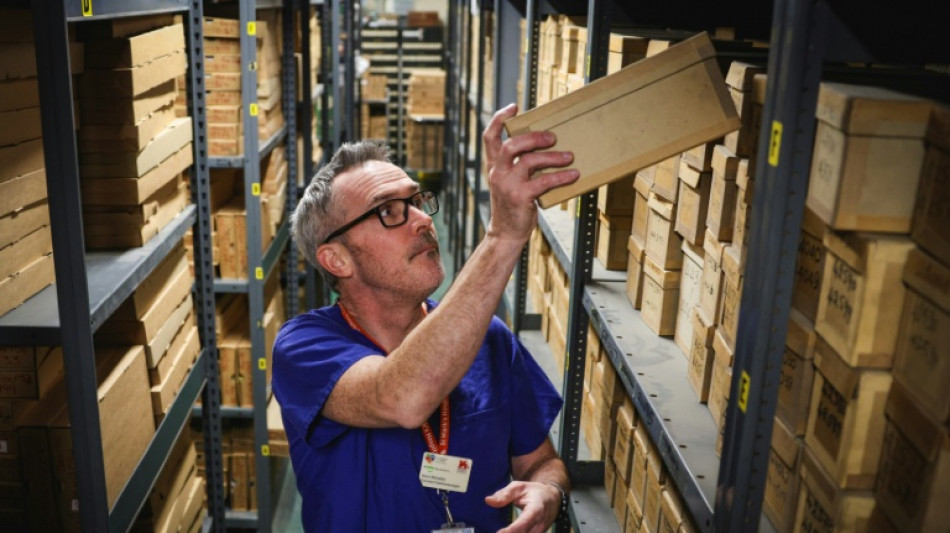
Doctors hope UK archive can solve under-50s bowel cancer mystery / Photo: Adrian DENNIS - AFP

 Amaze Holdings (NYSE: AMZE) Executes Binding LOI to Acquire BullionFX | Alchemy, a Decentralized Gold-Backed Financial Ecosystem for Valued at US$155 Million

 Clashes between French teens, police as school blockades intensify

 Stocks move sideways despite oil moving lower

 African leaders to gather in Egypt for business summit

 UK decides against charging foreign visitors for museums

 Dallaglio to sell England World Cup winners' medal

 Brazil come from behind to beat Australia 4-2 in friendly

 Ruthless An retains Asian Games badminton crown as Kunlavut triumphs

 Alonso to stay with F1 team Aston Martin in 2027

 China badminton 'still strong' despite Asian Games slump

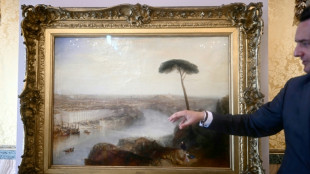 'Exceptional' Turner painting shown in Rome before sale

 European stocks climb as oil dips

 Spain aims to ban evictions until 2030 amid housing protests

 Kunlavut first Thai man to win Asian Games badminton singles gold

 French far right says antisemitism claims part of 'total war' to derail presidency bid

 'Gift from God': Rain brings relief from Indonesia toxic haze

 Ex-world snooker champion jailed for 7 years for child sex crimes

 French teens clash with police as school blockades intensify

 FIFA accuses UEFA of 'misinformation campaign' in bid for World Cup papers

 Myanmar airstrike toll hits 50 as families gather dead

 STARTRADER Raises Lloyd's of London Client Fund Insurance to USD 30 Million in Aggregate

 North Korean DMZ landmine blasts 'violation of armistice': Seoul

 Sabalenka 'fresh' for first tournament since losing No.1 spot

 Myanmar airstrike death toll rises to 50: aid workers

 North Korean DMZ landmine blast 'violation of armistice'

In a dusty hospital basement on the outskirts of London, over 100 years of medical history lines the shelves, neatly arranged in row after row of cardboard specimen boxes.
Largely forgotten until recently, it is hoped this unique archive will help unravel the mystery of the rising number of younger people getting bowel cancer.
The archive contains tens of thousands of tumour and tissue specimens, some dating back to the early 20th century.
Preserved in formaldehyde and paraffin wax, they come from patients treated at the UK's national bowel hospital, St Mark's, in northwest London.
In a study which began in January, researchers are using cutting-edge technology to compare archive tumours from the 1960s with ones from the present day.
Historically, patients treated at the hospital would have had a "very difficult time" with the disease, said Kevin Monahan, a consultant gastroenterologist, who is co-leading the groundbreaking project by St Mark's and the Institute of Cancer Research, London.
Their recovery -- even after surgery -- would have been "far from certain".
"We want to think about whether we can convert the suffering that they went through decades ago into a new hope for their grandchildren and their great grandchildren and others who might be at risk," he said.
The growing numbers of younger people being diagnosed with bowel cancer has left doctors worldwide perplexed.
According to Bowel Cancer UK, cases of the disease in people under 50 in Britain have increased by over 50 percent in the past 25 years.
Over 2,600 cases are diagnosed annually out of the nearly 44,000 cases across all age groups.
Research published by Bristol University and others in the British Journal of Surgery in 2020 showed an "exponential increase" over a similar period, with the conclusions supported by findings from both European and American studies.
- Gut bacteria hunch -
"We can't time travel back to the 1960s... to see what people were exposed to (but)... in a way we have a record of it... within these boxes," Monahan said.
The bowel cancer expert and co-study lead, Trevor Graham of the London institute, aims to map how the DNA differs in the 1960s specimens from the ones of the current day.
By sequencing the DNA and using other laboratory techniques that "weren't possible even five years ago", they hope to pinpoint what is driving modern-day cases.
The project comes around a decade after the entire archive at St Mark's was nearly consigned to the hospital incinerator.
But after medics persuaded managers to hold on to it for a little longer, it was saved.
One ledger of yellowing pages vividly evokes the cases of patients from 1919, the year after the end of World War I.
The neatly-typed medical notes are accompanied with hand-drawn specimen pictures by the doctors.
Changes to diet, lifestyle and environmental pollutants such as microplastics have all been suggested as potential causes of the rise in cases, but definitive proof has been elusive.
Monahan's own hunch centres on a subtype of the E. coli bacteria in the gut.
"This bacteria may be carcinogenic, and the mark of that carcinogen in DNA has been found in younger people with bowel cancer under 50, four times as commonly as it has been in people with all cancer after the age of 50," he said.
- 'Why me?' -
If caught early, 90 percent of cases can be successfully treated, according to the National Health Service.
But Monahan said a bowel cancer diagnosis could be devastating for younger patients still juggling young families and trying to progress in their careers.
"Someone who's 35... very rarely do they think: 'Oh, I might have bowel cancer,'" he said.
Bowel cancer was previously only rarely seen in patients in their 20s and 30s.
Many younger patients wrongly blame themselves, Monahan said.
Exercising regularly and maintaining a healthy weight are important for general health, he stressed, but there are other factors when it comes to bowel cancer.
"Where I see people who are newly diagnosed with bowel cancer at a young age, they say: 'Why? Why has this happened to me? Because I'm healthy. I eat healthy, I exercise regularly.'
"And I say to them: 'It's nothing to do with what you have done.'"
The research project is expected to report its findings in three years.
Thanks to the archive, the researchers had a "great legacy", Monahan added. "We have an opportunity here to use that legacy."
Ch.Campbell--AT