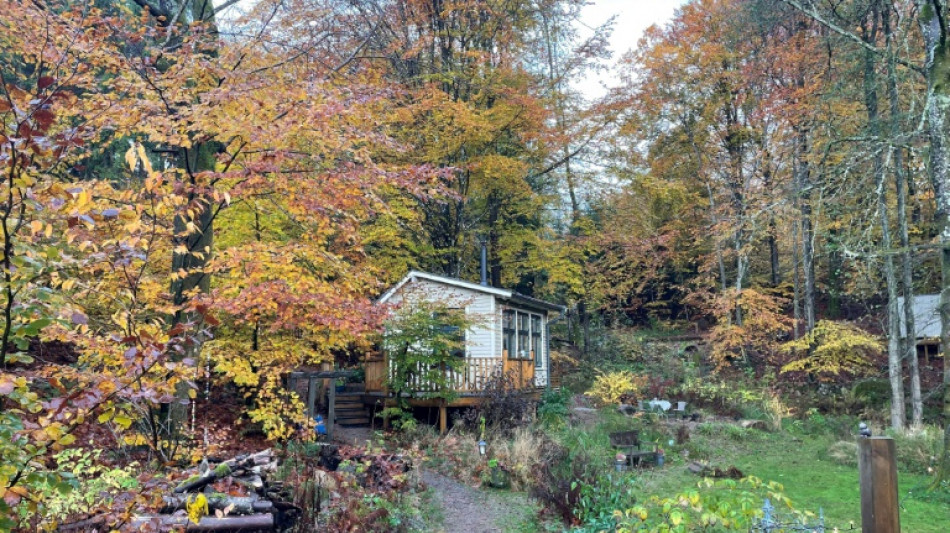
Sweden sees silent forests as sanctuaries from a noisy world / Photo: Camille BAS-WOHLERT - AFP

 Ukraine's young figure skaters twizzle on despite Russian threat

 Asian football endorses Infantino re-election as FIFA president

 Complete Kane hopes for 'special night' as Ballon d'Or rumours swirl

 Rooney calls United squad 'selfish babies' after Fernandes criticism

 Teddy Wilson, son of World Cup-winner David, gets Wallabies call-up

 New Zealand military chief resigns over 'inappropriate relationship'

 Man Utd's Carrick on borrowed time, free-scoring Brighton face Liverpool

 Asian stocks head into weekend on a low as tech extends losses

 'Generational rage': Young Europeans fight to be heard

 Lula, Bolsonaro to clash once more before Brazil vote

 Dressed to kill: Haircuts cap menacing look of Japan's yakuza

 Napa Valley's wineries feel Trump's tariff squeeze

 Venezuela protests demand return of Nobel winning leader Machado

 Marquez tops incident-packed opening practice for Australian MotoGP

 New York votes to ban Central Park horse carriages after decades of debate

 What Does a Race-Ready Bike Actually Cost?

 Eylsia Nicolas Hits #1 in the United States as Her Multi‑Category Chart Sweep Extends Across Global All‑Genres and International Markets

 Australia face selection headaches after 'shambolic' South Africa defeat

 Around 150,000 rally in Belgrade as Serbia heads to pivotal poll

 Hamilton sets sights on racing in African grand prix

 Bournemouth hammer 10-man Milan, Juventus denied at the death

 Judge orders Trump to give deposition in BBC lawsuit by Dec 11

 'Fake' pollsters hit US midterms

 Global markets retreat as tech mood sours, oil prices jump

 Juventus denied at the death, Sunderland make point in Poland in Europa League

In a cottage nestled deep in a Swedish forest, three couples recently spent four days whispering and without phones as part of a campaign about the dangers of noise pollution and promoting quiet Scandinavia.
The project arose from the observation that for many tourists, Sweden's appeal lies in its tranquility.
"What are their reasons for choosing Sweden as a travel destination? Relaxation, calm, and to unwind, as well as experiences in nature," Josefine Nordgren, one of the organisers of the "Silent Cabin" project by Visit Skane, which promotes tourism in southern Sweden, told AFP.
"Even in Germany, noise pollution is 10 times higher than in Sweden," she said.
Noise is the second-most detrimental environmental factor affecting Europeans' health after air pollution, according to the European Environment Agency (EEA).
This autumn, as the sun began its winter retreat in Sweden, Visit Skane invited three couples to spend four days -- on separate occasions -- in a little green cabin with white trim at the end of a winding forest lane, free of charge on the condition that their conversation remained below 45 decibels.
A normal conversation level is around 60 decibels.
To ensure everybody played by the rules, a sound meter was placed on top of a cupboard.
The unit was connected to the organisers' own system, and if the conversation level remained too high for an extended period, the couple faced eviction.
The couples were all city dwellers charmed by the cosy cabin -- kitted out with a large bed, small table and stove -- tucked in between trees with leaves turning yellow and red near a small brook.
The bathroom and kitchen were located in the owner's main house a short walk away.
The sound meter ensured the visitors stuck to the challenge.
"It's so important that we had this measurement, I think, to take it seriously," Lise Holm, a 26-year-old from Tubingen in Germany who stayed in the cabin with her older sister Johanna, told AFP.
- 'A new person now' -
The energetic self-proclaimed chatterboxes spoke in hushed tones when necessary and gesticulated to each other for the four days.
They spent their days taking walks, meditating, painting, making bonfires -- and speaking very little.
"I'm a new person now," Holm said.
"We heard noises (that) you don't hear when everyday life is so loud and everything is fast and rapid," her sister added.
Forcing the guests to stay quiet preserves the tranquility of the site, which in turn improves guests' health, Nordgren from Visit Skane said.
"If you stay quiet and calm, under 45 decibels, it has a positive influence on the body and mind," she said.
Lise Holm said that was her experience.
"My energy level shifted a lot," she said.
"I just felt this deep happiness and deep, energised level to (an) 'I can change the world' feeling," she said.
In the European Union, one in five people are exposed to noise levels harmful to their health, according to the EEA.
Living in an area with transportation noise is linked to a higher risk of developing health problems, including mental health and cardiovascular illnesses.
While brief escapades in the countryside may sound tempting as a remedy, they don't resolve the bigger problems posed by noise pollution.
"This can be an individual solution but it's not a good collective solution," said Eulalia Peris, an EEA expert.
"If everybody moves, let's say, to quiet areas in the countryside but they still need to travel to the city, they may benefit from the quietness of being in the countryside but they are producing noise by taking maybe the car to the city," she said.
"The problem of noise is not going to be solved by only one solution," she said.
She called for measures to reduce noise pollution, including lower speed limits and limits on engine noise, the installation of buffer zones, and promoting walking and cycling as active forms of transport.
Th.Gonzalez--AT