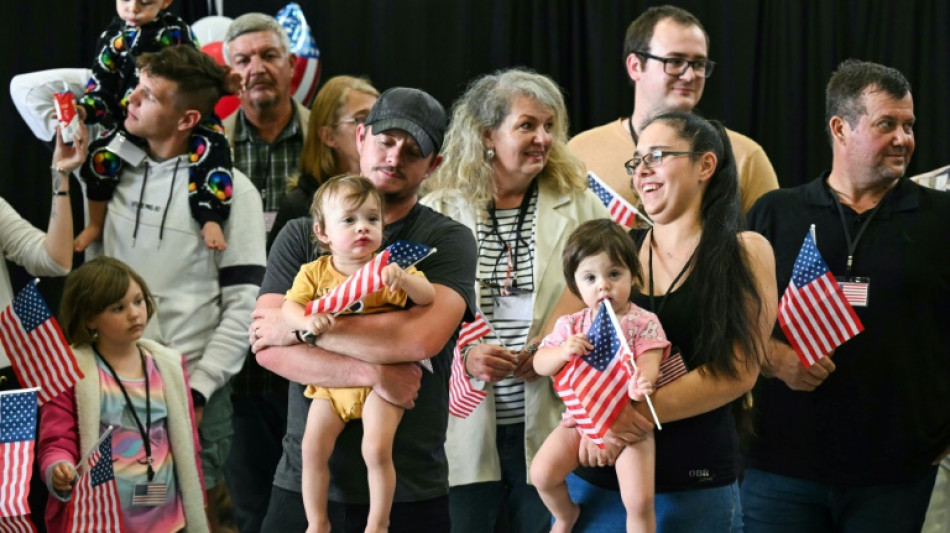
US to limit refugees to record low 7,500, mostly white South Africans / Photo: SAUL LOEB - AFP

 Alexander Skarsgard and his viral 'Wicker' transformation

 Thousands protest in Turkey over journalists' arrests, media shutdowns

 Man City beaten by Aston Villa to end perfect Premier League start

 Luis Enrique says PSG unbothered by Lyon match switch
 US gymnast Richard wins floor exercise gold at worlds
 Moltzan upstages Shiffrin to win season-opening World Cup giant slalom
 Infantino says backed by 'vast majority' in bid for re-election

 Police fire tear gas as new French protests kick off

 Police fire tear gas as new French demonstrations kick off
 Tropical Storm Champi nears China after battering Taiwan, Japan

 'Weeks, not days' in Kompany recovery, say Bayern

 Unfair to compare us to Barca: Real Madrid's Mourinho
 North Korea's Kim makes unannounced visit to Chinese border city

 Fire breaks out at Hitler's mountain retreat, suspect arrested

 Marc Marquez wins Australian sprint as Martin crashes out
 North Korea's Kim calls for training world's 'strongest' military

 Brewers edge Rays to capture World Series opener

 France to deploy 70,000 police for fresh weekend protests
 Tatum delivers as Celtics down winless Knicks

 Romantasy fans ready for sleepless night as 'Court of Thorns and Roses' returns
 De Goede hat-trick as Canada defeat England again

 How to Build an Emergency Fund for Your Furry Best Friend

 5 Ways to Prepare Financially for Parenthood
 Ebola vaccine trial begins in DR Congo

 Travelling man Wade equals Prem try record

The Trump administration announced plans on Thursday to drastically cut back the number of refugees to be accepted annually by the United States to a record low and give priority to white South Africans.
Under the new policy, the United States would welcome 7,500 refugees in fiscal 2026, down from more than 100,000 a year under Democratic president Joe Biden.
The vast majority of those being accepted during the fiscal year which began on October 1 would be white South Africans and "other victims of illegal or unjust discrimination in their respective homelands," according to a White House memo.
"The admissions numbers shall primarily be allocated among Afrikaners from South Africa," it said.
Republican President Donald Trump essentially halted refugee arrivals after taking office in January, but has been making an exception for white South Africans despite Pretoria's insistence that they do not face persecution in their homeland.
A first group of around 50 Afrikaners -- descendants of the first European settlers of South Africa -- arrived for resettlement in the United States in May.
Trump campaigned for the White House on a pledge to deport millions of undocumented migrants and signed an executive order in January suspending the US Refugee Admissions Program.
Aaron Reichlin-Melnick, a senior fellow at the American Immigration Council, said that since 1980 more than two million people fleeing persecution have been admitted into the United States under the program.
"Now it will be used as a pathway for White immigration," Reichlin-Melnick said on X. "What a downfall for a crown jewel of America's international humanitarian programs."
- 'Lifeline' -
Krish O'Mara Vignarajah, president of another immigration-focused group, Global Refuge, also criticized the move by the Trump administration.
"For more than four decades, the US refugee program has been a lifeline for families fleeing war, persecution, and repression," Vignarajah said in a statement.
"At a time of crisis in countries ranging from Afghanistan to Venezuela to Sudan and beyond, concentrating the vast majority of admissions on one group undermines the program's purpose as well as its credibility."
In addition to slashing refugee numbers, the Trump administration has moved to strip Temporary Protected Status (TPS) for Afghans, Haitians, Venezuelans and nationals of several other countries.
The United States grants TPS to foreign citizens who cannot safely return home because of war, natural disasters or other "extraordinary" conditions.
Trump has said the Afrikaners being taken in as refugees by the United States are fleeing a "terrible situation" back home and has even gone so far as to describe it as "genocide," an allegation widely dismissed as absurd.
Whites, who make up 7.3 percent of South Africa's population, generally enjoy a higher standard of living than the Black majority. They still own two-thirds of farmland and on average earn three times as much as Black South Africans.
Mainly Afrikaner-led governments imposed the race-based apartheid system that denied Black people political and economic rights until it was voted out in 1994.
R.Garcia--AT