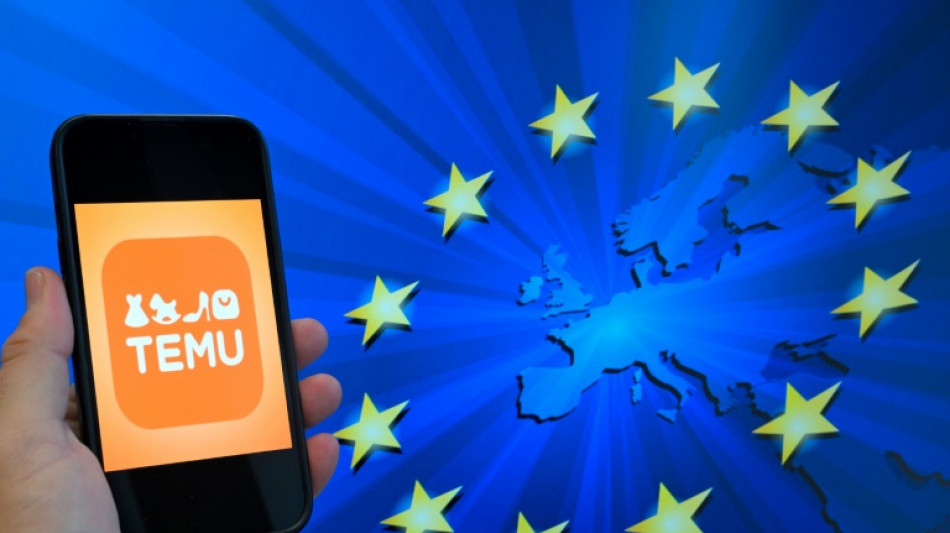
EU accuses online giant Temu over sale of 'illegal' products / Photo: Nicolas TUCAT - AFP/File

 EU seeks deportation powers for beefed up border agency

 Two charged with UK security offences over airbase plot: police

 Maresca defends Donnarumma, Guehi after Man City defeat

 Nordic leaders call Putin as local truce begins in Ukraine

 Osaka unveils crane outfit in Tokyo before win over Paolini

 Ronaldo in line for Portugal return after fallout with coach

 Norway media take legal action to block Meta from using content

 Bayern praise 'humble' Kane after Ballon d'Or win

 Colts retain Daniel Jones as starter despite continued offensive struggles

 Madushanka wrecks Pakistan as Sri Lanka press for final slot

 Destructive Abhishek 113 leads India to series win over New Zealand

 Norway, Finland leaders hold 'frank and substantive' talk with Putin

 Wall Street faces earnings and Fed tests after turbulent technology-led week

 Ukraine, Russia say US-brokered truce holding in ravaged city

 Police form SIT after vehicles in Rahul Gandhi convoy collide on expressway

 Delhi grants minimum monthly pay and DA to about 4,000 MCD health workers

 Ather Energy shares climb 14% after quarterly profit and expansion plan

 Gold ETF flows turn negative after 13 weeks as bullion loses 4%

 Pakistan's last antique restorers give old treasures new life

 India braces for Cyclone Arnab with evacuations

 Steel Strips Wheels gains 36% in two sessions on growth outlook

 Cavs edge T'Wolves in overtime despite superb Edwards

 Prescott fires Cowboys to 38-21 win over plummeting Eagles

 Kuwait padel chief hails national showing at Premier Padel Major

 Britain prepares constrained budget as debt and defence pressures mount

The European Union accused Chinese-founded online shopping giant Temu on Monday of breaking the bloc's digital rules by not "properly" assessing the risks of illegal products.
EU regulators believe Temu is not doing enough to protect European consumers from dangerous products and that it may not be acting sufficiently to mitigate risks to users.
"Evidence showed that there is a high risk for consumers in the EU to encounter illegal products on the platform," the European Commission said in its preliminary finding.
It pointed to a mystery shopping exercise that found consumers were "very likely to find non-compliant products among the offer, such as baby toys and small electronics".
Temu said only it would "continue to cooperate fully with the commission".
Wildly popular in the European Union despite only having entered the continent's market in 2023, Temu has 93.7 million average monthly active users in the 27-country bloc.
The EU said Temu's October 2024 risk assessment was "inaccurate and relying on general industry information rather than on specific details about its own marketplace".
Temu is under investigation as part of a mammoth law known as the Digital Services Act (DSA) that forces the world's largest tech firms to do more to protect European consumers online and better police content online.
Temu will now be able to respond to the EU regulators' findings and defend itself, but there is no time limit on how long an investigation may last.
If confirmed to be in breach, the EU can slap a fine on Temu.
Fines under the DSA can go as high as six percent of a company's total worldwide annual turnover and force it to make changes to address violations.
Launched in October, the EU probe continues to investigate other suspected breaches including the use of addictive design features that could hurt users' physical and mental well-being and how Temu's systems recommend content and products.
- EU law under attack -
The DSA is part of the EU's reinforced legal weaponry to curb the excesses of Big Tech, with stricter rules for the world's biggest platforms.
It has faced criticism from the US administration under President Donald Trump.
The Republican-dominated judiciary committee of the US House of Representatives described the DSA in a scathing report as a "foreign censorship threat" on Friday.
Staunch President Donald Trump ally Jim Jordan, committee chair, met EU tech sovereignty chief Henna Virkkunen in Brussels as part of a bipartisan delegation on Monday.
"We had a constructive discussion on how to promote digital innovation, AI and regulate this field smartly," she said on X after the meeting.
There are currently other DSA probes into Chinese online retailer AliExpress, social media platforms Facebook and Instagram and X as well as TikTok.
The EU also wants to crack down on cheap packages that flood into the bloc each year, with a proposal under discussion for a two-euro flat fee per parcel.
Last year, 4.6 billion such packages entered the EU -- more than 145 per second -- with 91 percent originating in China. The EU expects the numbers to increase.
F.Wilson--AT