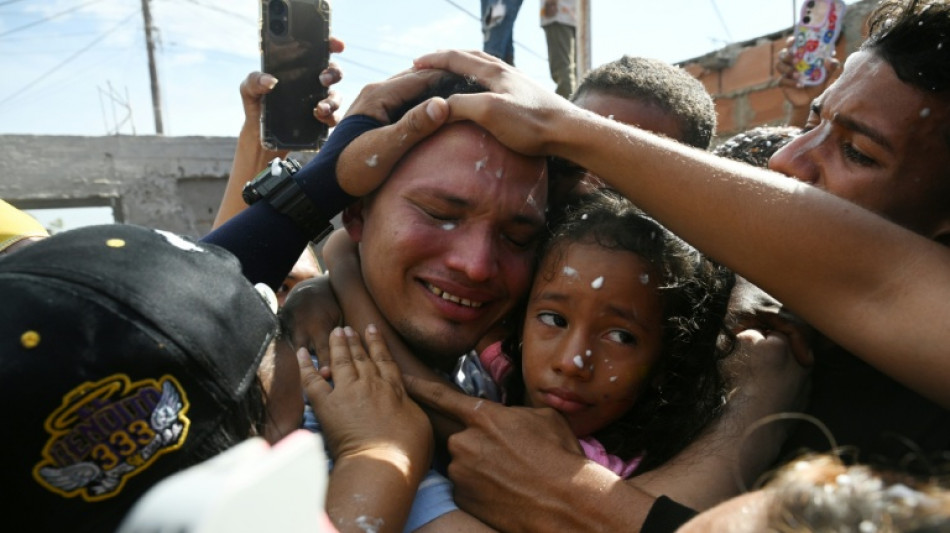
'Welcome to hell': Freed migrants tell of horrors in Salvadoran jail / Photo: Federico PARRA - AFP

 Exiled Russian dissident Navalnaya warns dictators becoming 'more cunning'
 Bayern 'risk' reaps huge reward for Ballon d'Or winner Kane

 Record turnout as Israeli voters deliver verdict on Netanyahu

 Iraola says Isak 'feels the trust' after Liverpool scoring streak

 French media protest manhandling of journalists at far-right party rally

 EU seeks deportation powers for beefed up border agency

 Two charged with UK security offences over airbase plot: police

 Maresca defends Donnarumma, Guehi after Man City defeat
 Nordic leaders call Putin as local truce begins in Ukraine

 Osaka unveils crane outfit in Tokyo before win over Paolini

 Ronaldo in line for Portugal return after fallout with coach

 Norway media take legal action to block Meta from using content

 Bayern praise 'humble' Kane after Ballon d'Or win

 Colts retain Daniel Jones as starter despite continued offensive struggles

 Madushanka wrecks Pakistan as Sri Lanka press for final slot

 Destructive Abhishek 113 leads India to series win over New Zealand

 Norway, Finland leaders hold 'frank and substantive' talk with Putin

 Wall Street faces earnings and Fed tests after turbulent technology-led week

 Ukraine, Russia say US-brokered truce holding in ravaged city

 Police form SIT after vehicles in Rahul Gandhi convoy collide on expressway

 Delhi grants minimum monthly pay and DA to about 4,000 MCD health workers

 Ather Energy shares climb 14% after quarterly profit and expansion plan

 Gold ETF flows turn negative after 13 weeks as bullion loses 4%

 Pakistan's last antique restorers give old treasures new life

 India braces for Cyclone Arnab with evacuations

Mervin Yamarte left Venezuela with his younger brother, hoping for a better life.
But after a perilous jungle march, US detention, and long months in a Salvadoran jail surviving riots, beatings and fear, he has returned home a wounded and changed man.
On entering the sweltering Caribbean port of Maracaibo, the first thing Yamarte did after hugging his mother and six-year-old daughter was to burn the baggy white prison shorts he wore during four months of "hell."
"The suffering is over now," said the 29-year-old, enjoying a longed-for moment of catharsis.
Yamarte was one of 252 Venezuelans detained in US President Donald Trump's March immigration crackdown, accused without evidence of gang activity, and deported to El Salvador's notorious Terrorism Confinement Center, known as CECOT.
According to four ex-detainees interviewed by AFP, the months were marked by abuse, violence, spoiled food and legal limbo.
"You are going to die here!" heavily armed guards taunted them on arrival to the maximum security facility east of the capital San Salvador. "Welcome to hell!"
The men had their heads shaved and were issued with prison clothes: a T-shirt, shorts, socks, and white plastic clogs.
Yamarte said a small tuft of hair was left at the nape of his neck, which the guards tugged at.
The Venezuelans were held separately from the local prison population in "Pavilion 8" -- a building with 32 cells, each measuring about 100 square meters (1,076 square feet).
Each cell -- roughly the size of an average two-bedroom apartment -- was designed to hold 80 prisoners.
- 'Carried out unconscious' -
Salvadoran President Nayib Bukele built the prison to house the country's most dangerous gang members in deliberately brutal conditions, drawing constant criticism from rights groups.
Trump's administration paid Bukele $6 million to keep the Venezuelans behind bars.
AFP has unsuccessfully requested a tour of the facility and interviews with CECOT authorities.
Another prisoner, 37-year-old Maikel Olivera, recounted there were "beatings 24 hours a day" and sadistic guards who warned, "You are going to rot here, you're going to be in jail for 300 years."
"I thought I would never return to Venezuela," he said.
For four months, the prisoners had no access to the internet, phone calls, visits from loved ones, or even lawyers.
At least one said he was sexually abused.
The men said they slept mostly on metal cots, with no mattresses to provide comfort.
There were several small, poorly-ventilated cells where prisoners would be locked up for 24 hours at a time for transgressions -- real or imagined.
"There were fellow detainees who couldn't endure even two hours and were carried out unconscious," Yamarte recounted.
The men never saw sunlight and were allowed one shower a day at 4:00 am. If they showered out of turn, they were beaten.
Andy Perozo, 30, told AFP of guards firing rubber bullets and tear gas into the cells.
For a week after one of two riots that were brutally suppressed, "they shot me every morning. It was hell for me. Every time I went to the doctor, they beat me," he said.
Edwuar Hernandez, 23, also told of being beaten at the infirmary.
"They would kick you... kicks everywhere," he said. "Look at the marks; I have marks, I'm all marked."
The detainees killed time playing games with dice made from bits of tortilla dough.
They counted the passing days with notches on a bar of soap.
- 'Out of hell' -
An estimated eight million Venezuelans have fled the political and economic chaos of their homeland to try to find a job in the United States that would allow them to send money home.
Yamarte left in September 2023, making the weeks-long journey on foot through the Darien Gap that separates Colombia from Panama.
It is unforgiving terrain that has claimed the lives of countless migrants who must brave predatory criminal gangs and wild animals.
Yamarte was arrested in Dallas in March and deported three days later, without a court hearing.
All 252 detainees were suddenly, and unexpectedly, freed on July 18 in a prisoner exchange deal between Caracas and Washington.
Now, many are contemplating legal action.
Many of the men believe they were arrested in the United States simply for sporting tattoos wrongly interpreted as proof of association with the feared Tren de Aragua gang.
Yamarte has one that reads: "Strong like Mom."
"I am clean. I can prove it to anyone," he said indignantly, hurt at being falsely accused of being a criminal.
"We went... to seek a better future for our families; we didn't go there to steal or kill."
Yamarte, Perozo, and Hernandez are from the same poor neighborhood of Maracaibo, where their loved ones decorated homes with balloons and banners once news broke of their release.
Yamarte's mom, 46-year-old Mercedes, had prepared a special lunch of steak, mashed potatoes, and fried green plantain.
At her house on Tuesday, the phone rang shortly after Yamarte's arrival.
It was his brother Juan, who works in the United States without papers and moves from place to place to evade Trump's migrant dragnet.
Juan told AFP he just wants to stay long enough to earn the $1,700 he needs to pay off the house he had bought for his wife and child in Venezuela.
"Every day we thought of you, every day," Juan told his brother. "I always had you in my mind, always, always."
"The suffering is over now," replied Mervin. "We've come out of hell."
K.Hill--AT