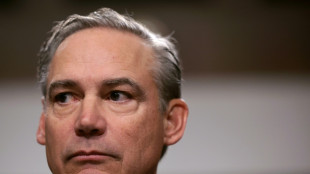
New cryptocurrency may be aiding Russia to dodge sanctions / Photo: TATYANA MAKEYEVA - AFP/File

 Exiled Russian dissident Navalnaya warns dictators becoming 'more cunning'
 Bayern 'risk' reaps huge reward for Ballon d'Or winner Kane

 Record turnout as Israeli voters deliver verdict on Netanyahu
 Iraola says Isak 'feels the trust' after Liverpool scoring streak

 French media protest manhandling of journalists at far-right party rally

 EU seeks deportation powers for beefed up border agency

 Two charged with UK security offences over airbase plot: police

 Maresca defends Donnarumma, Guehi after Man City defeat

 Nordic leaders call Putin as local truce begins in Ukraine

 Osaka unveils crane outfit in Tokyo before win over Paolini

 Ronaldo in line for Portugal return after fallout with coach

 Norway media take legal action to block Meta from using content

 Bayern praise 'humble' Kane after Ballon d'Or win

 Colts retain Daniel Jones as starter despite continued offensive struggles

 Madushanka wrecks Pakistan as Sri Lanka press for final slot
 Destructive Abhishek 113 leads India to series win over New Zealand

 Norway, Finland leaders hold 'frank and substantive' talk with Putin
 Wall Street faces earnings and Fed tests after turbulent technology-led week

 Ukraine, Russia say US-brokered truce holding in ravaged city

 Police form SIT after vehicles in Rahul Gandhi convoy collide on expressway

 Delhi grants minimum monthly pay and DA to about 4,000 MCD health workers

 Ather Energy shares climb 14% after quarterly profit and expansion plan

 Gold ETF flows turn negative after 13 weeks as bullion loses 4%

 Pakistan's last antique restorers give old treasures new life
 India braces for Cyclone Arnab with evacuations

Russia could be turning to a new cryptocurrency called A7A5 to allow money to flow in and out of the country and avoid Western sanctions, experts have told AFP.
Multiple rounds of international sanctions have been imposed on Moscow since its February 2022 invasion of Ukraine seeking to ramp up economic pressure to halt the war.
But the launch of A7A5 in February this year opened up an alternative payment method for Russian businesses and individuals to sidestep sanctions when trading with foreign partners, the UK-based non-profit Centre for Information Resilience (CIR) said in a report.
A7A5 is a stablecoin -- a form of cryptocurrency backed by traditional assets -- in this case pegged to the ruble, making it harder for Western authorities to monitor than dollar-based alternatives.
It was launched by a pro-Russian Moldovan oligarch and a Russian state-owned bank as "the first ever ruble-pegged stablecoin," George Voloshin from anti-money laundering group ACAMS told AFP.
While it is not widely used yet, experts say its creation marks a significant step in Russia's efforts to reduce its dependence on major crypto companies -- many of which cooperate with Western governments.
- Russian stablecoin -
Since Russia was kicked out of the international banking system SWIFT and hit with asset freezes and investment bans, Moscow has already turned to crypto to sidestep financial restrictions imposed by the United States and its allies.
Stablecoins are especially attractive because they are less volatile than other cryptocurrencies.
People have also used cryptocurrency to donate directly to both the Ukrainian army and Russian militias, according to several analytics firms such as Elliptic.
But Russia has faced a problem: USDT, the most popular stablecoin, is tied to the US dollar and controlled by a company called Tether, which cooperates with US and European authorities.
Earlier this year, Tether blocked $28 million in USDT held in wallets on Garantex, Russia's largest crypto exchange, which was shut down following a global crackdown on illegal transactions.
"That was a real wake-up call" for Russia, said Elise Thomas, senior investigator at CIR.
"It made them think that they need their own stablecoin, they need something that they control," she added.
Just before Garantex was shut down, tens of millions of dollars were moved from USDT into A7A5, according to data from crypto tracking firm Global Ledger.
- How it works -
A7A5 is backed by deposits in Promsvyazbank, a Russian bank under sanctions for its ties to the government and the military.
The coin is traded on Grinex, a crypto exchange based in Kyrgyzstan -- a country seen as friendlier to Russian interests and less vulnerable to Western pressure.
A7A5 is also registered in Kyrgyzstan rather than Russia because the country offers a crypto-friendly legal environment and is less exposed to "sanctions and other economic pressures," project director Leonid Shumakov said in an interview posted online.
Less than six months after its launch, around $150 million is now held in A7A5.
These transactions are not necessarily illegal, but they could become problematic if used by sanctioned individuals or entities to reconnect with the global financial system, warned ACAMS's Voloshin.
The man behind the A7 group, which developed A7A5, is Ilan Shor, a Moldovan businessman and politician now living in Russia.
Investigators found links between A7A5 and Shor's political activities in Moldova, including websites related to both sharing the same IP address.
These findings have suggested that the cryptocurrency could be used as a tool for political influence.
Shor and his company have already been sanctioned by the UK, and more recently by the European Union, which accused them of trying to meddle in Moldova’s 2024 presidential election and its referendum on joining the EU -- all while keeping close ties with Moscow.
H.Thompson--AT