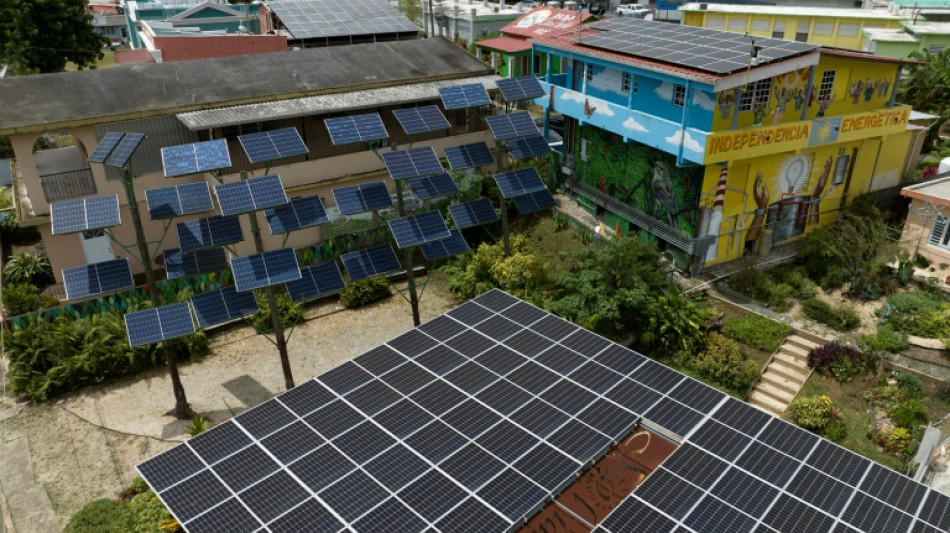
Puerto Rico's community-owned solar power: alternative to frequent blackouts / Photo: Ricardo ARDUENGO - AFP

 Exiled Russian dissident Navalnaya warns dictators becoming 'more cunning'
 Bayern 'risk' reaps huge reward for Ballon d'Or winner Kane
 Record turnout as Israeli voters deliver verdict on Netanyahu
 Iraola says Isak 'feels the trust' after Liverpool scoring streak

 French media protest manhandling of journalists at far-right party rally

 EU seeks deportation powers for beefed up border agency
 Two charged with UK security offences over airbase plot: police

 Maresca defends Donnarumma, Guehi after Man City defeat
 Nordic leaders call Putin as local truce begins in Ukraine

 Osaka unveils crane outfit in Tokyo before win over Paolini

 Ronaldo in line for Portugal return after fallout with coach

 Norway media take legal action to block Meta from using content

 Bayern praise 'humble' Kane after Ballon d'Or win

 Colts retain Daniel Jones as starter despite continued offensive struggles

 Madushanka wrecks Pakistan as Sri Lanka press for final slot
 Destructive Abhishek 113 leads India to series win over New Zealand

 Norway, Finland leaders hold 'frank and substantive' talk with Putin
 Wall Street faces earnings and Fed tests after turbulent technology-led week

 Ukraine, Russia say US-brokered truce holding in ravaged city
 Police form SIT after vehicles in Rahul Gandhi convoy collide on expressway

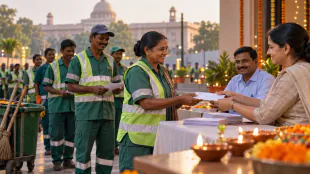 Delhi grants minimum monthly pay and DA to about 4,000 MCD health workers
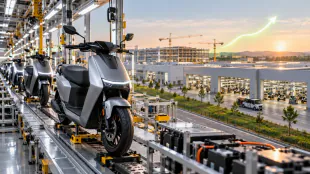 Ather Energy shares climb 14% after quarterly profit and expansion plan

 Gold ETF flows turn negative after 13 weeks as bullion loses 4%

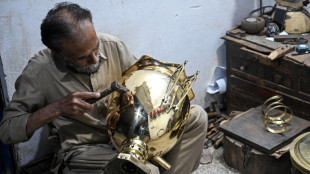 Pakistan's last antique restorers give old treasures new life
 India braces for Cyclone Arnab with evacuations

Enid Medina Guzman always has candles on hand -- not for creating ambiance, but because one of the blackouts that plague Puerto Rico could strike at any time.
But she is hopeful the lingering hardship will soon be a thing of the past: solar panels are being installed on her home as part of a community program promoting energy independence.
At her house nestled high in the mountains of the lush tropical forests of the archipelago's central city Adjuntas, "it rains a lot and when there's a little wind, the power goes out really quickly," Medina Guzman told AFP.
She has lived in Adjuntas, which has a population of about 20,000, virtually all her life. She said blackouts have always been a feature.
"Sometimes it's at night when it's super hot, and you can't sleep, you can't rest," the 60-year-old said. "It's difficult."
Puerto Rico is a Caribbean territory of more than three million people that has been under US control since 1898.
Its chronic infrastructure woes were exacerbated by 2017's devastating Hurricane Maria, which razed the island's already deteriorating power grid.
After the massive storm, it took roughly 11 months to restore power across the island.
The electrical grid went private in June 2021 in an apparent effort to resolve the problem of perennial blackouts.
But outages persist: this past year, Puerto Rico experienced massive blackouts in April and also on New Year's Eve.
"It's not normal," Medina Guzman said, as a crew installed the battery that will soon store captured energy from the sun.
- 'Hands of the people' -
Like everywhere in Puerto Rico, Adjuntas went dark during Maria -- but in the city's main square, a pink, 1920s-era house was a beacon of light.
It was Casa Pueblo, the nucleus of a grassroots non-profit focused on ecological protection and community support.
It became a haven in the storm's aftermath: the solar panels on its roof meant Casa Pueblo had precious power. People could charge their electronic devices, and crucially plug in medical equipment like oxygen machines.
Cell towers and power lines were down, but Casa Pueblo's community radio station still functioned, becoming a vital source of information in the mountain town.
Casa Pueblo came into being in 1980 -- the brainchild of a citizens group whose original mission was to thwart a series of planned open-pit mines in the region.
They were successful. Over the years, the organization bloomed into a model of bottom-up energy independence, on an island frequently hampered by economic crisis and natural disaster.
"Our aspiration isn't just a technological transition away from fossil fuels to solar. Yes, we need to produce clean and renewable energy, but we are aspiring towards a transformation -- a just, eco-social transition," said Casa Pueblo's director Arturo Massol Deya, a biologist by training.
"That means the energy infrastructure being in the hands of the people," added Massol Deya, whose parents were the group's original founders.
- 'Path to change' -
Among Casa Pueblo's efforts is sustaining a community solar belt that gives vulnerable populations control over their own energy.
The group also has distributed solar lamps and solar refrigerators, especially in rural communities.
Casa Pueblo has so far helped install solar panels on nearly 300 homes, with over 400 projects in total including businesses. Massol Deya told AFP those initiatives are primarily funded through grassroots donations and philanthropy.
Their microgrids -- a localized energy system -- are interconnected and self-sufficient.
And net metering -- a billing mechanism that credits consumers for excess power produced from renewable systems -- allows Casa Pueblo's center to sell back what it doesn't use.
That is particularly meaningful given that average Puerto Ricans pay more than double the price for electricity than mainland US residents, according to US Energy Information Administration data.
"The traditional model is a unilateral, exploitative, monopolistic, dictatorial model," Massol Deya said.
"They decide the price of fuel and whether they give it to you or not. Sometimes they fail and can't provide the service," he said.
"This energy insecurity translates to many issues -- well, not anymore."
Approximately 10 percent of Puerto Rican households currently have solar panels, according to the energy authority, a number that reflects households with net-metering agreements. There is no publicly available data for structures that operate off-grid.
Sergio Rivera Rodriguez is part of a team of academic researchers studying the public health impact of energy security on populations like those in Adjuntas.
He told AFP the Casa Pueblo model could be successful elsewhere.
"I think it's making a difference -- it's of course just one municipality," he said. But "structural changes take years."
Casa Pueblo functions above all, Massol Deya said, because it is a social program that fosters communal control of resources.
"The people are doing it," he said. "This is the path to change."
M.White--AT