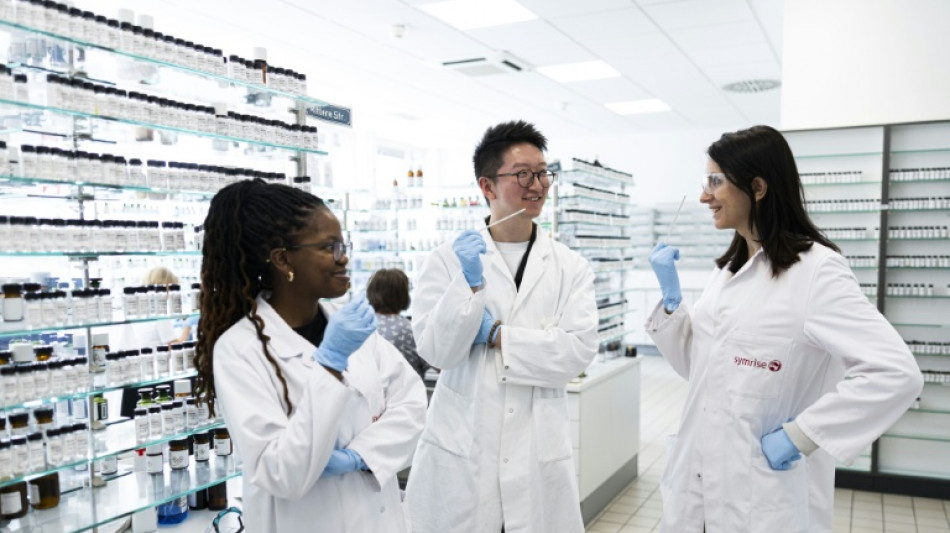
Who makes laundry smell nice? Meet the professional 'noses' / Photo: MICHAEL MATTHEY - AFP

 Flight data, satellite images reveal growing US role at Ecuador base

 McInnes feels 'guilt' ahead of Hearts return with Rangers

 Brazil's Lula turns 81, vows to work '24 hours a day'

 Boeing releases cautious growth plan as shares fall sharply

 Exiled Russian dissident Navalnaya warns dictators becoming 'more cunning'

 Bayern 'risk' reaps huge reward for Ballon d'Or winner Kane

 Record turnout as Israeli voters deliver verdict on Netanyahu

 Iraola says Isak 'feels the trust' after Liverpool scoring streak

 French media protest manhandling of journalists at far-right party rally

 EU seeks deportation powers for beefed up border agency

 Two charged with UK security offences over airbase plot: police

 Maresca defends Donnarumma, Guehi after Man City defeat

 Nordic leaders call Putin as local truce begins in Ukraine

 Osaka unveils crane outfit in Tokyo before win over Paolini

 Ronaldo in line for Portugal return after fallout with coach

 Norway media take legal action to block Meta from using content

 Bayern praise 'humble' Kane after Ballon d'Or win

 Colts retain Daniel Jones as starter despite continued offensive struggles

 Madushanka wrecks Pakistan as Sri Lanka press for final slot

 Destructive Abhishek 113 leads India to series win over New Zealand

 Norway, Finland leaders hold 'frank and substantive' talk with Putin

 Wall Street faces earnings and Fed tests after turbulent technology-led week

 Ukraine, Russia say US-brokered truce holding in ravaged city

 Police form SIT after vehicles in Rahul Gandhi convoy collide on expressway

 Delhi grants minimum monthly pay and DA to about 4,000 MCD health workers

In the laboratories of German fragrance and flavours giant Symrise, a citrus scent clings to the lab coats of trainees -- "noses" who are learning the art of making things smell good.
These busy heroes of the world of smells and aromas shape the connection millions of consumers have with everyday items.
While at high-end perfume labels, olfactory artists create scents for luxury body sprays, Symrise's experts work on everyday products that might range from mint-flavoured toothpaste to barbeque chips.
Smell, a powerful sense that can trigger emotions and memories, and aroma often decide which food or beverage, cleaning or personal hygiene product ends up in the shopping cart.
At Symrise's headquarters in Holzminden, a quiet town south of Hanover, each day at the company's in-house perfumery school begins the same way: sniffing out scents from dozens of tiny bottles while blindfolded.
"It's just like tuning a musical instrument before you play," said Alicia De Benito Cassado, a 32-year-old former professional pianist from Spain.
Her career switch into scent development was a natural step: she made her own perfumes as a teenager to match the poetry and music that she wrote.
"For me, not everything has to smell good," she said. "The horror of smell also helps us discover ourselves."
But commercial clients demand something different, De Benito Cassado added. "In the end, we need to create scents that are strong, beautiful, powerful -- and affordable."
- Professional sniffers -
Being a "nose" is a full-time job and comes with a three-year training programme.
The smell of a fabric softener can be composed of 80 compounds, far more than in a premium body perfume, and the best noses can make out over 1,000 different odours while blindfolded.
Shangyun Lyu, 31, came from China to study at the school and says that a professional sniffer can get by with knowing about 500scents.
Being able to break down odours into their chemical components is key.
"As a kid, I just smelled jasmine or gardenia as flowers," he said. "Now, I recognise the chemicals: it's a blend of many elements."
Students weigh ingredients down to the milligramme, mix, smell, and start over, often by replicating existing smells to understand their structure and then innovate from there.
"When developing perfume, it is very important that several people smell it," said 56-year-old master perfumer Marc vom Ende, head of the school.
"We all perceive smell differently."
- 'Nose has the final say' -
Pleasant smells cannot come at any cost, and the rules of the game change over time.
Lilial, a chemical once prized for its floral and sweet Lily-of-the-Valley notes, has been banned in the European Union since 2022 over fears it can cause skin irritation and damage the reproductive system.
Fragrances applied directly to the body have stricter regulations than detergents, said 27-year-old South African trainee Attiya Setai.
"We're more restricted in raw materials and must replace banned ingredients with new compliant ones," she said.
Tastes also vary across global markets, with Shangyun pointing to the example of Chinese shampoos that sell well with a young clientele there but would struggle in Europe.
"Something old-fashioned in one country can be new elsewhere," he said.
Cost also enters the equation. Symrise extracts aromatic compounds from wood resin, a by-product of the paper industry, in a move "that makes both economic and environmental sense", said vom Ende.
It is hard to be a nose.
About 500 perfumers work in the industry and 80 of them at Symrise, which has a workforce of 13,000. The company markets about 30,000 products to clients ranging from confectioners to pet food manufacturers and suncream makers.
Symrise's competitors include DSM-Firmenich, headquartered in both Switzerland and the Netherlands, as well as Givaudan, another Swiss firm.
Artificial intelligence increasingly plays a role, with computer programmes predicting which fragrances will hit the mark.
Still, the machines cannot -- yet -- smell, even if they can understand speech and read text.
"We're supported by AI," vom Ende said. "But the nose has the final say".
F.Wilson--AT