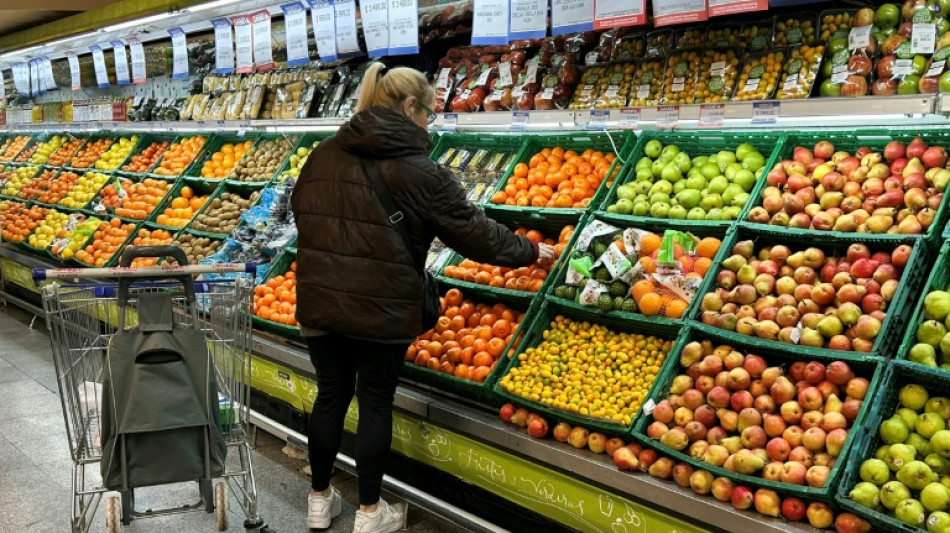
Argentina under Milei: a tale of two economies / Photo: Luis Robayo - AFP

 Tuvalu has 'limited' power to halt its fossil fuel investments: NZ govt papers seen by AFP
 Palestinian activist Khalil returns to Columbia after US detention

 Trump drastically loosens oil and gas methane rules

 French Senate weighs bill to make protesters pay for unrest damage
 'A very sad day': Arteta despair as Arsenal stunned by Fleetwood
 Charles tackles thorny legacy of slavery on Caribbean trip

 Former Grand Slam winner Wawrinka ends tennis career

 Brazil's Flavio Bolsonaro flees to US after election loss
 'Faerie' nights: 'ACOTAR' fans finally get their book

 American woman convicted of getting military training from Islamic State

 Israel opposition holds narrow edge over Netanyahu in first projections

 Floriani hits maiden goal as Lazio go top
 Trump set to drastically loosen oil and gas sector's methane rules

 Storied Paris department store seeks bankruptcy protection
 Xhaka, Embolo can return to Swiss squad after fake Covid docs affair
 Allegri suspended for two Serie A games after red card

 Flight data, satellite images reveal growing US role at Ecuador base
 McInnes feels 'guilt' ahead of Hearts return with Rangers

 Brazil's Lula turns 81, vows to work '24 hours a day'
 Boeing releases cautious growth plan as shares fall sharply
 Exiled Russian dissident Navalnaya warns dictators becoming 'more cunning'
 Bayern 'risk' reaps huge reward for Ballon d'Or winner Kane
 Record turnout as Israeli voters deliver verdict on Netanyahu
 Iraola says Isak 'feels the trust' after Liverpool scoring streak

 French media protest manhandling of journalists at far-right party rally

In Javier Milei's Argentina, falling inflation has stimulated a boom in car and real estate sales and foreign-bound planes take off laden with tourists.
But on the other side of a very complicated economic coin, consumption is dropping precipitously among low- and middle-income groups while more and more people work in precarious jobs and buy groceries on credit.
Milei, who took office as president in December 2023, has partly succeeded in his quest to curb state spending and runaway inflation, which reached a five-year monthly low in May.
But the price has been a devalued peso and deep cuts to state subsidies that made access to housing, health care and education prohibitively expensive for millions.
Consumer spending dipped heavily last year and a tentative rebound has been unequal: spending on tangible assets such as apartments and cars has skyrocketed among the rich, while ever more poorer people can not afford shoes or food.
Nine out of 10 Argentine households are in debt, official data shows. Even more have defaulted on a loan.
- 'An excellent June' -
"Nothing is selling," shoe store employee Laura Comiso told AFP in downtown Buenos Aires after yet another afternoon without customers.
But in San Andres de Giles west of the capital, car salesman Blas Morales waxed lyrical about "an excellent June!"
According to Sebastian Beato, president of Argentina's ACARA car dealership association, the first half of 2025 was "the best in seven years" with sales up nearly 80 percent from 2024.
Under Milei's measures, loans have become cheaper, and Argentines have been encouraged by a tax amnesty to bring out billions of US dollars they had stashed under mattresses and floorboards, in safety deposit boxes and offshore accounts.
Investment in real estate increased 22 percent year-on-year in Buenos Aires in May.
In the first four months of 2025, more mortgages were taken out in Argentina than in all of 2024.
"The change in government has been very positive for this sector," third-generation real estate agent Diego Sardano told AFP.
"Under the previous government, we went months without making a single sale. Now we have about five sales per month," he added.
A stronger peso also benefits those traveling abroad but harms domestic tourism, with bookings plummeting.
Between January and April, about six million Argentines traveled abroad -- 70 percent more than in the same period in 2024.
The country received only two million visitors at the same time, the lowest figure in a decade.
- No more candy -
Consumption is being driven largely by Argentina's upper class, which comprises no more than six percent of the population.
Consulting firm Moiguer said in a recent report the economic recovery after months of recession was not benefiting everyone equally, and was exacerbating income inequality.
Half of Argentines tell pollsters they cannot make ends meet, and a third delay planned purchases in order to pay for essentials.
Sardano, the realtor, said he feared spending on homes and apartment may have peaked "because people's purchasing power isn't increasing."
"High-end car registrations are increasing while food consumption is falling. The middle class is being wiped out," added Rodolfo Aguilar, head of the State Workers' Union (ATE) which has reported 40,000 job losses among its ranks under Milei.
Fernando Savore, head of the Federation of Small Businesses in Buenos Aires province, said having a job no longer guarantees financial stability because wages have not kept pace with rising gas, electricity and transport prices, or school fees.
"Much of a worker's income goes toward these obligations. There are items that no longer sell, like candy and desserts," he told AFP.
"People only buy necessities like pasta and tomato puree, nothing more, and many are buying on credit."
T.Wright--AT