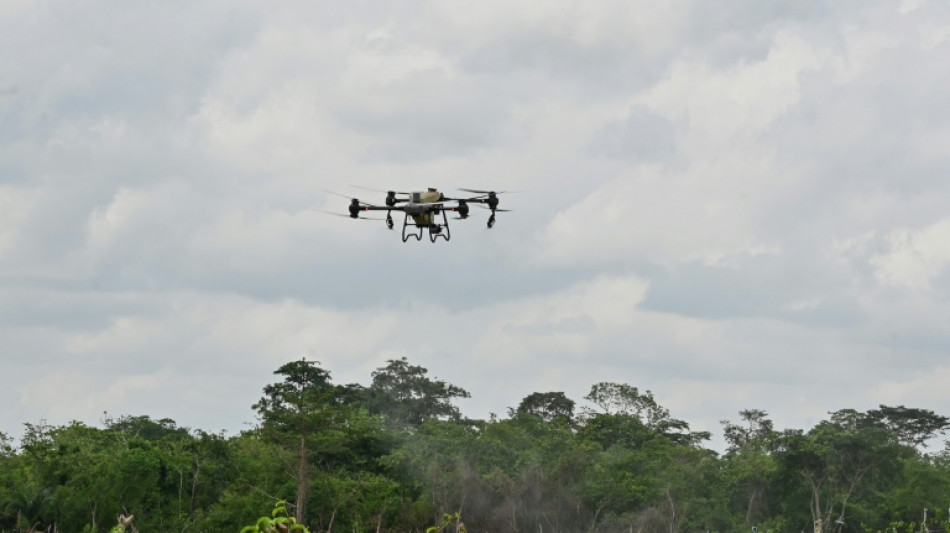
Ivory Coast farmers hope tech tempts jaded youth back to fields / Photo: Issouf SANOGO - AFP

 Tuvalu has 'limited' power to halt its fossil fuel investments: NZ govt papers seen by AFP
 Palestinian activist Khalil returns to Columbia after US detention

 Trump drastically loosens oil and gas methane rules
 French Senate weighs bill to make protesters pay for unrest damage
 'A very sad day': Arteta despair as Arsenal stunned by Fleetwood
 Charles tackles thorny legacy of slavery on Caribbean trip

 Former Grand Slam winner Wawrinka ends tennis career

 Brazil's Flavio Bolsonaro flees to US after election loss

 'Faerie' nights: 'ACOTAR' fans finally get their book

 American woman convicted of getting military training from Islamic State

 Israel opposition holds narrow edge over Netanyahu in first projections

 Floriani hits maiden goal as Lazio go top
 Trump set to drastically loosen oil and gas sector's methane rules

 Storied Paris department store seeks bankruptcy protection
 Xhaka, Embolo can return to Swiss squad after fake Covid docs affair

 Allegri suspended for two Serie A games after red card

 Flight data, satellite images reveal growing US role at Ecuador base
 McInnes feels 'guilt' ahead of Hearts return with Rangers

 Brazil's Lula turns 81, vows to work '24 hours a day'

 Boeing releases cautious growth plan as shares fall sharply
 Exiled Russian dissident Navalnaya warns dictators becoming 'more cunning'
 Bayern 'risk' reaps huge reward for Ballon d'Or winner Kane
 Record turnout as Israeli voters deliver verdict on Netanyahu

 Iraola says Isak 'feels the trust' after Liverpool scoring streak
 French media protest manhandling of journalists at far-right party rally

Stopwatch in hand, dozens of Ivory Coast students raced against the clock to design robots for the farms of the future in the world's top cocoa-producing nation.
With each team facing off to draw up the best bot blueprint, the competition is part of a broader push to tempt the west African nation's large population of young people, disillusioned with farming life, back to the plough.
Though farming has long been the pillar of Ivory Coast's economy, many young Ivorians have turned their backs on fruit-picking and tree-felling, discouraged by the hard labour and the slow pace of progress.
"I come from a family of farmers," 20-year-old student Pele Ouattara told AFP at the event in Abidjan, Ivory Coast's largest city.
"My passion for robotics grew out of my desire to improve the conditions in which my parents used to farm," he added.
On a rival team several metres away, fellow student Urielle Diaidh, 24, feared that Ivorian farming "risks dying out with time if modern technologies aren't adopted".
Dominated by the cultivation of cocoa, rubber and cashew nuts, nearly half of Ivorians with jobs work in agriculture in one way or another.
Yet the country's farms have been slow to modernise. Less than 30 percent of farms are mechanised, according to the National Centre for Agronomic Research.
And although three-quarters of Ivorians are under the age of 35, the sector is struggling to refresh an ageing workforce.
Surrounded by a flurry of tiny white robots on their circuit rounds, digital transformation engineer Paul-Marie Ouattara said he has seen "a real enthusiasm from young people" for bringing agriculture into the 21st century.
This "agriculture 4.0" that the competition wishes to promote is "improved, enhanced through new technologies, whether they be robots, drones, artificial intelligence, or data processing", the 27-year-old said.
All these "will help the farmer", insisted Ouattara, who works for a private business which sponsored the contest.
- Change, but for whom? -
Young people have not wholly given up on farming, however -- just on the old way of tilling the land.
At the Ivorian digital transition ministry, Stephane Kounandi Coulibaly, director of innovation and private sector partnerships, said he had seen a boom in agricultural start-ups.
Most of them were founded by young people, he added.
The "agritech" trend mirrors that already in motion across the continent, including in Benin, Nigeria and Kenya, with Abidjan hosting a forum for African start-ups at the beginning of July.
Ivory Coast's world-leading cocoa growers, who produce 40 percent of the global supply, are also climbing aboard.
"We have noticed the appearance of new technologies since four or five years ago," said Thibeaut Yoro, secretary-general of the national union of cocoa producers.
Yoro hailed how those shiny new gadgets helped lighten a "strenuous" job still riddled with "archaic practices".
"We dig, we hack through the bush, we harvest with machetes," he said, with planters suffering from "back aches and fatigue" as a result.
"These are things which could be changed with new technology," the trade union leader argued.
Who can afford those mod cons is another question altogether.
A pesticide-spraying drone with a capacity of 20 litres (five US gallons) can cost nine million CFA francs, or around $16,000.
That is nine times what the average farmer, owning one hectare (two-and-a-half acres) of cocoa trees, would make in six months.
- 10 minutes vs two days -
To reduce those costs, out of the reach of most farmers, a number of Ivorian enterprises offering equipment and technology for hire have sprung up.
In the verdant countryside outside of Tiassale, around 125 kilometres (78 miles) outside of Abidjan, Faustin Zongo has called in a contractor to spray his field of passion fruit plants with pesticides.
Thanks to the drone, the job took 10 minutes per hectare to complete, for the cost of around $27.
Using traditional methods, "it would take two days for each hectare", the farmer said.
By his side, Nozene Ble Binate, project manager for Investiv -- the company Zongo hired -- said that using up-to-date technology made farming "more attractive".
"More and more young people are returning to the land and reaching out to us," the 42-year-old said.
Back in Abidjan, Jool has made a business of offering ranchers software-powered analysis of their crops, with prices starting under $100.
The start-up's 32-year-old founder, Joseph-Olivier Biley -- the son of farmers himself -- boasted of his tool's ability to "know what to plant, where and how" and to "detect diseases before they strike".
With it, farmers could expect yields "optimised by more than 40 percent", Biley told AFP at Jool's offices, on the outskirts of the Ivorian economic capital.
At the digital transformation ministry, Coulibaly, the innovation chief, said the west African country plans to build a centre for manufacturing state-of-the-art inventions and training farmers in their use.
That would mean Ivorian businesses would no longer have to import their technology from abroad, often from China, he added.
A.Taylor--AT