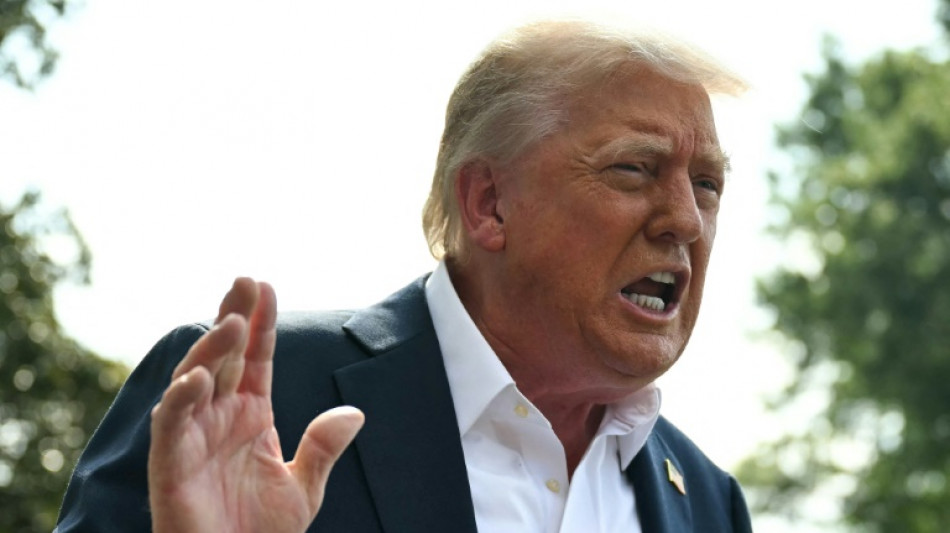
Impact of US tariffs varies across European Union / Photo: ANDREW CABALLERO-REYNOLDS - AFP/File

 Trump tamed after US midterms? Europe doubts it

 Tech stocks soar as SK hynix adds to rising AI confidence

 Sri Lanka's Tamil farmers fight to reclaim land after civil war

 Afghans compete for jobs, homes as millions return

 'They don't care about us': Trump food aid cuts leave Americans struggling and angry

 Meta, Snap head to trial in another case about social media's harms

 French Senate passes bill to make protesters pay for unrest damage

 India evacuates tens of thousands as Cyclone Arnab makes landfall

 In tight Israel vote, both camps hold out cautious hope

 AI chip giant SK hynix says quarterly operating profit soars 630%

 Youths testify about 'despair' in unprecedented Canadian climate trial

 Syria, Jordan agree to mend ties after deadly strike

 Arsenal stunned by fourth-tier Fleetwood in League Cup

 Last-gasp Sabitzer strike sends Dortmund past Bremen in German Cup

 Rights groups reject Emirati diplomat for UN top job

 Flavio Bolsonaro headed to US after Brazil election defeat: US media

 Alcaraz and Zverev win Vienna openers

 Tech firms gain ahead of Fed decision, results from AI giants

 Syria condemns deadly Jordan strikes as 'unacceptable violation'

 England's Fin Smith in race against time to face Australia

 UN nuclear watchdog chief urges Iran to grant access

 Boeing shares tumble after it releases cautious growth forecast

 Lula's re-election revives Brazil-US tensions

 Carney moves to remake Canada alliances as US ties strained

 Serbia's students demand state media chiefs resign after poll win

European countries are not all equally exposed to the US market and so will not suffer the same consequences should President Donald Trump go ahead with his threats to impose 30-percent tariffs on the European Union.
Ireland, with a major pharmaceutical industry, is in the front line along with Germany, for whom the United States is a major outlet for its cars, steel and machine tools.
France is less exposed, even if it does have aeronautics, food, wine and luxury goods companies that risk losing markets.
The EU as a whole has an annual trade surplus with the United States of $235.6 billion, according to the Bureau of Economic Analysis (BEA), which reports to the U.S. Department of Commerce. Only China has a higher amount.
- Ireland, Europe's lab -
Ireland has the largest surplus among EU members, at $86.7 billion.
That is largely due to the presence of major American pharmaceutical companies such as Pfizer, Eli Lilly, and Johnson & Johnson. They all set up in Ireland to benefit from a 15 percent corporate tax, compared to 21 percent in the United States.
These companies can thus host their patents in Ireland and sell on the American market, where drug prices are traditionally higher than in the rest of the world.
Ireland also hosts most of the European headquarters of American tech giants, such as Apple, Google and Meta, also attracted by the attractive Irish tax system.
Overall, pharmaceuticals account for 22.5 percent of EU exports to the United States, according to Eurostat, with many major players having announced major investments in the United States.
- Germany, the industrial powerhouse -
Germany, the EU's largest economy, is under particular pressure due to its dependence on exports: it has a surplus of $84.8 billion with the United States, thanks to its large automobile, chemical, steel and machine industries.
The United States accounts for 23 percent of the revenue of Mercedes Benz. While some of that is accounted for by SUVs manufactured in the United States and exported, they risk being hit by any tariff reprisals from the EU.
The Federation of German Industries (BDI) reacted promptly to Donald Trump's announcements on Saturday, calling on the EU and the United States to "quickly find solutions and to avoid an escalation".
- Italy, France in the second line -
Italy and France, with surpluses of $44 billion and $16.4 billion respectively, according to US statistics (French data says the surplus is much smaller), would appear to be less affected. But some sectors are heavily exposed.
The food and wine industries would be particularly affected in both countries, as is also the case for Spain.
A 30-percent tariff would be a "catastrophe" for the French wine and spirits sector, Jerome Despey, head of the viticulture branch of the FNSEA union, said Saturday.
Coldiretti, Italy's main agricultural organisation, said Saturday that tariffs of 30 percent would cost US consumers and Italian food producers some $2.3 billion.
Like Germany, Italy is also concerned about its automotive sector. Franco-Italian manufacturer Stellantis (particularly Fiat and Peugeot) has suspended its forecasts for the year due to these uncertainties.
Exposed French sectors also include aeronautics and luxury goods. LVMH, the world's largest luxury conglomerate, makes a quarter of its sales in the United States.
About a fifth of France's exports to the United States come from the aerospace industry, much of it from Airbus.
Austria and Sweden also have surpluses with the United States, $13.1 billion and $9.8 billion respectively.
T.Perez--AT