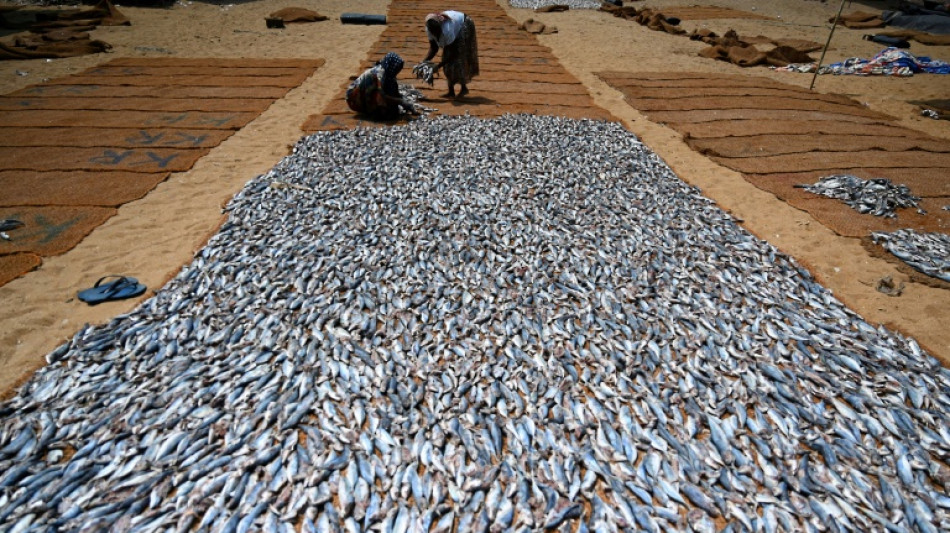
Aquaculture drives aquatic food yields to new high / Photo: Ishara S. KODIKARA - AFP/File

 China-Nepal flood toll tops 1,000 as tunnel rescue offers last hope

 Japan to relax overtime regulation under workaholic PM

 Thwarted Niger mutiny exposes junta's Russia dependence

 Illegal mining ravages S.Africa's economic hub

 Nepal's wall of missing offers last hope after Himalayan flood

 US to press G20 on light-touch AI regulation

 2 die in Grand Canyon flash flood, only 1 person unaccounted for

 US Army Secretary Driscoll submits resignation: White House

 Oil extends gains, stocks drop as Trump issues fresh Iran warning

 Tsitsipas says Kyrgios's positive cocaine test 'kind of expected'

 In Japan's mountains, a different way to manage bears

 Middle East war a boon for UAE defence giant with global ambitions

 Former gang member found guilty of murdering Tupac Shakur

 InterContinental Hotels Group PLC Announces Transaction in Own Shares - September 01

 Connecting Excellence Group PLC Announces First Acquisition Heads of Terms & Trading Update

 Heavy rain at Grand Canyon after flood kills 2, dozen missing

 Kushner blames soccer power struggle for World Cup plan collapse

 Buoyant Alcaraz shakes off nerves to advance at US Open

 US draws European pushback with Russia G20 finance invite

 Jury begins deliberations in Tupac Shakur murder trial

 US Supreme Court allows Trump ballroom project to proceed

 Trump says US reviewing position on Falkland Islands

 Saka strikes as flawless Arsenal punish troubled Villa

 Oil prices surge on renewed fighting in US-Iran war

 Cycling superstar Pogacar has surgery after Vuelta crash

The amount of fish, shellfish and algae caught in the wild and farmed in aquaculture hit a record 214 million tonnes in 2020, the Food and Agriculture Organization said Wednesday.
Driven by a sustained surge in aquaculture, the new record is good news for a world facing price hikes and food shortages due to the war in Ukraine, disrupted supply chains, and inflation.
"The growth of fisheries and aquaculture is vital in our efforts to end global hunger and malnutrition," said FAO director Qu Dongyu.
But overfished oceans, climate change and pollution -- if left unaddressed -- could threaten that potential, the UN agency warned in its 2022 state of the world fisheries report.
"Aquaculture growth has often occurred at the expense of the environment," it said.
"Sustainable aquaculture development remains critical to supply the growing demand for aquatic food."
Production of aquatic animals in 2020 -- totalling 178 million tonnes -- was evenly divided between fisheries and aquaculture.
The remaining 36 million tonnes was algae production.
Yields of fish, shrimp and other shellfish destined for human consumption is more than 60 percent higher than during the 1990s, far outpacing population growth, according to the report, released during the UN Ocean Conference in Lisbon.
On average, people worldwide consume over 20 kilos (44 pounds) of aquatic foods per year today, more than double the amount 50 years ago.
Globally, 17 percent of the protein consumed by humans comes from aquatic sources. In many Asian and African countries, that figure rises to more than 50 percent, according to the report.
Wild and farmed food from the seas and inland waters are also a critical source of essential omega-3 fatty acids and micronutrients, recent research has shown.
"Aquatic foods are increasingly recognised for their key role in food security and nutrition," Qu said.
Nearly 90 percent of aquatic animal production is for human consumption, with the rest destined for non-food uses such as fishmeal and fish oil.
Asian countries were the source of 70 percent of the world's fisheries and aquaculture of aquatic animals in 2020.
China remaining by far the top fisheries producer, followed by Indonesia, Peru, Russia, the United States and Vietnam.
So-called capture fisheries in the wild -- which have stagnated since the mid-1990s -- dropped by four percent in 2020 compared to the average of the previous three years.
Part of the drop can be attributed to disruptions caused by the Covid pandemic, but long-term decline is due to overfishing.
"The FAO estimates that 34 percent of caught fish come from overfished stocks," University of British Columbia economist and fisheries expert Rashid Sumaila told AFP.
"But they are very conservative," he added. "Independent studies put that figure at 50 percent."
T.Wright--AT